Argireline (Acetyl Hexapeptide-8)
A synthetic hexapeptide used in topical cosmetics that mimics part of the SNAP-25 protein to reduce the appearance of expression lines and wrinkles through a Botox-like mechanism.
Evidence-led profile
Research snapshot
- Evidence stage
- Emerging research
- References
- 8 linked sources
- Research coverage
- 2 areas
- Editorial review
- Jul 7, 2026
Published by the PepGuide Editorial Team using our research methodology.
Overview
Argireline is the trade name for acetyl hexapeptide-8 (also known as acetyl hexapeptide-3), a synthetic peptide consisting of six amino acids with an acetyl group. Developed by Lipotec (now part of Lubrizol) and commercially available since 2001, it is one of the most widely used cosmeceutical peptides designed to reduce the appearance of facial wrinkles and expression lines. With a molecular weight of 889 Da, it is designed as a topical alternative to injectable botulinum toxin (Botox), though considerably less potent.
Argireline is a fragment of SNAP-25, one of the three proteins that form the SNARE complex responsible for synaptic vesicle fusion and neurotransmitter release at the neuromuscular junction. By acting as a competitive inhibitor of SNAP-25, argireline interferes with the assembly of the SNARE complex, thereby reducing the release of acetylcholine that triggers facial muscle contractions. This mechanism parallels that of botulinum toxin but operates through competitive inhibition rather than enzymatic cleavage, resulting in a milder, non-toxic, and reversible effect. Clinical studies have reported wrinkle depth reductions of 17–30% after 15–28 days of topical application at concentrations of 5–10%.
A significant limitation of argireline is its poor skin penetration due to its relatively large molecular size and hydrophilic nature. Studies indicate that less than 0.2% of topically applied peptide penetrates the stratum corneum after 24 hours. No clinical studies have directly compared its efficacy to injectable botulinum toxin, and the statistical significance of reported improvements has been inconsistent across trials. Despite these limitations, argireline's non-invasive nature, favorable safety profile, lack of systemic toxicity, and ease of self-application have made it a popular ingredient in anti-aging skincare formulations worldwide.
Research
Reported Effects
Clinical Evidence:: Multiple randomized controlled trials demonstrate measurable anti-wrinkle effects, particularly for periorbital lines and facial wrinkles. Application Duration:: Visible improvements typically observed after 4-6 weeks of consistent twice-daily topical application. Permeation Limitations:: Large molecular weight and hydrophilic nature limit skin penetration, though formulations with penetration enhancers show improved efficacy. Safety Profile:: Cytotoxicity studies and clinical trials confirm good tolerability with minimal adverse effects when used topically
Topical neuromodulatory anti-aging peptide
Argireline (acetyl hexapeptide-8, formerly acetyl hexapeptide-3) is a synthetic fragment mimicking the N-terminus of SNAP-25, a SNARE-complex protein targeted by botulinum toxin. By competitively interfering with SNARE assembly it is proposed to reduce catecholamine/acetylcholine release and dampen facial muscle contraction, softening expression lines. Randomized cosmetic studies show modest wrinkle-depth reduction, though efficacy is constrained by limited transdermal penetration.
- Mimics SNAP-25 to interfere with SNARE-mediated exocytosis
- Modest reduction in wrinkle depth in placebo-controlled cosmetic studies
- Low skin penetration limits bioavailability and effect size
Safety and Limitations
Common Side Effects
- Mild, transient skin irritation including redness, tingling, or burning sensation at the application site, reported in approximately 5-10% of users during initial use.
- Skin dryness or flaking, particularly when used in combination with other active skincare ingredients such as retinoids or alpha-hydroxy acids.
- Temporary skin tightness, which generally resolves within 15-30 minutes of application.
- Rare reports of contact dermatitis or allergic reaction manifesting as localized itching, swelling, or hives.
Contraindications
- Known hypersensitivity to acetyl hexapeptide-3 (argireline) or any formulation components. Patch testing is recommended for individuals with sensitive or reactive skin.
- Open wounds, active infections, or severely compromised skin barrier at the intended application site.
- Concurrent use with botulinum toxin (Botox) injections in the same facial region: While no direct interaction has been documented, the overlapping mechanism of action (SNARE complex inhibition) raises theoretical concerns about excessive neuromuscular suppression leading to localized muscle weakness or facial asymmetry.
- Active dermatological conditions such as eczema, psoriasis, or rosacea at the application site may be exacerbated.
Drug Interactions
- Botulinum toxin type A (Botox, Dysport): Theoretical additive effect on neuromuscular junction signaling. Argireline mimics the N-terminal end of SNAP-25 and competitively inhibits SNARE complex formation, which is the same pathway targeted by botulinum toxin. Combined use may produce unpredictable results.
- Topical retinoids (tretinoin, adapalene): Increased skin irritation and barrier disruption when layered with peptide serums; stagger application times.
- Chemical exfoliants (AHAs, BHAs): May degrade peptide stability at low pH; apply argireline at neutral pH before acidic products.
- No systemic drug interactions have been identified, as topical peptide absorption is limited to the superficial dermal layers with negligible systemic bioavailability.
Special Populations
- Pregnancy and lactation: No systemic absorption studies during pregnancy; considered likely safe due to minimal dermal penetration, but conservative guidance recommends physician consultation.
- Pediatric use: Not indicated; cosmetic anti-aging peptides are not appropriate for children.
- Elderly: Well-tolerated; this is the primary target demographic.
Monitoring
- Visual inspection of application site for irritation, erythema, or allergic reaction during the first 1-2 weeks of use.
- No laboratory monitoring required due to negligible systemic absorption.
- Periodic skin assessment for desired cosmetic outcomes and adverse dermatologic effects.
Common Side Effects
- Oxidation Concern:: Methionine residue in argireline sequence can undergo oxidation, affecting product stability and potentially efficacy
- Minimal Adverse Events:: Clinical trials report good tolerability with no significant safety concerns at recommended concentrations
- Formulation Stability:: Product stability depends on proper formulation and storage to prevent peptide oxidation
- No Systemic Effects:: As a topical agent with limited penetration, systemic side effects are not reported in literature
Mechanism of Action
SNARE Complex Inhibition
Argireline (acetyl hexapeptide-8/acetyl hexapeptide-3) is a synthetic peptide mimicking the N-terminal domain of SNAP-25 (synaptosomal-associated protein of 25 kDa), one of three proteins forming the SNARE complex required for neurotransmitter vesicle fusion at the neuromuscular junction. By competing with native SNAP-25 for incorporation into the SNARE complex, Argireline impairs the formation of the functional ternary SNARE assembly (syntaxin-1/SNAP-25/VAMP-2) (PMID: 12220523).
Mechanism Comparison with Botulinum Toxin
While botulinum toxin type A (Botox) enzymatically cleaves SNAP-25 via its zinc metalloprotease activity, Argireline works through competitive inhibition — occupying the SNAP-25 binding site without destroying the protein. This results in a milder, dose-dependent reduction in exocytosis rather than complete neuromuscular blockade. The effect is partial (~30% reduction in catecholamine release in chromaffin cell models) and fully reversible upon discontinuation (PMID: 19146602).
Neuromuscular Junction Effects
By destabilizing SNARE complex formation at facial neuromuscular junctions, Argireline reduces acetylcholine vesicle exocytosis from motor nerve terminals. The decreased ACh release attenuates muscle fiber contraction at sites of expression wrinkles (forehead lines, crow's feet, glabellar furrows), producing a muscle-relaxing effect that softens dynamic wrinkles over repeated application (PMID: 21034529).
Extracellular Matrix Effects
Beyond neuromuscular modulation, in vitro studies suggest Argireline may promote collagen synthesis in dermal fibroblasts and reduce MMP (matrix metalloproteinase) expression, potentially supporting dermal structural integrity. However, these ECM effects are less well characterized than the SNARE-based mechanism.
Penetration & Delivery Considerations
As a hydrophilic hexapeptide (MW ~889 Da), Argireline's epidermal penetration is limited. Efficacy depends on formulation technology (liposomal delivery, penetration enhancers) and consistent topical application at concentrations of 5-10% for several weeks.
Pharmacokinetic Profile
- Half-life
- 1 h
- Tmax
- 0.5 h
Molecular Structure
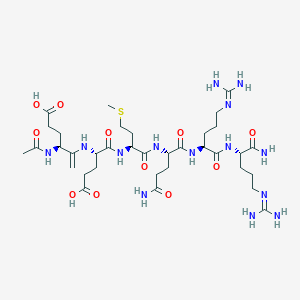
- Formula
- C35H62N14O11S
- Weight
- 887.0 Da
- PubChem CID
- 71587772
- Exact Mass
- 886.4443 Da
- LogP
- -5.2
- TPSA
- 472 Ų
- H-Bond Donors
- 14
- H-Bond Acceptors
- 15
- Rotatable Bonds
- 33
- Complexity
- 1610
Identifiers (SMILES, InChI)
InChI=1S/C35H62N14O11S/c1-18(20(45-19(2)50)9-12-27(52)53)44-23(10-13-28(54)55)31(58)49-25(14-17-61-3)33(60)48-24(8-11-26(36)51)32(59)47-22(7-5-16-43-35(40)41)30(57)46-21(29(37)56)6-4-15-42-34(38)39/h20-25,44H,1,4-17H2,2-3H3,(H2,36,51)(H2,37,56)(H,45,50)(H,46,57)(H,47,59)(H,48,60)(H,49,58)(H,52,53)(H,54,55)(H4,38,39,42)(H4,40,41,43)/t20-,21-,22-,23-,24-,25-/m0/s1
AJLNZWYOJAWBCR-OOPVGHQCSA-NResearch Indications
Cosmetic / Dermatologic (topical)
SNAP-25 mimetic that modestly reduces facial wrinkle depth by attenuating neuromuscular contraction when applied topically.
Marketed cosmeceutical peptide reported to improve skin texture; limited by low skin penetration.
References (8)
- [1]The anti-wrinkle efficacy of argireline, a synthetic hexapeptide, in Chinese subjects: a randomized, placebo-controlled study
→ A randomized trial of 60 Chinese subjects found that topical argireline applied twice daily for 4 weeks achieved 48.9% total anti-wrinkle efficiency with notable reduction in wrinkle depth compared to placebo.
- [2]The anti-wrinkle efficacy of Argireline
→ In aged mice induced by D-galactose, topical argireline applied twice daily for 6 weeks improved skin histology by increasing type I collagen fibers and decreasing type III collagen fibers, demonstrating skin rejuvenation effects.
- [4]Enhanced Skin Permeation of Anti-wrinkle Peptides via Molecular Modification
→ Research found that while argireline demonstrates anti-wrinkle efficacy up to 48% with 4 weeks of twice-daily treatment, its large molecular weight and hydrophilicity limit skin permeation, leading to investigations of molecular modifications to enhance absorption.
- [5]The study of cellular cytotoxicity of argireline - an anti-aging peptide
→ Cytotoxicity testing on multiple cell lines (HEK-293, IMR-32, and primary skin fibroblasts) using formazan-based assays found argireline to be relatively safe with minimal antiproliferative effects at tested concentrations.
- [6]Public Interest in Acetyl Hexapeptide-8: Longitudinal Analysis
→ Analysis of Google search trends from 2013-2023 showed substantial increases in public interest in argireline in 2022, with the peptide emerging as a cost-effective, over-the-counter alternative to botulinum neurotoxin treatments.
- [7]Skin scars and wrinkles temporary camouflage in dermatology and oncoesthetics: focus on acetyl hexapeptide-8
→ A retrospective study of 26 patients using gel cream containing 10% argireline demonstrated improved skin quality parameters including hydration, elasticity, and sebum production, with clinical improvement in masking skin imperfections.
- [8]3D-bioengineered model of human skeletal muscle tissue with phenotypic features of aging for drug testing purposes
→ A 3D-bioengineered skeletal muscle model demonstrated that argireline and other anti-aging compounds could be effectively tested for their effects on muscle tissue differentiation, functionality, and force generation in aging models.
- [3]Investigating the effects of Argireline in a skin serum containing hyaluronic acids on skin surface wrinkles using the Visia® Complexion Analysis camera system
→ A double-blind study of 19 female participants using objective facial imaging found that argireline-containing serum applied twice daily showed measurable effects on skin surface wrinkles when compared to placebo-treated facial sides.
Continue researching Argireline (Acetyl Hexapeptide-8)
Keep scientific evidence separate from commercial availability. Review how claims are evaluated, explore question-led research paths, or inspect disclosed source records without changing the editorial conclusions on this page.