Anandamide
Anandamide research profile covering evidence quality, proposed mechanisms, safety considerations, regulatory status, and linked primary sources.
Evidence-led profile
Research snapshot
- Evidence stage
- Emerging research
- References
- 8 linked sources
- Research coverage
- 1 area
- Editorial review
- Mar 8, 2026
Published by the PepGuide Editorial Team using our research methodology.
Overview
Anandamide (N-arachidonoylethanolamine, AEA) was the first endocannabinoid to be identified, discovered in 1992 by Raphael Mechoulam and colleagues. Its name derives from the Sanskrit word ānanda ("bliss" or "joy"). Anandamide is synthesized on demand from membrane phospholipid precursors, primarily through the action of N-acyl phosphatidylethanolamine phospholipase D (NAPE-PLD), rather than being stored in vesicles like classical neurotransmitters. It acts as a partial agonist at CB1 receptors (predominantly in the central nervous system) and CB2 receptors (primarily in immune tissues), and also activates TRPV1 vanilloid receptors.
Anandamide participates in retrograde signaling at synapses, where it is released from postsynaptic neurons to modulate presynaptic neurotransmitter release, thereby fine-tuning neural circuit activity. It plays documented roles in pain perception, appetite regulation, mood, memory consolidation, and reproductive processes including embryo implantation. Circulating anandamide levels have been found to be altered in various pathological states including depression, anxiety disorders, schizophrenia, and migraine. Notably, individuals carrying loss-of-function variants in the FAAH gene (which encodes the enzyme that degrades anandamide) report reduced pain sensitivity and anxiety.
Anandamide is rapidly degraded by fatty acid amide hydrolase (FAAH) into arachidonic acid and ethanolamine, giving it a short biological half-life. This has led to significant pharmaceutical interest in FAAH inhibitors as a strategy to elevate endogenous anandamide levels for therapeutic purposes, targeting conditions such as chronic pain, anxiety, and PTSD. Although several FAAH inhibitors have entered clinical trials, development has been complicated by safety concerns, most notably the fatal BIA 10-2474 incident in 2016. Anandamide itself is not used as a therapeutic agent due to its rapid degradation and poor oral bioavailability.
Mechanism of Action
Endocannabinoid Biosynthesis
Anandamide (N-arachidonoylethanolamine, AEA) is an endogenous lipid neurotransmitter synthesized on demand from membrane phospholipid precursors. The primary biosynthetic route involves N-acyltransferase (NAT) generating N-arachidonoyl phosphatidylethanolamine (NAPE), followed by cleavage by NAPE-specific phospholipase D (NAPE-PLD) to release anandamide. Unlike classical neurotransmitters, AEA is not stored in vesicles but produced in response to elevated intracellular calcium and depolarization (PMID: 16596779).
CB1 Receptor Signaling
Anandamide acts as a partial agonist at cannabinoid CB1 receptors, which are the most abundant GPCRs in the brain. CB1 activation triggers Gi/o protein coupling, leading to: (1) inhibition of adenylyl cyclase and reduced cAMP, (2) activation of MAPK/ERK cascades, (3) opening of inwardly rectifying K⁺ channels (GIRKs), and (4) closure of voltage-gated Ca²⁺ channels. This results in retrograde suppression of neurotransmitter release (both glutamate and GABA) at presynaptic terminals (PMID: 11316474).
TRPV1 & Non-Cannabinoid Targets
Anandamide is also an endogenous agonist of TRPV1 (vanilloid receptor 1) at intracellular binding sites, where it modulates pain perception, thermosensation, and neuronal excitability. At higher concentrations, it activates PPARgamma nuclear receptors, influencing lipid metabolism and anti-inflammatory gene transcription (PMID: 12435418).
Degradation & Reuptake
AEA signaling is terminated by cellular reuptake (via a putative membrane transporter or simple diffusion) followed by intracellular hydrolysis by fatty acid amide hydrolase (FAAH) to arachidonic acid and ethanolamine. FAAH inhibition extends anandamide's half-life and amplifies endocannabinoid tone, which is a therapeutic target for anxiety and pain (PMID: 11050014).
Synaptic Plasticity
Through CB1-mediated retrograde signaling, anandamide mediates depolarization-induced suppression of inhibition/excitation (DSI/DSE) and contributes to long-term depression (LTD) at corticostriatal and hippocampal synapses.
Research
Reported Effects
Synergistic Effect:: Most effective when combined with CBD (50-100mg) or other FAAH inhibitors to prevent rapid degradation and extend duration of effects. Individual Variation:: Effects appear highly variable between users, with some experiencing profound benefits while others notice minimal impact. Cannabis Substitution:: Some users successfully use anandamide to reduce nighttime THC consumption while maintaining similar relaxation effects. Dose-Response:: Users typically start with 160mg doses, with some products like Anaquell QR providing standardized formulations
- Most effective when combined with CBD (50-100mg) or other FAAH inhibitors to prevent rapid degradation and extend duration of effects
- Effects appear highly variable between users, with some experiencing profound benefits while others notice minimal impact
- Some users successfully use anandamide to reduce nighttime THC consumption while maintaining similar relaxation effects
- Users typically start with 160mg doses, with some products like Anaquell QR providing standardized formulations
Safety and Limitations
Common Side Effects
- Anandamide as an endogenous endocannabinoid is rapidly degraded by fatty acid amide hydrolase (FAAH) in vivo, so direct supplementation is not standard practice. Most safety considerations relate to FAAH inhibitors or synthetic anandamide analogs that elevate endogenous levels.
- Psychoactive effects: Euphoria, altered perception, anxiety, and paranoia at supraphysiological concentrations due to CB1 receptor activation in the central nervous system.
- Cardiovascular effects: Transient hypotension, tachycardia, and vasodilation. Anandamide is a potent vasodilator acting through CB1, TRPV1, and endothelium-dependent mechanisms.
- Gastrointestinal effects: Appetite stimulation (munchies effect), nausea at high doses, and reduced gastrointestinal motility.
- Sedation and impaired psychomotor function at concentrations that significantly activate CB1 receptors.
Contraindications
- Psychiatric disorders, particularly schizophrenia, psychotic disorders, and severe anxiety disorders: Cannabinoid receptor activation can exacerbate psychotic symptoms and destabilize mental health conditions.
- Cardiovascular disease: Hypotensive effects and tachycardia may be dangerous in patients with unstable angina, recent myocardial infarction, or severe heart failure.
- History of substance use disorder: Endocannabinoid system manipulation carries abuse potential and may trigger relapse behaviors.
- FAAH genetic polymorphisms (particularly FAAH C385A): Individuals with reduced FAAH activity already have elevated anandamide levels; additional elevation could produce unpredictable effects.
- Pregnancy: Endocannabinoid signaling plays a critical role in embryo implantation and early pregnancy; exogenous manipulation may disrupt reproductive processes.
Drug Interactions
- FAAH inhibitors (experimental compounds): Dramatically potentiate anandamide effects by blocking enzymatic degradation. The BIA 10-2474 clinical trial disaster, which caused fatal neurotoxicity, underscores the danger of excessive FAAH inhibition.
- CNS depressants (benzodiazepines, opioids, alcohol): Additive sedation and respiratory depression risk.
- Antihypertensive medications: Additive hypotensive effects may cause symptomatic low blood pressure.
- CYP450 interactions: Anandamide is metabolized by CYP3A4 and CYP2D6; inhibitors of these enzymes may prolong its effects.
- Anticoagulants: Some cannabinoids affect platelet function; potential interaction with warfarin and other blood thinners.
- Antipsychotic medications: Complex bidirectional interactions with dopaminergic and cannabinoid receptor systems.
Special Populations
- Pregnancy and lactation: Contraindicated. Endocannabinoid signaling is essential for implantation, placentation, and fetal neurodevelopment.
- Adolescents: The developing brain is particularly vulnerable to cannabinoid-mediated disruption of synaptic pruning and prefrontal cortex maturation.
- Elderly: Increased sensitivity to cardiovascular and CNS effects; start with minimal doses if indicated.
Monitoring
- Cardiovascular parameters (blood pressure, heart rate) during acute administration.
- Psychiatric assessment including mood, anxiety, and psychotic symptom scales.
- Cognitive function testing for attention, memory, and executive function.
- Plasma anandamide levels (via LC-MS/MS) for research purposes.
- Liver function tests if using FAAH inhibitors concurrently.
Common Side Effects
- Minimal Reports:: Very few side effects reported at standard doses, suggesting good tolerability for most users
- Rapid Degradation:: Without FAAH inhibitors like CBD, anandamide breaks down quickly in the body, limiting effectiveness
- Individual Sensitivity:: Some users may experience different responses to cannabis-like compounds due to endocannabinoid system variations
- Long-term Unknown:: Limited data on long-term supplementation effects, though endogenous anandamide is naturally produced by the body
Research protocol summary
- Typical Dose
- Most users report taking 160mg of anandamide, often from commercial products like Anaquell QR
These values summarize cataloged research protocols. They are not personal dosing instructions or medical guidance.
Reconstitution Calculator
Pharmacokinetic Profile
Anandamide — Pharmacokinetic Curve
SubcutaneousMolecular Structure
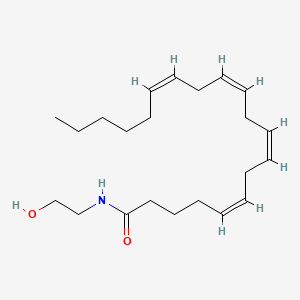
- Formula
- C22H37NO2
- Weight
- 347.5 Da
- PubChem CID
- 5281969
- Exact Mass
- 347.2824 Da
- LogP
- 5.4
- TPSA
- 49.3 Ų
- H-Bond Donors
- 2
- H-Bond Acceptors
- 2
- Rotatable Bonds
- 16
- Complexity
- 408
Identifiers (SMILES, InChI)
InChI=1S/C22H37NO2/c1-2-3-4-5-6-7-8-9-10-11-12-13-14-15-16-17-18-19-22(25)23-20-21-24/h6-7,9-10,12-13,15-16,24H,2-5,8,11,14,17-21H2,1H3,(H,23,25)/b7-6-,10-9-,13-12-,16-15-
LGEQQWMQCRIYKG-DOFZRALJSA-NReferences (8)
- [2]Targeting the endocannabinoid system with microbial interventions to improve gut integrity
→ The endocannabinoid system regulates intestinal barrier integrity, and targeting it through microbial interventions may help address disorders like inflammatory bowel disease, obesity, and major depressive disorder by reducing inflammation and bacterial metabolite translocation.
- [7]N-Acyl amines of docosahexaenoic acid and other n-3 polyunsatured fatty acids - from fishy endocannabinoids to potential leads
→ Omega-3 fatty acid consumption affects anandamide synthesis and stimulates formation of specific endocannabinoid-related conjugates with overlapping biological activities, providing promising leads for inflammatory and neurological disorder treatment.
- [5]Exercise as an adjunctive treatment for cannabis use disorder
→ Exercise may serve as an effective adjunctive treatment for cannabis use disorder by modulating the endocannabinoid system, particularly through effects on anandamide and related endocannabinoids.
- [6]Anandamide inhibits the growth of colorectal cancer cells through CB1 and lipid rafts
→ Anandamide demonstrated anti-proliferative and pro-apoptotic effects on colorectal cancer cells through CB1 receptor and lipid raft mechanisms, suggesting potential therapeutic applications in cancer treatment.
- [3]Quality of Life and a Surveillant Endocannabinoid System
→ The endocannabinoid system is a major brain modulatory network regulating homeostasis, development, learning, memory, mood, and energy metabolism, with loss of ECS control potentially affecting mood disorders, obesity, and overall quality of life.
- [4]Vaccenic acid suppresses intestinal inflammation by increasing anandamide and related N-acylethanolamines in the JCR:LA-cp rat
→ Vaccenic acid supplementation increased anandamide levels and suppressed intestinal inflammation, demonstrating that dietary interventions can modulate the endocannabinoid system to reduce inflammation.
- [1]Care and feeding of the endocannabinoid system: a systematic review of potential clinical interventions that upregulate the endocannabinoid system
→ This systematic review identified clinical interventions that can enhance the endocannabinoid system by upregulating cannabinoid receptors, increasing ligand synthesis, or inhibiting ligand degradation, particularly relevant for conditions associated with endocannabinoid deficiency syndrome including migraine, fibromyalgia, and psychological disorders.
- [8]Endocannabinoid involvement in beneficial effects of caloric restriction in a rodent model of comorbid depression and epilepsy
→ Caloric restriction produced beneficial effects in depression and epilepsy models through modulation of the endocannabinoid system, including effects on anandamide levels.
Continue researching Anandamide
Keep scientific evidence separate from commercial availability. Review how claims are evaluated, explore question-led research paths, or inspect disclosed source records without changing the editorial conclusions on this page.