Exenatide (Byetta/Bydureon)
Exenatide is a synthetic glucagon-like peptide-1 (GLP-1) receptor agonist originally derived from the saliva of the Gila monster lizard, used to improve glycemic control in type 2 diabetes. It mimics the incretin hormone GLP-1, stimulating insulin secretion, suppressing glucagon release, and slowing gastric emptying.
Evidence-led profile
Research snapshot
- Evidence stage
- Emerging research
- References
- 11 linked sources
- Research coverage
- 3 areas
- Editorial review
- Jul 7, 2026
Published by the PepGuide Editorial Team using our research methodology.
Overview
Exenatide is a 39-amino acid peptide that shares approximately 53% sequence homology with human GLP-1. Originally isolated from the venom of the Gila monster (Heloderma suspectum), it was developed as a therapeutic agent under the brand names Byetta (twice-daily injection) and Bydureon (once-weekly extended-release formulation). It was the first GLP-1 receptor agonist approved by the FDA for the treatment of type 2 diabetes mellitus.
As an incretin mimetic, exenatide binds to and activates the GLP-1 receptor on pancreatic beta cells, enhancing glucose-dependent insulin secretion while simultaneously suppressing inappropriately elevated glucagon release. It also slows gastric emptying, which helps reduce postprandial glucose spikes and promotes satiety. These combined mechanisms contribute to improved HbA1c levels and modest weight loss in many patients.
Clinical trials have demonstrated that exenatide reduces HbA1c by approximately 0.8–1.0% and is associated with weight loss of 2–4 kg over 6 months. Common side effects include nausea and gastrointestinal discomfort, which typically diminish over time. Exenatide paved the way for newer GLP-1 receptor agonists such as liraglutide and semaglutide, which offer improved pharmacokinetic profiles and additional cardiovascular benefits.
Research
Reported Effects
Diabetes Management:: Shows similar efficacy to insulin regimens for glycemic control but with advantage of weight loss rather than weight gain. Metabolic Health:: Improves multiple metabolic parameters including insulin resistance, lipid profiles, and cardiovascular risk markers. PCOS Treatment:: When combined with metformin, demonstrates superior improvements in insulin resistance and metabolic outcomes compared to metformin alone. Individual Response:: Clinical effectiveness varies, with best results seen in patients with poor glycemic control on oral medications
GLP-1 receptor agonism in type 2 diabetes
Exenatide is a synthetic exendin-4 GLP-1 receptor agonist that enhances glucose-dependent insulin secretion, suppresses glucagon, slows gastric emptying, and reduces appetite. The DURATION program established both twice-daily (Byetta) and once-weekly (Bydureon) formulations, delivering durable HbA1c reduction and weight loss.
- Once-weekly formulation gave superior HbA1c reduction to twice-daily
- Glucose-dependent action lowers hypoglycemia risk
- Associated with modest weight loss
Neuroprotection and Parkinson's disease
Because GLP-1 receptors are expressed in the brain, exenatide was investigated as a disease-modifying therapy for Parkinson's disease. A phase 2 trial suggested a sustained motor benefit, but the larger, longer phase 3 Exenatide-PD3 trial found no effect on motor progression, tempering enthusiasm for GLP-1 neuroprotection in PD.
- Phase 2 showed sustained off-medication motor improvement
- Phase 3 Exenatide-PD3 was negative for disease modification
- Highlights uncertainty around central GLP-1 effects in neurodegeneration
Safety and Limitations
Safety Profile: Exenatide (Byetta/Bydureon)
Common Side Effects
- Nausea (most common; affects 40-50% of patients initially, usually subsides over weeks)
- Vomiting and diarrhea
- Injection site reactions: nodules (especially with extended-release Bydureon), erythema, pruritus
- Headache and dizziness
- Decreased appetite and weight loss (often a therapeutic benefit)
- Dyspepsia and gastroesophageal reflux
- Hyperhidrosis (excessive sweating)
- Jitteriness or feeling anxious
Serious Adverse Effects
- Acute pancreatitis: FDA black box warning; discontinue immediately if pancreatitis suspected; fatal and non-fatal hemorrhagic/necrotizing pancreatitis reported
- Thyroid C-cell tumors: Observed in rodents with GLP-1 receptor agonists; relevance to humans uncertain; FDA requires REMS
- Severe hypoglycemia: Primarily when combined with sulfonylureas or insulin; rare as monotherapy
- Acute kidney injury: Reports of renal impairment, sometimes requiring dialysis, often associated with dehydration from GI side effects
- Severe allergic reactions: Anaphylaxis and angioedema reported
- Medullary thyroid carcinoma (MTC) risk: Theoretical based on animal data
Contraindications
- Personal or family history of medullary thyroid carcinoma (MTC)
- Multiple Endocrine Neoplasia syndrome type 2 (MEN 2)
- History of pancreatitis
- Severe renal impairment (CrCl < 30 mL/min) or end-stage renal disease
- Known hypersensitivity to exenatide or any excipients
- Type 1 diabetes or diabetic ketoacidosis
- Severe gastrointestinal disease (gastroparesis)
Drug Interactions
- Sulfonylureas (glipizide, glyburide): Significantly increased hypoglycemia risk; reduce sulfonylurea dose when initiating exenatide
- Insulin: Additive hypoglycemic effects; not recommended for concurrent use with Bydureon
- Oral medications: Delays gastric emptying; take oral medications (especially antibiotics, oral contraceptives) at least 1 hour before exenatide injection
- Warfarin: Delayed absorption may cause unpredictable INR changes; monitor closely when initiating or changing doses
- Acetaminophen: Reduced and delayed absorption; clinical significance usually minimal
- ACE inhibitors: Monitor renal function; additive risk of renal impairment
Population-Specific Considerations
- Type 2 diabetes patients: Primary indicated population; start with 5 mcg BID (Byetta) and titrate to 10 mcg after 1 month
- Elderly: No specific dose adjustment but monitor renal function; increased dehydration risk with GI symptoms
- Renal impairment: No adjustment for mild impairment; use caution in moderate (CrCl 30-50); contraindicated in severe
- Pediatric: Not approved for use in children
- Pregnant/Lactating: Category C; discontinue at least 2 months before planned pregnancy (extended-release); animal studies show adverse fetal effects
- Pancreatitis history: Absolutely contraindicated; use alternative antidiabetic therapy
Common Side Effects
- Gastrointestinal Issues:: Nausea and gastrointestinal adverse events are the most common side effects, particularly during initiation
- Cancer Concerns:: Retrospective studies have examined pancreatic and thyroid cancer risk, though evidence remains inconclusive
- Hypoglycemia Risk:: Low risk when used alone but increased when combined with insulin or sulfonylureas
- Dependency Concerns:: Users express concerns about long-term GLP-1 dependence and preference for short-acting formulations to avoid continuous suppression
Mechanism of Action
GLP-1 Receptor Agonism
Exenatide is a 39-amino acid peptide originally isolated from the saliva of the Gila monster (Heloderma suspectum). It shares 53% sequence homology with human glucagon-like peptide-1 (GLP-1) and is a potent full agonist at the GLP-1 receptor (GLP-1R), a class B G-protein-coupled receptor expressed on pancreatic beta cells, CNS neurons, cardiomyocytes, and gastrointestinal epithelium. Unlike native GLP-1, exenatide resists degradation by dipeptidyl peptidase-4 (DPP-4) due to a glycine-to-alanine substitution at position 2, giving it a half-life of ~2.4 hours versus ~2 minutes for endogenous GLP-1 (PMID: 15655530).
Pancreatic Beta-Cell Signaling
GLP-1R activation by exenatide stimulates adenylyl cyclase, increasing intracellular cAMP. cAMP activates both protein kinase A (PKA) and Epac2 (exchange protein activated by cAMP), which potentiate glucose-stimulated insulin secretion (GSIS) by closing KATP channels, enhancing L-type calcium channel activity, and promoting insulin granule exocytosis. Importantly, this insulinotropic effect is glucose-dependent — it diminishes at normoglycemia, minimizing hypoglycemia risk (PMID: 17306374).
Beta-Cell Preservation & Proliferation
Exenatide activates PI3K/Akt and MAPK/ERK pathways in beta cells, upregulating the transcription factors PDX-1 and MAFA, which drive insulin gene transcription and beta-cell differentiation. It inhibits beta-cell apoptosis by suppressing caspase-3 activation and endoplasmic reticulum stress markers (CHOP, ATF4). In preclinical models, exenatide promotes beta-cell neogenesis from ductal progenitor cells (PMID: 21270381).
Extrapancreatic Effects
Exenatide slows gastric emptying via vagal afferent signaling, reduces glucagon secretion from alpha cells in a glucose-dependent manner, and acts on hypothalamic GLP-1R to promote satiety and reduce food intake, contributing to weight loss observed in clinical use (PMID: 19389631).
Research protocol summary
- Typical Dose
- 10 μg twice daily subcutaneously is the most commonly studied and prescribed dose
These values summarize cataloged research protocols. They are not personal dosing instructions or medical guidance.
Pharmacokinetic Profile
- Half-life
- 2.4 h
- Tmax
- 2.1 h
Molecular Structure
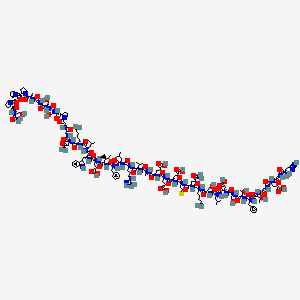
- Formula
- C184H282N50O60S
- Weight
- 4187 Da
- PubChem CID
- 45588096
- Exact Mass
- 4185.0307 Da
- LogP
- -21
- TPSA
- 1780 Ų
- H-Bond Donors
- 58
- H-Bond Acceptors
- 66
- Rotatable Bonds
- 135
- Complexity
- 10300
Identifiers (SMILES, InChI)
InChI=1S/C184H282N50O60S/c1-16-94(10)147(178(289)213-114(52-58-144(257)258)163(274)218-121(73-101-77-195-105-39-24-23-38-103(101)105)168(279)215-116(68-90(2)3)165(276)205-107(41-26-28-61-186)158(269)219-122(75-134(189)243)154(265)198-79-135(244)196-83-139(248)231-63-30-43-129(231)175(286)225-127(87-238)174(285)223-125(85-236)155(266)200-80-136(245)202-96(12)181(292)233-65-32-45-131(233)183(294)234-66-33-46-132(234)182(293)232-64-31-44-130(232)176(287)222-124(84-235)150(190)261)229-170(281)119(71-99-34-19-17-20-35-99)217-166(277)117(69-91(4)5)214-159(270)108(42-29-62-194-184(191)192)212-177(288)146(93(8)9)228-151(262)95(11)203-156(267)111(49-55-141(251)252)208-161(272)112(50-56-142(253)254)209-162(273)113(51-57-143(255)256)210-164(275)115(59-67-295-15)211-160(271)110(47-53-133(188)242)207-157(268)106(40-25-27-60-185)206-172(283)126(86-237)224-167(278)118(70-92(6)7)216-169(280)123(76-145(259)260)220-173(284)128(88-239)226-180(291)149(98(14)241)230-171(282)120(72-100-36-21-18-22-37-100)221-179(290)148(97(13)240)227-138(247)82-199-153(264)109(48-54-140(249)250)204-137(246)81-197-152(263)104(187)74-102-78-193-89-201-102/h17-24,34-39,77-78,89-98,104,106-132,146-149,195,235-241H,16,25-33,40-76,79-88,185-187H2,1-15H3,(H2,188,242)(H2,189,243)(H2,190,261)(H,193,201)(H,196,244)(H,197,263)(H,198,265)(H,199,264)(H,200,266)(H,202,245)(H,203,267)(H,204,246)(H,205,276)(H,206,283)(H,207,268)(H,208,272)(H,209,273)(H,210,275)(H,211,271)(H,212,288)(H,213,289)(H,214,270)(H,215,279)(H,216,280)(H,217,277)(H,218,274)(H,219,269)(H,220,284)(H,221,290)(H,222,287)(H,223,285)(H,224,278)(H,225,286)(H,226,291)(H,227,247)(H,228,262)(H,229,281)(H,230,282)(H,249,250)(H,251,252)(H,253,254)(H,255,256)(H,257,258)(H,259,260)(H4,191,192,194)/t94-,95-,96-,97+,98+,104-,106-,107-,108-,109-,110-,111-,112-,113-,114-,115-,116-,117-,118-,119-,120-,121-,122-,123-,124-,125-,126-,127-,128-,129-,130-,131-,132-,146-,147-,148-,149-/m0/s1
HTQBXNHDCUEHJF-XWLPCZSASA-NResearch Indications
Approved Indications
GLP-1 receptor agonist (Byetta twice-daily, Bydureon once-weekly) approved to improve glycemic control.
Promotes weight loss through appetite suppression and delayed gastric emptying alongside glycemic benefit.
Investigational Uses
Phase 2 showed motor benefit but the larger phase 3 Exenatide-PD3 was negative for disease modification.
References (11)
- [2]Clinical Benefits of Therapeutic Interventions Targeting Mitochondria in Parkinson's Disease Patients
→ Among compounds tested in randomized clinical trials for Parkinson's disease, only exenatide has shown promising neuroprotective and symptomatic effects, though translation to clinical practice requires confirmation.
- [6]Exenatide use and incidence of pancreatic and thyroid cancer: A retrospective cohort study
→ A large retrospective cohort study examined cancer risk associated with exenatide use in type 2 diabetes patients, addressing safety concerns regarding pancreatic and thyroid cancer incidence.
- [5]Cardiovascular Outcomes with Once-Weekly GLP-1 RAs: Clinical and Economic Implications
→ GLP-1 receptor agonists including exenatide show beneficial effects on cardiovascular risk factors and potential reduction in major adverse cardiac events, with low risk of hypoglycemia.
- [3]The anti-diabetic drug exenatide counteracts hepatocarcinogenesis through cAMP-PKA-EGFR-STAT3 axis
→ Exenatide demonstrated protective effects against hepatocellular carcinoma development in preclinical models, suggesting potential anti-cancer properties beyond its antidiabetic effects.
- [4]Impact of GLP-1 receptor agonist versus omega-3 fatty acids supplement on obesity-induced alterations of mitochondrial respiration
→ Exenatide administration improved obesity-induced mitochondrial dysfunction, demonstrating beneficial effects on cellular energy metabolism in multiple tissues including skeletal muscle, liver, and adipose tissue.
- [7]Effect of GLP-1 receptor agonists on waist circumference among type 2 diabetes patients
→ Network meta-analysis showed significant reductions in waist circumference with liraglutide and exenatide treatment, demonstrating benefits for abdominal obesity beyond glycemic control.
- [1]Exenatide efficacy and safety: a systematic review
→ Exenatide 10 μg twice daily improved HbA1c by approximately 1.0% over 30 weeks and was associated with weight loss of 1.0-2.5 kg, showing similar glycemic control to insulin regimens but with weight loss advantages.
- [8]Effects of Exenatide plus Metformin versus Metformin alone on insulin resistance in women with Polycystic Ovary Syndrome
→ Combination therapy of exenatide plus metformin showed superior improvements in insulin resistance, BMI, and metabolic parameters compared to metformin alone in overweight and obese women with PCOS.
- [9]Drucker DJ, Buse JB, Taylor K, et al. Exenatide once weekly versus twice daily for the treatment of type 2 diabetes: a randomised, open-label, non-inferiority study (DURATION-1) The Lancet (2008)
→ Once-weekly exenatide produced greater HbA1c reduction than twice-daily dosing in type 2 diabetes, supporting the extended-release formulation.
- [10]Athauda D, Maclagan K, Skene SS, et al. Exenatide once weekly versus placebo in Parkinson's disease: a randomised, double-blind, placebo-controlled trial The Lancet (2017)
→ In 60 patients, exenatide improved off-medication MDS-UPDRS motor scores at 60 weeks, sustained after washout (adjusted difference -3.5 points).
- [11]Vijiaratnam N, Girges C, Auld G, et al. Exenatide once a week versus placebo as a potential disease-modifying treatment for people with Parkinson's disease (Exenatide-PD3) The Lancet (2025)
→ The larger phase 3 trial (n=194, 96 weeks) found no disease-modifying benefit on motor progression, contrasting with the earlier phase 2 result.
Continue researching Exenatide (Byetta/Bydureon)
Keep scientific evidence separate from commercial availability. Review how claims are evaluated, explore question-led research paths, or inspect disclosed source records without changing the editorial conclusions on this page.