Lutein
Lutein research profile covering evidence quality, proposed mechanisms, safety considerations, regulatory status, and linked primary sources.
Evidence-led profile
Research snapshot
- Evidence stage
- Emerging research
- References
- 4 linked sources
- Research coverage
- 1 area
- Editorial review
- Mar 8, 2026
Published by the PepGuide Editorial Team using our research methodology.
Overview
Lutein is a xanthophyll carotenoid — a yellow-orange pigment synthesized by plants but not by the human body — that must be obtained from dietary sources, primarily dark leafy greens (kale, spinach, collard greens), egg yolks, and marigold flowers (Tagetes erecta, the primary commercial extraction source). Along with its stereoisomer zeaxanthin, lutein is preferentially accumulated in the macula lutea of the retina at concentrations 1,000-fold higher than plasma, forming the macular pigment optical density (MPOD) that serves as a natural blue-light filter and antioxidant shield protecting the photoreceptors and retinal pigment epithelium from phototoxic damage. This selective macular concentration, mediated by specific binding proteins (StARD3 for lutein), underscores the biological importance of these carotenoids for visual function.
The landmark Age-Related Eye Disease Study 2 (AREDS2, n=4,203) demonstrated that supplementation with 10 mg lutein and 2 mg zeaxanthin daily reduced the risk of progression to advanced age-related macular degeneration (AMD) by approximately 18% in individuals with low dietary carotenoid intake, and proved superior to the original AREDS formula's beta-carotene (which was removed due to lung cancer risk in smokers). Mechanistically, lutein protects against AMD through three complementary pathways: optical blue-light filtration (absorbing 40–90% of incident blue light at peak MPOD), potent singlet oxygen quenching and reactive oxygen species scavenging in the lipid-rich photoreceptor membranes, and anti-inflammatory effects through inhibition of NF-kB and complement pathway activation in the retina. Higher MPOD is consistently associated with better visual acuity, contrast sensitivity, glare recovery, and reduced photostress in both observational and interventional studies.
Emerging research extends lutein's benefits beyond vision to cognitive health. Lutein is the dominant carotenoid in brain tissue (comprising approximately 60–77% of total brain carotenoids despite representing only 12% of serum carotenoids), where it localizes to neuronal membranes and influences cell signaling, membrane fluidity, and gap junction communication. The LIMPIA trial and other cognitive studies demonstrate that lutein supplementation (12 mg/day for 12 months) improves verbal fluency, memory, and processing speed in older adults. Lutein pairs naturally with zeaxanthin and meso-zeaxanthin for complete macular carotenoid coverage, astaxanthin for broader carotenoid antioxidant protection, omega-3 fatty acids (which enhance lutein absorption and provide complementary retinal DHA support), and bilberry for comprehensive eye health protocols. Typical supplemental doses of 10–20 mg/day are well-tolerated and supported by the clinical evidence base.
Mechanism of Action
Lutein is a xanthophyll carotenoid (a dihydroxy derivative of alpha-carotene) that cannot be synthesized de novo by humans and must be obtained from dietary sources, primarily dark green leafy vegetables. Its distinctive molecular structure, featuring hydroxyl groups at each end of the polyene chain, allows it to span lipid bilayer membranes in a perpendicular orientation, providing structural stabilization and membrane protection. Lutein, along with its stereoisomer zeaxanthin, is selectively transported to and concentrated in the macula lutea of the retina by specific binding proteins (StARD3 for lutein, GSTP1 for zeaxanthin), where they form the macular pigment at concentrations 1,000-fold higher than in plasma.
As macular pigment, lutein serves two primary protective functions. First, it acts as a short-wavelength light filter, absorbing high-energy blue light (400-500 nm peak absorption at 460 nm) before it reaches the photoreceptors, reducing photo-oxidative damage to the delicate retinal pigment epithelium (RPE) and photoreceptor outer segments. Second, lutein is a potent quencher of singlet oxygen and other reactive oxygen species (ROS), with the conjugated double-bond system in its polyene chain capable of physically quenching singlet oxygen by accepting its energy and dissipating it as heat. It also scavenges lipid peroxyl radicals, interrupting chain reactions of lipid peroxidation in the phospholipid-rich photoreceptor membranes.
Beyond direct antioxidant activity, lutein modulates inflammatory and oxidative stress signaling pathways. It activates the Nrf2 (nuclear factor erythroid 2-related factor 2) pathway, promoting translocation of Nrf2 to the nucleus where it binds antioxidant response elements (ARE) and upregulates phase II detoxification enzymes including heme oxygenase-1 (HO-1), NAD(P)H quinone oxidoreductase 1 (NQO1), and glutathione S-transferases. Lutein inhibits NF-κB activation by suppressing IκB kinase (IKK) phosphorylation, reducing expression of pro-inflammatory mediators including COX-2, iNOS, IL-1beta, and IL-6. In the context of age-related macular degeneration (AMD), lutein also modulates the complement cascade by reducing C3a and C5a deposition in the RPE/Bruch's membrane complex, attenuating complement-driven inflammation that contributes to drusen formation and geographic atrophy.
Research
Reported Effects
Eye Health:: Highly effective for reducing digital eye strain and protecting against age-related macular degeneration, with effects often noticed within weeks. Preventive Care:: Strong evidence for long-term protective benefits against AMD progression (up to 30% reduction) when used consistently. Brain Health:: Emerging evidence shows lutein accumulates in brain tissue and may support cognitive function and memory, particularly in aging. Synergistic Effects:: Works best when combined with zeaxanthin and other carotenoids; dietary sources (eggs, leafy greens) may be more effective than isolated supplements
- Highly effective for reducing digital eye strain and protecting against age-related macular degeneration, with effects often noticed within weeks
- Strong evidence for long-term protective benefits against AMD progression (up to 30% reduction) when used consistently
- Emerging evidence shows lutein accumulates in brain tissue and may support cognitive function and memory, particularly in aging
- Works best when combined with zeaxanthin and other carotenoids; dietary sources (eggs, leafy greens) may be more effective than isolated supplements
Safety and Limitations
Lutein is generally very safe and well-tolerated at recommended doses. The primary side effect of very high intake is carotenemia, a harmless and reversible yellowing of the skin. No significant contraindications or toxicity have been reported, even at high supplemental doses.
Common Side Effects
- Minimal Side Effects:: Very few side effects reported by users or in research; considered extremely safe
- Skin Yellowing:: At very high doses (rare), some users report slight yellowing of skin (carotenemia), which is harmless and reversible
- Digestive Tolerance:: Generally well-tolerated with no gastrointestinal issues at recommended doses
- No Known Toxicity:: No upper limit established due to lack of toxicity concerns even at high supplemental doses
Research protocol summary
- Typical Dose
- 10-20mg daily is most commonly recommended and used in research studies
These values summarize cataloged research protocols. They are not personal dosing instructions or medical guidance.
Reconstitution Calculator
Pharmacokinetic Profile
Molecular Structure
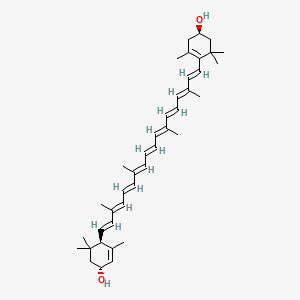
- Formula
- C40H56O2
- Weight
- 568.9 Da
- PubChem CID
- 5281243
- Exact Mass
- 568.4280 Da
- LogP
- 11
- TPSA
- 40.5 Ų
- H-Bond Donors
- 2
- H-Bond Acceptors
- 2
- Rotatable Bonds
- 10
- Complexity
- 1270
Identifiers (SMILES, InChI)
InChI=1S/C40H56O2/c1-29(17-13-19-31(3)21-23-37-33(5)25-35(41)27-39(37,7)8)15-11-12-16-30(2)18-14-20-32(4)22-24-38-34(6)26-36(42)28-40(38,9)10/h11-25,35-37,41-42H,26-28H2,1-10H3/b12-11+,17-13+,18-14+,23-21+,24-22+,29-15+,30-16+,31-19+,32-20+/t35-,36+,37-/m0/s1
KBPHJBAIARWVSC-RGZFRNHPSA-NReferences (4)
- [1]Dietary Lutein and Cognitive Function in Adults: A Meta-Analysis of Randomized Controlled Trials
→ Meta-analysis found that dietary lutein supplementation significantly improved cognitive function in adults, particularly in domains of memory, processing speed, and verbal fluency.
- [2]Green leafy vegetable and lutein intake and multiple health outcomes
→ Review of 24 meta-analyses covering 29 health outcomes showed that higher lutein and green leafy vegetable intake was associated with reduced risk of cardiovascular disease, cognitive decline, and age-related macular degeneration.
- [3]Intakes of Lutein, Zeaxanthin, and Other Carotenoids and Age-Related Macular Degeneration During 2 Decades of Prospective Follow-up
→ Large prospective study of over 100,000 participants found that higher dietary lutein and zeaxanthin intake was associated with 40% reduced risk of advanced age-related macular degeneration over 20 years.
- [4]The effects of lutein on cardiometabolic health across the life course: a systematic review and meta-analysis
→ Systematic review found that lutein intake and higher serum concentrations were associated with improved cardiovascular markers, reduced inflammation, and better metabolic health outcomes.
Continue researching Lutein
Keep scientific evidence separate from commercial availability. Review how claims are evaluated, explore question-led research paths, or inspect disclosed source records without changing the editorial conclusions on this page.