Salicin
Salicin research profile covering evidence quality, proposed mechanisms, safety considerations, regulatory status, and linked primary sources.
Evidence-led profile
Research snapshot
- Evidence stage
- Emerging research
- References
- 5 linked sources
- Research coverage
- 1 area
- Editorial review
- Jul 7, 2026
Published by the PepGuide Editorial Team using our research methodology.
Overview
Salicin is a phenolic glycoside consisting of salicyl alcohol (saligenin) bound to a glucose molecule, found primarily in the bark and leaves of willow trees (Salix species), as well as in poplar and meadowsweet. It is the compound that launched modern pharmacology: the use of willow bark for pain and fever was documented by Hippocrates circa 400 BCE, and salicin's isolation in 1828 by Johann Buchner eventually led to the synthesis of acetylsalicylic acid (aspirin) by Felix Hoffmann at Bayer in 1897. Salicin itself functions as a prodrug — after oral ingestion, it is hydrolyzed by intestinal bacteria and esterases to saligenin, which is then oxidized in the liver and gut to salicylic acid, the active anti-inflammatory and analgesic metabolite. This two-step bioactivation pathway produces a gradual, sustained release of salicylic acid, contributing to the gentler pharmacokinetic profile of willow bark compared to synthetic aspirin.
Salicylic acid exerts its anti-inflammatory and analgesic effects primarily through inhibition of cyclooxygenase (COX) enzymes, reducing the synthesis of prostaglandins (particularly PGE2) and thromboxanes that mediate pain, inflammation, and fever. However, willow bark extract — and by extension salicin — appears to work through additional mechanisms beyond simple COX inhibition, as its clinical effects exceed what would be predicted based on the modest plasma salicylate levels achieved. Other constituents of willow bark, including flavonoids, polyphenols, and additional salicylate compounds (salicortin, tremulacin), likely contribute synergistically. Clinical trials of willow bark extract standardized to 120-240 mg salicin/day have demonstrated efficacy for chronic low back pain, osteoarthritis, and headache, with effect sizes comparable to low-dose aspirin or NSAIDs in some studies but with significantly fewer gastrointestinal adverse events.
The gastrointestinal advantage of salicin/willow bark over synthetic aspirin is attributed to the gradual generation of salicylic acid (avoiding the acute gastric mucosal damage caused by direct contact with concentrated acetylsalicylic acid) and the absence of irreversible COX-1 acetylation in the gastric epithelium. However, individuals with aspirin allergy or sensitivity should avoid salicin, as cross-reactivity can occur. Salicin does not produce the same degree of antiplatelet activity as aspirin, making it less suitable as a cardiovascular prophylactic but potentially safer for patients at bleeding risk. Typical dosing of willow bark extract provides 120-240 mg salicin/day, divided into two doses. Salicin complements other natural anti-inflammatory compounds including curcumin, boswellia, omega-3 fatty acids, and bromelain for multimodal pain and inflammation management.
Mechanism of Action
Salicin is the principal bioactive beta-glucoside found in willow bark (Salix spp.) and serves as a prodrug for salicylic acid. Following oral ingestion, salicin is hydrolyzed by beta-glucosidases in the gut and by intestinal microbiota, cleaving the glucose moiety to release saligenin (salicyl alcohol). Saligenin is then absorbed and undergoes hepatic oxidation by alcohol dehydrogenase and aldehyde dehydrogenase, first to salicylaldehyde and then to salicylic acid, the pharmacologically active metabolite.
Salicylic acid exerts its anti-inflammatory and analgesic effects primarily through non-selective inhibition of cyclooxygenase enzymes (COX-1 and COX-2), although its COX inhibitory potency is weaker than that of aspirin (acetylsalicylic acid) because salicylic acid does not acetylate the enzyme. Instead, salicylic acid appears to act as a competitive inhibitor at the COX active site, reducing the conversion of arachidonic acid to prostaglandins (PGE2, PGI2) and thromboxanes involved in inflammation, pain sensitization, and fever. This results in reduced vasodilation, decreased edema, and attenuated peripheral pain signaling.
Beyond COX inhibition, salicylic acid directly suppresses NF-kB activation by inhibiting IKK-beta (IkB kinase beta), preventing phosphorylation and degradation of IkB-alpha. This blocks nuclear translocation of NF-kB and reduces transcription of pro-inflammatory cytokines (TNF-alpha, IL-1beta, IL-6), adhesion molecules, and iNOS. Willow bark extract also contains additional polyphenols and flavonoids that may contribute synergistic anti-inflammatory and antioxidant effects beyond those attributable to salicin alone.
Research
Reported Effects
Bioavailability:: 240mg salicin produces serum salicylic acid levels equivalent to only ~87mg aspirin, indicating relatively low bioconversion and systemic exposure. Mechanism Complexity:: Anti-inflammatory and analgesic effects may involve compounds beyond salicin/salicylic acid, including polyphenols and flavonoids in willow bark extract. Comparative Potency:: Significantly less potent than synthetic salicylates for direct analgesic effects, requiring interpretation as a gentler botanical alternative. Fat Loss Role:: Used in supplement stacks primarily as a theoretical potentiator of thermogenic effects, though individual contribution is difficult to isolate
- 240mg salicin produces serum salicylic acid levels equivalent to only ~87mg aspirin, indicating relatively low bioconversion and systemic exposure
- Anti-inflammatory and analgesic effects may involve compounds beyond salicin/salicylic acid, including polyphenols and flavonoids in willow bark extract
- Significantly less potent than synthetic salicylates for direct analgesic effects, requiring interpretation as a gentler botanical alternative
- Used in supplement stacks primarily as a theoretical potentiator of thermogenic effects, though individual contribution is difficult to isolate
Safety and Limitations
Safety Profile: Salicin
Common Side Effects
- Gastrointestinal irritation: nausea, stomach pain, and dyspepsia (though generally milder than aspirin)
- Allergic reactions in individuals with aspirin or salicylate sensitivity
- Mild headache and dizziness
- Increased bleeding time
Serious Adverse Effects
- Salicylate sensitivity reactions: Can trigger asthma exacerbation, urticaria, angioedema, and anaphylaxis in aspirin-sensitive individuals
- GI bleeding: Risk is lower than aspirin but still present, especially at high doses or with concurrent NSAID use
- Reye syndrome: Same theoretical risk as other salicylates in children with viral infections
- Renal impairment with chronic high-dose use
- Tinnitus at high doses (salicylism)
Contraindications
- Known aspirin or salicylate allergy (cross-reactivity is expected)
- Children under 16 with viral illness (Reye syndrome risk)
- Active peptic ulcer or GI bleeding
- Bleeding disorders or concurrent anticoagulant therapy
- Third trimester of pregnancy (salicylate effects on fetal ductus arteriosus)
- Severe renal or hepatic impairment
Drug Interactions
- Anticoagulants (warfarin) and antiplatelets: Increased bleeding risk
- NSAIDs: Additive GI and renal toxicity
- Methotrexate: Salicylates reduce renal clearance of methotrexate; risk of methotrexate toxicity
- Sulfonylureas: Enhanced hypoglycemic effect
- ACE inhibitors and diuretics: Reduced efficacy due to salicylate-induced sodium retention
Population-Specific Considerations
- White willow bark context: Salicin is the primary active compound in white willow bark; often marketed as "natural aspirin"
- Slower onset: Converted to salicylic acid in the liver; slower onset but potentially longer duration than aspirin
- Pain management: Used for back pain and osteoarthritis; evidence supports doses equivalent to 120–240 mg salicin/day
- Pregnancy: Avoid, especially in third trimester; first and second trimester use requires physician approval
Common Side Effects
- Gastrointestinal Effects:: Potential for stomach upset similar to but milder than synthetic salicylates, though less commonly reported than with aspirin
- Bleeding Risk:: Theoretical concern for increased bleeding time due to salicylate activity, though effects are much weaker than pharmaceutical doses
- Allergic Reactions:: Possible sensitivity reactions in individuals with aspirin or salicylate allergies
- Limited Reporting:: Minimal side effect discussion in user communities, possibly due to low doses used or lack of standalone use
Research protocol summary
- Typical Dose
- 90mg salicin (from white willow bark extract) commonly used in fat loss stacks, typically taken 2 times daily
These values summarize cataloged research protocols. They are not personal dosing instructions or medical guidance.
Reconstitution Calculator
Pharmacokinetic Profile
Molecular Structure
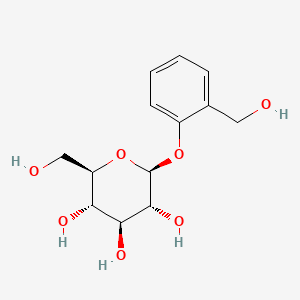
- Formula
- C13H18O7
- Weight
- 286.28 Da
- PubChem CID
- 439503
- Exact Mass
- 286.1053 Da
- LogP
- -1.2
- TPSA
- 120 Ų
- H-Bond Donors
- 5
- H-Bond Acceptors
- 7
- Rotatable Bonds
- 4
- Complexity
- 300
Identifiers (SMILES, InChI)
InChI=1S/C13H18O7/c14-5-7-3-1-2-4-8(7)19-13-12(18)11(17)10(16)9(6-15)20-13/h1-4,9-18H,5-6H2/t9-,10-,11+,12-,13-/m1/s1
NGFMICBWJRZIBI-UJPOAAIJSA-NReferences (5)
- [1]Pharmacokinetics of salicin after oral administration of a standardised willow bark extract
→ Study found that willow bark extract (240mg salicin) produced peak serum salicylic acid levels equivalent to only 87mg of aspirin, with much lower salicylate concentrations than therapeutic doses of synthetic salicylates. The formation of salicylic acid alone is unlikely to fully explain willow bark's analgesic effects.
- [2]Willow bark extract--effects and effectiveness. Status of current knowledge regarding pharmacology, toxicology and clinical aspects
→ Standardized willow bark extracts demonstrated anti-inflammatory activities comparable to higher doses of acetylsalicylic acid and showed antinociceptive effects. The extract appears to work through mechanisms beyond simple salicylic acid conversion.
- [3]Salicin from Willow Bark can Modulate Neurite Outgrowth in Human Neuroblastoma SH-SY5Y Cells
→ Research demonstrated that salicin binds and activates the bitter taste receptor TAS2R16, with studies showing general expression of bitter taste receptors in various tissues beyond the oral cavity, suggesting additional mechanisms of action.
- [4]Efficacy and Safety of White Willow Bark (Salix alba) Extracts
→ Review confirms willow bark's long history as an anti-inflammatory, antipyretic, and analgesic agent, though relatively few modern clinical studies have been published to confirm traditional uses.
- [5]Chrubasik S, Eisenberg E, Balan E, Weinberger T, Luzzati R, Conradt C Treatment of low back pain exacerbations with willow bark extract: a randomized double-blind study American Journal of Medicine (2000)
→ Willow bark extract standardized to 240 mg salicin/day for 4 weeks produced significantly more pain-free patients (39%) with low back pain than 120 mg (21%) or placebo (6%), showing a dose response.
Continue researching Salicin
Keep scientific evidence separate from commercial availability. Review how claims are evaluated, explore question-led research paths, or inspect disclosed source records without changing the editorial conclusions on this page.