Pramiracetam
Pramiracetam research profile covering evidence quality, proposed mechanisms, safety considerations, regulatory status, and linked primary sources.
Evidence-led profile
Research snapshot
- Evidence stage
- Emerging research
- References
- 5 linked sources
- Research coverage
- 1 area
- Editorial review
- Mar 8, 2026
Published by the PepGuide Editorial Team using our research methodology.
Overview
Pramiracetam is a synthetic racetam-class nootropic derived from piracetam, in which the amide group is replaced with a dipropan-2-ylaminoethyl group. This structural modification substantially increases lipophilicity and potency — pramiracetam is estimated to be 5-30 times more potent than piracetam — while also producing a distinct pharmacological profile. Its primary mechanism centers on enhancement of high-affinity choline uptake (HACU) in the hippocampus, the rate-limiting step in acetylcholine synthesis. By increasing the availability of choline for acetylcholine production in memory-critical brain regions, pramiracetam specifically targets the cholinergic processes underlying memory encoding and consolidation, making it one of the more memory-selective racetams available.
Clinical evidence for pramiracetam, while more limited than for piracetam, is notable. A key study in young men with head injuries demonstrated significant improvements in memory and cognitive function with pramiracetam treatment over an 18-month period. In elderly patients with cognitive decline, pramiracetam has shown benefits in memory tasks, particularly those involving delayed recall — consistent with its cholinergic mechanism of action. Unlike phenylpiracetam, pramiracetam produces minimal stimulant effects and does not significantly modulate dopaminergic or noradrenergic systems, resulting in a "cleaner" cognitive enhancement profile focused on memory without mood alteration or arousal changes. Some users describe it as producing a uniquely lucid, emotionally neutral state of heightened recall capacity.
Typical dosing ranges from 400-1,200 mg/day, usually divided into two or three administrations. Due to its fat solubility, pramiracetam is best absorbed when taken with a fat-containing meal or lipid carrier. Its half-life is approximately 5 hours. Because pramiracetam enhances choline uptake rather than directly providing choline, co-supplementation with choline sources such as alpha-GPC, CDP-choline, or phosphatidylcholine is commonly recommended to ensure adequate substrate availability. Pramiracetam is approved as a prescription drug (Pramistar) in several European countries for cognitive disorders. Within the racetam family, it is often compared to aniracetam (which adds anxiolytic properties) and oxiracetam (which emphasizes logical and analytical thinking), with pramiracetam being preferred specifically for memory-intensive tasks.
Mechanism of Action
Pramiracetam is a lipophilic racetam-class nootropic that primarily enhances cognitive function through modulation of cholinergic neurotransmission. Its central mechanism involves stimulation of the high-affinity choline uptake (HACU) system in hippocampal neurons, increasing the availability of choline for acetylcholine synthesis. Unlike some racetams that directly modulate neurotransmitter receptors, pramiracetam's cognitive effects are largely mediated through this indirect enhancement of cholinergic activity, which is critical for memory formation, learning, and attention processes.
Studies have demonstrated that systemic administration of pramiracetam (300 mg/kg) significantly increases neuronal nitric oxide synthase (NOS) activity in the cerebral cortex, producing approximately a 20% increase in cortical NOS activity, an effect that was amplified to 40% when combined with lithium chloride pretreatment (Corasaniti et al., Functional Neurology 1995). This NOS activation enhances nitric oxide-mediated signaling, which plays an important role in synaptic plasticity, long-term potentiation (LTP), and memory consolidation. Histological studies in BALB/c mice have also shown that pramiracetam promotes hippocampal myelination, supporting neuronal connectivity. Pramiracetam has high oral bioavailability, low plasma protein binding (20-22%), and crosses the blood-brain barrier effectively, with a half-life of 2-3 hours in animal models. Its mechanism is distinct from piracetam in that it demonstrates greater potency and more specific cholinergic enhancement.
Research
Reported Effects
Highly Potent:: Effective at much lower doses than piracetam.. Consistent:: Reliable cognitive enhancement for most users.. Choline Demanding:: Requires adequate choline more than other racetams.
- Effective at much lower doses than piracetam.
- Reliable cognitive enhancement for most users.
- Requires adequate choline more than other racetams.
Safety and Limitations
Safety Profile: Pramiracetam
Common Side Effects
- Headache (the most commonly reported side effect, often attributed to increased acetylcholine demand)
- Gastrointestinal discomfort: nausea, diarrhea, and stomach upset
- Insomnia and nervousness, especially at higher doses or with evening dosing
- Dry mouth and mild dizziness
- Irritability or emotional blunting reported by some users
Serious Adverse Effects
- Rare cases of allergic reactions (rash, urticaria)
- Exacerbation of pre-existing anxiety or agitation in susceptible individuals
- No significant organ toxicity reported in available clinical trials
- Theoretical risk of seizure threshold alteration at very high doses (based on racetam class)
Contraindications
- Known hypersensitivity to pramiracetam or other racetams
- Severe renal impairment (pramiracetam is primarily renally excreted)
- Huntington's disease (racetams may worsen choreiform movements)
- Pregnancy and lactation (no safety data)
Drug Interactions
- Cholinergic drugs: Additive effects on acetylcholine signaling; may increase cholinergic side effects
- Anticholinergics: May reduce pramiracetam's cognitive benefits
- Stimulants: Potential for overstimulation and increased anxiety
- Pramiracetam is fat-soluble and best absorbed with dietary fat
Population-Specific Considerations
- Elderly: Commonly used for age-related cognitive decline; start with lower doses
- Students/professionals: Popular nootropic; headache prevention with supplemental choline (e.g., alpha-GPC) is widely recommended
- Not FDA-approved: Available as a supplement in some countries; prescription drug in others (e.g., Europe)
Common Side Effects
- Headaches:: Very common without choline supplementation.
- Emotional Blunting:: Some report reduced emotional intensity.
- GI Upset:: Possible with high doses.
- Generally Well Tolerated:: Safe at recommended doses.
Research protocol summary
- Typical Dose
- 250-400mg twice daily.
These values summarize cataloged research protocols. They are not personal dosing instructions or medical guidance.
Reconstitution Calculator
Pharmacokinetic Profile
Molecular Structure
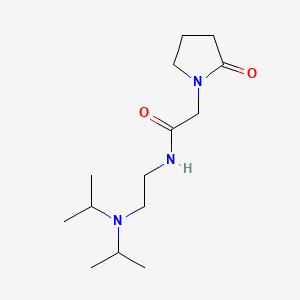
- Formula
- C14H27N3O2
- Weight
- 269.38 Da
- PubChem CID
- 51712
- Exact Mass
- 269.2103 Da
- LogP
- 0.8
- TPSA
- 52.7 Ų
- H-Bond Donors
- 1
- H-Bond Acceptors
- 3
- Rotatable Bonds
- 7
- Complexity
- 308
Identifiers (SMILES, InChI)
InChI=1S/C14H27N3O2/c1-11(2)17(12(3)4)9-7-15-13(18)10-16-8-5-6-14(16)19/h11-12H,5-10H2,1-4H3,(H,15,18)
ZULJGOSFKWFVRX-UHFFFAOYSA-NReferences (5)
- [4]A new one-trial test for neurobiological studies of memory in rats. Effects of piracetam and pramiracetam
→ Study assessed nootropic effects on rats' recognition memory using exploratory behavior tests. Specific pramiracetam doses significantly improved object recognition after 24 hours.
- [5]Some neurochemical properties of pramiracetam (CI-879), a new cognition-enhancing agent
→ Investigated pramiracetam's neurochemical effects and found it significantly increased choline uptake in the hippocampus, suggesting cognitive enhancement through boosted acetylcholine turnover.
- [1]Pramiracetam effects on scopolamine-induced amnesia in healthy volunteers
→ Study examined pramiracetam's ability to counteract memory loss induced by scopolamine in healthy male volunteers, showing pramiracetam partly reduced amnesic effects compared to placebo.
- [2]Pharmacokinetics of oral pramiracetam in normal volunteers
→ Study assessed pramiracetam's pharmacokinetics in healthy male volunteers receiving varying doses, demonstrating predictable absorption and clearance rates without significant side effects.
- [3]Placebo-controlled study of pramiracetam in young males with memory and cognitive problems resulting from head injury and anoxia
→ Found that 400 mg pramiracetam sulphate taken three times daily significantly improved memory, particularly delayed recall, in males with brain injuries versus placebo.
Continue researching Pramiracetam
Keep scientific evidence separate from commercial availability. Review how claims are evaluated, explore question-led research paths, or inspect disclosed source records without changing the editorial conclusions on this page.