SKF-38393
SKF-38393 research profile covering evidence quality, proposed mechanisms, safety considerations, regulatory status, and linked primary sources.
Evidence-led profile
Research snapshot
- Evidence stage
- Emerging research
- References
- 7 linked sources
- Research coverage
- 1 area
- Editorial review
- Mar 8, 2026
Published by the PepGuide Editorial Team using our research methodology.
Overview
SKF-38393 (1-phenyl-2,3,4,5-tetrahydro-1H-3-benzazepine-7,8-diol hydrochloride) is a synthetic benzazepine derivative that serves as one of the most widely used selective dopamine D1-like receptor agonists in neuropharmacological research. Developed by Smith Kline & French (now part of GSK), it was among the first compounds to demonstrate selective agonism at D1 receptors (D1 and D5 subtypes) with minimal activity at D2 receptors, providing a critical pharmacological tool for dissecting the distinct roles of D1 and D2 receptor families in the central and peripheral nervous systems. SKF-38393 acts as a partial agonist at D1 receptors, meaning it activates the receptor but produces submaximal stimulation of the coupled Gs/Golf-adenylyl cyclase-cAMP signaling cascade compared to the endogenous agonist dopamine. This partial agonist profile gives it a mixed agonist/antagonist character depending on the level of endogenous dopaminergic tone.
SKF-38393 has been instrumental in elucidating D1 receptor contributions to motor function, cognition, and reward. In Parkinson's disease models, D1 receptor stimulation by SKF-38393 produces contralateral rotation in unilaterally 6-OHDA-lesioned rats and synergizes with D2 agonists to restore motor behavior — demonstrating the cooperative D1/D2 interaction essential for normal basal ganglia function. In cognitive research, D1 receptor activation by SKF-38393 enhances working memory performance in prefrontal cortex-dependent tasks following an inverted-U dose-response curve, confirming the critical role of D1 signaling in executive function. This finding has influenced the development of D1-targeting strategies for cognitive deficits in schizophrenia, ADHD, and age-related cognitive decline. In reward and addiction research, SKF-38393 modulates drug self-administration and conditioned place preference, helping to define D1 receptor involvement in the motivational properties of drugs of abuse.
As a research compound rather than a therapeutic agent, SKF-38393 is not used clinically in humans. Its partial agonist efficacy and limited oral bioavailability make it suboptimal for drug development, though it has inspired the creation of more potent and selective D1 agonists including SKF-81297, A-68930, dihydrexidine, and the more recent non-catechol D1 agonists that have entered clinical trials for Parkinson's disease and cognitive disorders. SKF-38393's catechol structure (the 7,8-dihydroxy substitution on the benzazepine ring) is responsible for D1 receptor recognition but also confers rapid metabolic inactivation by catechol-O-methyltransferase (COMT) and poor blood-brain barrier penetration in some species. Despite these limitations, SKF-38393 remains a foundational tool in dopamine pharmacology, referenced in thousands of publications. Related D1 research tools include the full agonist SKF-81297 and the D1 antagonist SCH-23390.
Mechanism of Action
Mechanism of Action
SKF-38393 (1-phenyl-2,3,4,5-tetrahydro-(1H)-3-benzazepine-7,8-diol) is a benzazepine derivative and the prototypical selective D1-class dopamine receptor agonist. It has been extensively used as a research tool since the 1980s to delineate D1-specific functions in the brain.
Receptor Pharmacology
SKF-38393 is a partial-to-full agonist at D1 receptors (Ki ~150 nM) with approximately 10-fold selectivity over D5 receptors and minimal affinity for D2-family receptors. Its intrinsic activity varies by tissue and assay system; in striatal tissue it behaves as a partial agonist for cAMP production (~60-70% of dopamine maximal response) but can produce full agonist effects on other D1-coupled signaling cascades including phospholipase C activation.
cAMP/PKA Signaling Cascade
D1 receptor engagement activates Golf/Gs-protein, stimulating adenylyl cyclase type V (the predominant isoform in striatum). The resulting cAMP elevation activates PKA, which phosphorylates multiple substrates critical for neuronal function. In striatal medium spiny neurons, PKA phosphorylates DARPP-32 at Thr34, converting it into a PP-1 inhibitor that amplifies and sustains phosphorylation-dependent signaling. PKA also directly phosphorylates AMPA receptor GluA1 subunits (Ser845), enhancing synaptic strength.
Motor Control
In the basal ganglia, D1 receptors are expressed on direct pathway MSNs (striatonigral neurons). SKF-38393 activation of these neurons promotes GABA release onto the globus pallidus interna/substantia nigra pars reticulata, disinhibiting thalamocortical motor circuits. This produces grooming, rotational behavior (in unilaterally lesioned animals), and facilitates voluntary movement initiation. The motor effects of SKF-38393 are synergistic with D2 agonists, reflecting the cooperative relationship between direct and indirect pathways.
Cognitive Enhancement
D1 receptor activation in prefrontal cortex follows an inverted-U dose-response curve for working memory performance. At optimal doses, SKF-38393 enhances NMDA receptor-dependent persistent firing of pyramidal neurons that maintains information during delay periods. This involves PKA-mediated potentiation of NMDA receptor NR2B subunit currents. Too much D1 stimulation disrupts working memory through cAMP-dependent opening of HCN channels that shunt dendritic inputs.
Limitations as a Tool Compound
SKF-38393 has poor oral bioavailability due to the catechol moiety (rapid COMT methylation and glucuronidation). It also has some affinity for serotonin 5-HT2 receptors and alpha-1 adrenergic receptors at higher concentrations. These off-target effects must be considered when interpreting experimental results, particularly in behavioral studies using high systemic doses.
Research
Reported Effects
Partial Agonism:: Functions as a partial D1 agonist with approximately 40% efficacy relative to full dopamine stimulation. Selectivity:: Highly selective for D1 receptors over D2 receptors, producing distinct behavioral profiles. Species Consistency:: Demonstrates similar partial agonist properties across rodent and primate models. Research Applications:: Primarily effective as a research tool for studying D1 receptor function rather than therapeutic use
- Functions as a partial D1 agonist with approximately 40% efficacy relative to full dopamine stimulation
- Highly selective for D1 receptors over D2 receptors, producing distinct behavioral profiles
- Demonstrates similar partial agonist properties across rodent and primate models
- Primarily effective as a research tool for studying D1 receptor function rather than therapeutic use
Safety and Limitations
Safety Profile: SKF-38393
Common Side Effects
- Nausea and mild gastrointestinal discomfort (common with dopaminergic agents)
- Headache and dizziness
- Mild tachycardia and blood pressure fluctuations (D1 receptor activation has cardiovascular effects)
- Restlessness and psychomotor agitation
- Decreased appetite
Serious Adverse Effects
- Cardiovascular effects: D1 dopamine receptor agonism produces renal vasodilation and natriuresis at low doses but can cause systemic hypotension or hypertension at varying doses; cardiac arrhythmias are possible
- Seizure risk: D1 agonism can lower seizure threshold; reported in animal models at high doses
- Psychotomimetic effects: excessive dopaminergic stimulation may produce anxiety, agitation, or psychotic symptoms at high doses
- This is a research tool compound: SKF-38393 was developed as a selective D1 dopamine receptor partial agonist for laboratory use; it has never been approved for human therapeutic use and has not completed clinical safety evaluation
- Unknown human safety profile: virtually all safety data comes from animal pharmacological studies; human pharmacokinetic and toxicity data are extremely limited
Contraindications
- Not approved for human use—all administration is experimental
- Psychotic disorders or schizophrenia (dopaminergic stimulation may worsen positive symptoms)
- Seizure disorders (D1 agonism lowers seizure threshold in animal models)
- Severe cardiovascular disease or uncontrolled hypertension
- Pregnancy and lactation (no safety data)
- Pheochromocytoma (catecholamine interactions)
Drug Interactions
- Antipsychotics (D1/D2 antagonists): directly oppose SKF-38393's mechanism; reduced efficacy of both compounds
- Levodopa / dopamine agonists: additive dopaminergic stimulation; increased risk of dyskinesias and psychotic symptoms
- Antihypertensives: D1-mediated renal vasodilation and natriuresis may potentiate hypotension
- Anticonvulsants: may need dose adjustment due to seizure threshold lowering
- MAO inhibitors: risk of hypertensive crisis via dopaminergic potentiation
Population-Specific Considerations
- Regulatory status: SKF-38393 is a research chemical developed by SmithKline & French (now GSK); it has no FDA approval, no IND status for clinical use, and is intended solely for in vitro and animal research
- Research applications: widely used as a pharmacological tool to study D1 receptor function in models of Parkinson's disease, cognitive function, reward circuitry, and renal physiology
- Partial agonist: its partial agonist profile makes it weaker than full D1 agonists; this limits both efficacy and some toxicity risks but does not eliminate them
- No human dosing guidelines exist: any human self-administration carries unpredictable risk
Common Side Effects
- Biphasic Effects:: High doses can cause initial locomotor depression followed by hyperactivity
- Non-Typical Responses:: Does not produce classic dopaminergic stereotypy, leading to unusual behavioral patterns
- Oxidative Stress Sensitivity:: Effectiveness may be reduced in conditions of oxidative stress or aging
- Research Chemical Status:: Not approved for human use; safety profile in humans unknown
Reconstitution Calculator
Pharmacokinetic Profile
Molecular Structure
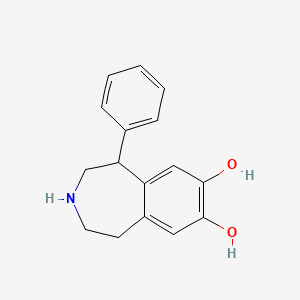
- Formula
- C16H17NO2
- Weight
- 255.31 Da
- PubChem CID
- 1242
- Exact Mass
- 255.1259 Da
- LogP
- 2.5
- TPSA
- 52.5 Ų
- H-Bond Donors
- 3
- H-Bond Acceptors
- 3
- Rotatable Bonds
- 1
- Complexity
- 290
Identifiers (SMILES, InChI)
InChI=1S/C16H17NO2/c18-15-8-12-6-7-17-10-14(13(12)9-16(15)19)11-4-2-1-3-5-11/h1-5,8-9,14,17-19H,6-7,10H2
JUDKOGFHZYMDMF-UHFFFAOYSA-NReferences (7)
- [4]Role of oxidative stress in defective renal dopamine D1 receptor-G protein coupling and function in old Fischer 344 rats
→ In aging rats with oxidative stress, SKF-38393 failed to stimulate G-proteins and adenylyl cyclase due to D1 receptor dysfunction. Antioxidant treatment (tempol) restored D1 receptor function and responsiveness to SKF-38393.
- [1]Assessment of grooming and other behavioural responses to the D-1 dopamine receptor agonist SK & F 38393 and its R- and S-enantiomers in the intact adult rat
→ SKF-38393 stereoselectively promoted non-stereotyped behaviors including grooming, sniffing, and locomotion in rats, with the R-enantiomer being the active form. The drug did not induce typical dopamine-like stereotyped behavior, demonstrating D1-specific behavioral effects.
- [2]SKF 38393 reverses cocaine-conditioned place preference in mice
→ SKF-38393 successfully blocked cocaine-conditioned place preference in mice without affecting locomotor activity. This suggests partial D1 receptor activation may be useful for developing pharmacotherapies for cocaine addiction.
- [3]Dopamine D1 receptors: efficacy of full (dihydrexidine) vs. partial (SKF38393) agonists in primates vs. rodents
→ SKF-38393 demonstrated partial agonist efficacy (approximately 40% relative to dopamine) in both rat and primate striatal tissue. The compound showed consistent partial efficacy across species, though with greater between-subject variation in primates.
- [5]Comparison of the discriminative-stimulus effects of SKF 38393 with those of other dopamine receptor agonists
→ Rats trained to discriminate SKF-38393 from vehicle showed that D1 full agonists substituted for SKF-38393, while D2 agonists and cocaine did not. This demonstrates SKF-38393 produces distinct D1-specific discriminative stimulus effects.
- [6]Neurophysiological investigation of effects of the D-1 agonist SKF 38393 on tonic activity of substantia nigra dopamine neurons
→ Unlike D2 agonists, SKF-38393 did not directly inhibit dopamine neuronal activity in anesthetized rats, suggesting D1 receptors do not mediate autoreceptor-like effects. Effects were only observed in non-anesthetized preparations, indicating complex indirect mechanisms.
- [7]Biphasic locomotor effects of the dopamine D1 agonist SKF 38393 and their attenuation in non-habituated mice
→ SKF-38393 produced dose-dependent locomotor stimulation in mice, with biphasic effects at high doses (initial depression followed by hyperlocomotion). Effects were attenuated by the D1 antagonist SCH 39166, confirming D1 receptor mediation.
Continue researching SKF-38393
Keep scientific evidence separate from commercial availability. Review how claims are evaluated, explore question-led research paths, or inspect disclosed source records without changing the editorial conclusions on this page.