CDP-Choline (Citicoline)
CDP-choline (citicoline) is an endogenous nucleotide compound that serves as an intermediate in the synthesis of phosphatidylcholine, a major component of cell membranes. It is used clinically and as a supplement for cognitive support and neuroprotection.
Evidence-led profile
Research snapshot
- Evidence stage
- Emerging research
- References
- 9 linked sources
- Research coverage
- 3 areas
- Editorial review
- Jul 7, 2026
Published by the PepGuide Editorial Team using our research methodology.
Overview
CDP-choline, also known as citicoline (cytidine 5'-diphosphocholine), is a naturally occurring compound that serves as a key intermediate in the Kennedy pathway — the primary biosynthetic route for phosphatidylcholine, the most abundant phospholipid in mammalian cell membranes. When taken orally, CDP-choline is hydrolyzed in the intestine into cytidine and choline, which are absorbed separately, cross the blood-brain barrier, and are resynthesized into CDP-choline within the brain.
The neuroprotective and cognitive-enhancing properties of CDP-choline operate through several complementary mechanisms. By supplying both choline and cytidine (which is converted to uridine), it supports phospholipid membrane synthesis and repair, which is particularly relevant following neuronal injury. CDP-choline also enhances the synthesis of acetylcholine by increasing choline availability, modulates dopaminergic neurotransmission, and has been shown to reduce phospholipase A2 activity, limiting the release of inflammatory arachidonic acid from damaged membranes.
CDP-choline has been extensively studied in clinical settings, including stroke recovery, traumatic brain injury, and age-related cognitive decline. It is approved as a pharmaceutical in many European and Asian countries for the treatment of cerebrovascular disorders and cognitive impairment. In the United States, it is available as a dietary supplement. The COGNITION trial and other studies have demonstrated improvements in attention, memory, and executive function in both healthy individuals and those with mild cognitive impairment, typically at doses of 500 to 2,000 mg per day.
Research
Reported Effects
Moderate Efficacy:: Generally considered effective but not as powerful as prescription medications; works well as part of comprehensive stacks. Individual Variation:: Response varies significantly between users; some report profound effects while others notice minimal benefits. Synergistic Effects:: Most effective when combined with other compounds like uridine, omega-3s, or racetams rather than as a standalone supplement. Timeline:: Benefits typically develop gradually over weeks rather than immediately, though some users report acute effects
Cognition and synaptic membrane synthesis
Citicoline (CDP-choline) is an intermediate in the synthesis of phosphatidylcholine and supplies both choline (for acetylcholine and membrane phospholipids) and cytidine, which is converted to uridine in humans, supporting synaptic membrane formation. Randomized trials in healthy older adults report modest improvements in memory and attention, and it is used clinically for age-related and vascular cognitive impairment in several countries. Effects are generally small and the evidence heterogeneous.
- Supplies choline and cytidine/uridine for synaptic membrane synthesis
- RCTs show modest memory and attention benefits in older adults
- Used for vascular/age-related cognitive impairment outside the US
Acute stroke and neuroprotection
Citicoline was long studied as a neuroprotectant to stabilize neuronal membranes and limit ischemic injury, with early pooled analyses suggesting benefit. The definitive ICTUS trial in moderate-to-severe acute ischemic stroke found no significant benefit over placebo, tempering enthusiasm, though interest persists in milder stroke, glaucoma and traumatic brain injury where membrane-stabilizing effects may matter.
- ICTUS found no benefit in moderate-to-severe ischemic stroke
- Early pooled analyses had suggested modest recovery benefit
- Neuroprotection still explored in glaucoma and brain injury
Safety and Limitations
Common Side Effects
- Gastrointestinal disturbances including nausea, diarrhea, stomach pain, and loss of appetite, particularly at doses exceeding 1,000 mg daily
- Headache is one of the most commonly reported side effects in clinical trials
- Insomnia and sleep disturbances, especially when taken later in the day, due to mild stimulatory properties
- Restlessness and psychomotor agitation at higher doses
- Mild decrease in blood pressure, which may cause dizziness in some individuals
Serious Adverse Effects
- No significant serious adverse effects have been documented in clinical trials at standard doses (250-1,000 mg daily) for durations up to 12 months
- Rare cases of chest tightness, shortness of breath, and blurred vision have been reported in post-marketing surveillance
- In individuals with bipolar disorder, CDP-choline may potentially trigger manic episodes, as cholinergic compounds can influence mood regulation
- Very rare allergic reactions including skin rash and urticaria
Contraindications
- Individuals with bipolar disorder or major depressive disorder with psychotic features should use with caution and under psychiatric supervision
- Those with Parkinson's disease on levodopa therapy should consult a neurologist, as CDP-choline may affect dopamine metabolism
- Individuals with known hypersensitivity to choline or cytidine should avoid use
- Caution in individuals with cholinergic sensitivity or those prone to acetylcholine-mediated side effects (excessive salivation, bronchoconstriction)
Drug Interactions
- May potentiate the effects of cholinesterase inhibitors (donepezil, rivastigmine, galantamine) used in Alzheimer's disease, potentially increasing cholinergic side effects
- Potential interaction with levodopa/carbidopa, as CDP-choline influences dopamine synthesis and release; concurrent use may require dosage adjustment
- May interact with anticholinergic medications (diphenhydramine, oxybutynin, benztropine) by counteracting their effects
- Theoretical interaction with meclizine and scopolamine (cholinergic antagonists)
- May enhance the effects of other nootropic supplements (racetams, alpha-GPC) through additive cholinergic mechanisms
- No significant interactions with common cardiovascular or metabolic medications have been documented
Special Populations
- Has been studied in pregnant women for fetal brain development with no significant adverse effects reported; however, routine supplementation during pregnancy should be discussed with an obstetrician
- Breastfeeding safety has not been formally established, though choline is a normal component of breast milk
- Extensive safety data in elderly populations from stroke and dementia trials; generally well-tolerated in patients aged 60+
- Pediatric safety data is limited to preliminary studies; not routinely recommended for children without medical supervision
Common Side Effects
- Depression Risk:: Some users report increased depression or flat affect, particularly at higher doses or with prolonged use
- Cholinergic Effects:: Occasional reports of headaches, which may indicate need for dose adjustment or are related to acetylcholine levels
- Stimulation vs. Sedation:: Can be more stimulating than Alpha-GPC for some users, potentially interfering with sleep if taken too late
- Generally Well-Tolerated:: Most users report minimal to no side effects at standard doses, with safety confirmed across multiple studies
Mechanism of Action
Endogenous Nucleotide — Kennedy Pathway Intermediate
CDP-choline (cytidine 5'-diphosphocholine, citicoline) is an endogenous intermediate in the Kennedy pathway of phosphatidylcholine (PC) biosynthesis. Following oral administration, CDP-choline is hydrolyzed to cytidine and choline in the intestinal wall, absorbed separately, and resynthesized to CDP-choline intracellularly by CTP:phosphocholine cytidylyltransferase (CCT), the rate-limiting enzyme in PC synthesis. Choline is phosphorylated by choline kinase, then combined with CTP (derived from cytidine) to regenerate CDP-choline, which donates its phosphocholine moiety to diacylglycerol (DAG) via cholinephosphotransferase to form phosphatidylcholine (PMID: 15591001).
Phospholipid Membrane Restoration
CDP-choline's primary neuroprotective mechanism involves restoration of phospholipid membrane integrity in damaged neurons. During ischemia and neurodegeneration, phospholipase A2 (PLA2) activation releases arachidonic acid and lysophosphatidylcholine from membranes, compromising structural integrity. CDP-choline provides both the polar head group (choline) and energy substrate (CTP) needed to reacylate lysophospholipids and synthesize new phosphatidylcholine, restoring membrane bilayer structure and function. It also increases synthesis of phosphatidylethanolamine, phosphatidylserine, and sphingomyelin (PMID: 16420464).
Cholinergic & Dopaminergic Enhancement
CDP-choline increases acetylcholine (ACh) synthesis by providing choline substrate for choline acetyltransferase (ChAT) in cholinergic neurons. It also enhances dopamine release in the striatum by increasing tyrosine hydroxylase activity and dopamine receptor density (particularly D2 receptors) in the corpus striatum. The cytidine component is converted to uridine, which crosses the blood-brain barrier and is incorporated into uridine triphosphate (UTP), activating P2Y receptors on neurons and glia to stimulate neurite outgrowth and synaptogenesis (PMID: 18816480).
Mitochondrial Membrane & Cardiolipin
CDP-choline supports mitochondrial membrane integrity by enhancing cardiolipin synthesis, a phospholipid exclusive to the inner mitochondrial membrane essential for electron transport chain complex assembly and cytochrome c retention (PMID: 22465051).
Research protocol summary
- Typical Dose
- Most commonly used at 250-500mg daily, with some users taking up to 1000mg divided into multiple doses
These values summarize cataloged research protocols. They are not personal dosing instructions or medical guidance.
Pharmacokinetic Profile
- Half-life
- 56 h
- Tmax
- 1 h
Molecular Structure
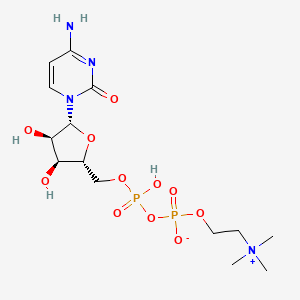
- Formula
- C14H26N4O11P2
- Weight
- 488.32 Da
- PubChem CID
- 13804
- Exact Mass
- 488.1073 Da
- LogP
- -4
- TPSA
- 214 Ų
- H-Bond Donors
- 4
- H-Bond Acceptors
- 11
- Rotatable Bonds
- 10
- Complexity
- 821
Identifiers (SMILES, InChI)
InChI=1S/C14H26N4O11P2/c1-18(2,3)6-7-26-30(22,23)29-31(24,25)27-8-9-11(19)12(20)13(28-9)17-5-4-10(15)16-14(17)21/h4-5,9,11-13,19-20H,6-8H2,1-3H3,(H3-,15,16,21,22,23,24,25)/t9-,11-,12-,13-/m1/s1
RZZPDXZPRHQOCG-OJAKKHQRSA-NResearch Indications
Clinical Uses
Used (especially in Europe/Japan) for age-related memory decline and vascular cognitive impairment; RCTs show modest memory benefit.
Widely used historically, but the large ICTUS trial found no benefit in moderate-severe stroke.
Other Research Areas
Studied for neuroprotection of retinal ganglion cells and visual function in glaucoma.
RCTs suggest improved sustained attention in healthy adults.
References (9)
- [1]Citicoline and Memory Function in Healthy Older Adults: A Randomized, Double-Blind, Placebo-Controlled Clinical Trial
→ A 12-week trial with 100 adults aged 50-85 found that 500mg daily citicoline significantly improved memory function in healthy elderly people with age-associated memory impairment, with no safety concerns reported.
- [2]Is Citicoline Effective in Preventing and Slowing Down Dementia?-A Systematic Review and a Meta-Analysis
→ This systematic review and meta-analysis concluded that citicoline has been proven to be useful in preventing dementia progression and enhancing cognitive functions, though its exact role in clinical practice requires further definition.
- [3]Application of Citicoline in Neurological Disorders: A Systematic Review
→ Review of 47 studies found citicoline prevents dementia progression, enhances cognitive functions in healthy individuals, improves stroke prognosis, and stimulates nerve regeneration in animal models, demonstrating wide-ranging neuroprotective effects.
- [4]Choline supplements: An update
→ Comprehensive review examining different forms of choline supplementation including CDP-choline, confirming these compounds represent an effective strategy for boosting memory and enhancing cognitive function.
- [5]CDP-choline: effects of the procholine supplement on sensory gating and executive function in healthy volunteers stratified for low, medium and high P50 suppression
→ Study examining CDP-choline's effects on sensory gating found it acts as a selective α7 nicotinic receptor agonist, though results varied based on baseline suppression levels in healthy volunteers.
- [6]Dietary CDP-choline supplementation prevents memory impairment caused by impoverished environmental conditions in rats
→ Animal study demonstrated that approximately 500mg/kg/day CDP-choline protected against hippocampal-dependent memory deficits in rats raised in impoverished conditions, suggesting protective effects against environmental stressors.
- [8]Citicoline: A Superior Form of Choline?
→ Analysis comparing citicoline to other choline forms found it is significantly less toxic than choline on a molar mass basis while serving as an effective source of both choline and cytidine.
- [7]Role of Citicoline in Patients With Mild Cognitive Impairment
→ Review concludes citicoline shows consistent improvement in cognitive function in patients with mild cognitive impairment, especially of vascular origin, through diverse neuroprotective mechanisms.
- [9]Dávalos A, Alvarez-Sabín J, Castillo J, et al. Citicoline in the treatment of acute ischaemic stroke: an international, randomised, multicentre, placebo-controlled study (ICTUS trial) The Lancet (2012)
→ In 2298 patients with moderate-severe acute ischemic stroke, citicoline (1000 mg q12h) was not superior to placebo for 90-day recovery, ending the trial for futility.
Continue researching CDP-Choline (Citicoline)
Keep scientific evidence separate from commercial availability. Review how claims are evaluated, explore question-led research paths, or inspect disclosed source records without changing the editorial conclusions on this page.