Astaxanthin
Astaxanthin research profile covering evidence quality, proposed mechanisms, safety considerations, regulatory status, and linked primary sources.
Evidence-led profile
Research snapshot
- Evidence stage
- Emerging research
- References
- 5 linked sources
- Research coverage
- 1 area
- Editorial review
- Mar 8, 2026
Published by the PepGuide Editorial Team using our research methodology.
Overview
Astaxanthin (3,3'-dihydroxy-β,β'-carotene-4,4'-dione) is a red-orange xanthophyll carotenoid pigment naturally synthesized by various microalgae, yeasts, and bacteria. The primary commercial source is the freshwater microalga Haematococcus pluvialis, which accumulates high concentrations of astaxanthin under environmental stress. In nature, astaxanthin moves up the food chain from algae to zooplankton, crustaceans, and fish, giving salmon, shrimp, lobster, and flamingos their characteristic pink-red coloration. It stands apart from other carotenoids in that it exhibits no pro-oxidant activity — an important safety advantage — and its unique molecular structure allows it to span the cell membrane, providing antioxidant protection on both the interior and exterior surfaces.
Astaxanthin is widely regarded as one of the most potent biological antioxidants found in nature. Its oxygen radical absorbance capacity (ORAC) is 100–500 times higher than that of alpha-tocopherol (vitamin E), and studies report it is up to 6,000 times more effective than vitamin C at quenching singlet oxygen. Its antioxidant activity against lipid peroxidation exceeds vitamin E by more than 100-fold. These properties underlie its documented benefits across multiple organ systems: cardiovascular health (improved cholesterol profiles and reduced blood pressure), eye health (enhanced blood flow and protection against age-related conditions), skin health (UV protection, wrinkle reduction, and improved hydration), and neuroprotection (reduced oxidative damage associated with neurodegenerative diseases).
Clinical and preclinical research has also demonstrated immunomodulatory effects, including activation of T-cells and natural killer cells, as well as potent anti-inflammatory activity. Astaxanthin is available in capsule, softgel, oil, and topical formulations, with study doses typically ranging from 2 to 12 mg daily. It is generally considered safe, though individuals on blood pressure medications should exercise caution due to its potential hypotensive effects. Its safety during pregnancy and breastfeeding has not been established. Four ounces of wild sockeye salmon provides approximately 4.5 mg of natural astaxanthin.
Mechanism of Action
Polyene Chain Radical Scavenging
Astaxanthin is a xanthophyll carotenoid (3,3'-dihydroxy-beta,beta-carotene-4,4'-dione) with a unique molecular architecture: its conjugated polyene chain spans the entire lipid bilayer while terminal polar hydroxyl and keto groups anchor to the membrane surface on both sides. This transmembrane orientation enables astaxanthin to quench reactive oxygen species across the full width of the phospholipid bilayer — a property unmatched by other carotenoids or vitamin E (PMID: 22428137).
Superior Singlet Oxygen Quenching
Astaxanthin quenches singlet oxygen at rates 6000x greater than vitamin C, 800x greater than CoQ10, and 550x greater than vitamin E, through energy transfer to its extended conjugation system (13 conjugated double bonds including two in the terminal rings). Unlike beta-carotene, astaxanthin does not exhibit pro-oxidant behavior at high oxygen tension due to its keto groups stabilizing the radical intermediate (PMID: 16521113).
Nrf2/ARE Pathway Activation
Astaxanthin activates the Keap1-Nrf2 signaling pathway by modifying Keap1 cysteine residues, releasing Nrf2 for nuclear translocation and binding to antioxidant response elements (ARE). This upregulates endogenous antioxidant enzymes: superoxide dismutase (SOD), catalase, glutathione peroxidase (GPx), heme oxygenase-1 (HO-1), and NAD(P)H quinone oxidoreductase 1 (NQO1) (PMID: 25590674).
NF-kB Suppression & Anti-Inflammatory Effects
Astaxanthin inhibits IKK-mediated IkB-alpha phosphorylation, preventing NF-kB nuclear translocation and downstream expression of COX-2, iNOS, TNF-alpha, IL-1beta, and IL-6. It also suppresses MAPK/ERK/JNK/p38 signaling cascades in macrophages and microglial cells (PMID: 20331520).
Mitochondrial Protection
Astaxanthin accumulates in mitochondrial membranes, reducing electron transport chain-generated superoxide, protecting cardiolipin from oxidation, and preserving mitochondrial membrane potential — enhancing oxidative phosphorylation efficiency and exercise endurance.
Research
Reported Effects
Onset Timeline:: Skin benefits typically noticed within 2-4 weeks; eye improvements can occur within 1 month; full anti-aging effects may take 3+ months of consistent use. Individual Variation:: Effects range from subtle to dramatic—some users report dramatic vision improvements while others notice minimal changes; fair-skinned individuals often report stronger sun protection effects. Long-term Use Validation:: Users who stopped after years of supplementation experienced rapid deterioration in skin, joints, and eye health, validating its protective effects. Dosage-Response:: Higher doses (12-24mg) show more pronounced effects than standard 4mg doses, particularly for skin and eye benefits
- Skin benefits typically noticed within 2-4 weeks; eye improvements can occur within 1 month; full anti-aging effects may take 3+ months of consistent use
- Effects range from subtle to dramatic—some users report dramatic vision improvements while others notice minimal changes; fair-skinned individuals often report stronger sun protection effects
- Users who stopped after years of supplementation experienced rapid deterioration in skin, joints, and eye health, validating its protective effects
- Higher doses (12-24mg) show more pronounced effects than standard 4mg doses, particularly for skin and eye benefits
Safety and Limitations
Common Side Effects
- Generally well-tolerated at doses up to 12 mg/day in clinical studies
- Gastrointestinal effects: Mild stomach discomfort, nausea, diarrhea
- Skin discoloration: Orange/reddish pigmentation of skin with chronic high-dose use (carotenodermia, reversible upon discontinuation)
- Altered stool color (reddish-orange)
- Headache (infrequent)
Serious Concerns
- Astaxanthin is a potent carotenoid and antioxidant. Unlike beta-carotene, it does not convert to vitamin A, so hypervitaminosis A is not a concern.
- No significant toxicity has been demonstrated in human clinical trials at doses up to 40 mg/day for short periods.
- Long-term safety data beyond 12 weeks is limited in controlled trials.
- Theoretical concern about interference with immune surveillance at very high antioxidant doses (not established for astaxanthin specifically).
Contraindications
- Known hypersensitivity to astaxanthin or related carotenoids
- Allergy to source organisms (typically Haematococcus pluvialis algae; some products derived from krill or shrimp — shellfish allergy relevant)
- Pregnancy and breastfeeding (insufficient human safety data)
Drug Interactions
- Antihypertensives: Astaxanthin may modestly reduce blood pressure; additive hypotensive effect possible
- Anticoagulants/antiplatelets: Some in vitro evidence of antiplatelet activity; theoretical bleeding risk with warfarin, aspirin, or clopidogrel
- 5-alpha reductase inhibitors (finasteride, dutasteride): Astaxanthin may inhibit 5-alpha reductase; potential additive effect
- Immunosuppressants: Astaxanthin modulates immune function; could theoretically interfere
- Other carotenoids: May compete for absorption; take separately
Special Populations
- Pediatric: No established dosing or safety data in children
- Geriatric: Generally well-tolerated; start at lower doses
- Hepatic impairment: Carotenoids are metabolized hepatically; use caution in liver disease
- Hormone-sensitive conditions: Some evidence of hormonal modulation (5-alpha reductase, estrogen pathways)
Monitoring
- Skin changes (carotenodermia) with chronic use
- Blood pressure if combined with antihypertensives
- No routine laboratory monitoring typically required at standard supplemental doses (4–12 mg/day)
Common Side Effects
- Skin Discoloration:: Fair-skinned users may develop orange/carrot-like skin tone at higher doses (12mg+), which reverses upon cessation within 1-3 months
- Minimal Adverse Effects:: Very few serious side effects reported even at high doses; generally well-tolerated long-term
- Nitric Oxide Depletion:: Some sources suggest it may reduce nitric oxide levels affecting circulation, though user reports don't strongly confirm this
- Individual Sensitivity:: Rare reports of no effect or mild digestive issues, but overwhelmingly considered safe and side-effect-free
Research protocol summary
- Typical Dose
- 4-12mg daily is most common, with 12mg being the sweet spot for noticeable benefits without excessive cost
These values summarize cataloged research protocols. They are not personal dosing instructions or medical guidance.
Reconstitution Calculator
Pharmacokinetic Profile
Astaxanthin — Pharmacokinetic Curve
SubcutaneousMolecular Structure
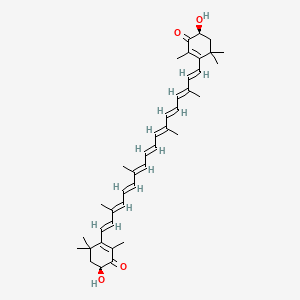
- Formula
- C40H52O4
- Weight
- 596.8 Da
- PubChem CID
- 5281224
- Exact Mass
- 596.3866 Da
- LogP
- 10.3
- TPSA
- 74.6 Ų
- H-Bond Donors
- 2
- H-Bond Acceptors
- 4
- Rotatable Bonds
- 10
- Complexity
- 1340
Identifiers (SMILES, InChI)
InChI=1S/C40H52O4/c1-27(17-13-19-29(3)21-23-33-31(5)37(43)35(41)25-39(33,7)8)15-11-12-16-28(2)18-14-20-30(4)22-24-34-32(6)38(44)36(42)26-40(34,9)10/h11-24,35-36,41-42H,25-26H2,1-10H3/b12-11+,17-13+,18-14+,23-21+,24-22+,27-15+,28-16+,29-19+,30-20+/t35-,36-/m0/s1
MQZIGYBFDRPAKN-UWFIBFSHSA-NReferences (5)
- [5]Astaxanthin in Skin Health, Repair, and Disease: A Comprehensive Review
→ Comprehensive analysis of astaxanthin's effects on skin oxidative stress markers, showing it reduces ROS and improves epithelial proliferation and differentiation homeostasis.
- [1]Exploring astaxanthin: a comprehensive review on its applications, health benefits, and biological activities
→ Comprehensive review documenting astaxanthin's wide-ranging health benefits including antioxidant, anti-inflammatory, and neuroprotective properties across multiple systems.
- [2]Effects of Astaxanthin Supplementation on Skin Health: A Systematic Review of Clinical Studies
→ Systematic review of clinical trials showing astaxanthin supplementation improves skin moisture, elasticity, wrinkles, and provides protection against UV-induced damage.
- [3]Systematic Review and Meta-Analysis on the Effects of Astaxanthin on Human Skin Ageing
→ Meta-analysis demonstrating significant improvements in skin texture, wrinkle depth, moisture content, and elasticity with astaxanthin supplementation.
- [4]The Role of Astaxanthin as a Nutraceutical in Health and Age-Related Conditions
→ Review examining astaxanthin's therapeutic potential in age-related diseases through antioxidant, anti-inflammatory, and mitochondrial protection mechanisms.
Continue researching Astaxanthin
Keep scientific evidence separate from commercial availability. Review how claims are evaluated, explore question-led research paths, or inspect disclosed source records without changing the editorial conclusions on this page.