Pyridoxal-5-Phosphate
Pyridoxal-5-Phosphate research profile covering evidence quality, proposed mechanisms, safety considerations, regulatory status, and linked primary sources.
Evidence-led profile
Research snapshot
- Evidence stage
- Emerging research
- References
- 3 linked sources
- Research coverage
- 1 area
- Editorial review
- Jul 7, 2026
Published by the PepGuide Editorial Team using our research methodology.
Overview
Pyridoxal-5-phosphate (P5P, also called pyridoxal phosphate or PLP) is the metabolically active coenzyme form of vitamin B6, functioning as an essential cofactor in more than 150 enzymatic reactions — representing approximately 4% of all classified enzyme activities. While dietary vitamin B6 exists in six interconvertible forms (pyridoxine, pyridoxal, pyridoxamine, and their phosphorylated counterparts), all must ultimately be converted to P5P in the liver by the enzyme pyridoxine 5'-phosphate oxidase (PNPO) before they can serve as cofactors. Supplementing with P5P directly bypasses this hepatic conversion step, which can be impaired by genetic polymorphisms in PNPO, liver dysfunction, certain medications (including oral contraceptives, isoniazid, and hydralazine), and advanced age.
P5P-dependent enzymes catalyze a remarkable diversity of biochemical transformations centered on amino acid metabolism: transamination (aminotransferases), decarboxylation, racemization, elimination, and replacement reactions. Neurotransmitter synthesis is particularly P5P-dependent — it is required for the conversion of 5-HTP to serotonin (via aromatic L-amino acid decarboxylase), L-DOPA to dopamine, glutamate to GABA (via glutamic acid decarboxylase), and for the synthesis of norepinephrine and histamine. P5P is also essential for heme biosynthesis (as a cofactor for ALA synthase, the rate-limiting enzyme), glycogen phosphorylase activity (making it relevant to glucose regulation), sphingolipid synthesis for myelin formation, and the transsulfuration pathway that converts homocysteine to cysteine — positioning P5P alongside folate and vitamin B12 as a key homocysteine-lowering nutrient.
Clinical applications of P5P supplementation include pyridoxine-responsive conditions where conventional B6 is inadequate (particularly PNPO deficiency causing neonatal epilepsy), premenstrual syndrome (where P5P may be more effective than pyridoxine at comparable doses), morning sickness, carpal tunnel syndrome, and as part of homocysteine-lowering protocols. Typical supplemental doses range from 25-100 mg/day. Unlike high-dose pyridoxine, which has been associated with peripheral neuropathy at chronic intakes above 200 mg/day, P5P appears to carry a lower risk of this adverse effect, though the evidence base is still developing. P5P works synergistically with other B vitamins including riboflavin (vitamin B2, required for PNPO activity), methylcobalamin, and folate in one-carbon metabolism and methylation pathways.
Mechanism of Action
Mechanism of Action: Pyridoxal-5-Phosphate
Pyridoxal-5-phosphate (P5P) is the metabolically active coenzyme form of vitamin B6, formed by phosphorylation of pyridoxal by pyridoxal kinase. It participates in over 140 distinct enzymatic reactions, representing approximately 4% of all classified enzyme activities.
Catalytic Mechanism
P5P functions through formation of a Schiff base (aldimine) with the ε-amino group of a lysine residue in the enzyme active site. During catalysis, the substrate amino acid displaces the lysine to form an external aldimine. The electron-withdrawing pyridinium ring then stabilizes carbanionic intermediates, enabling diverse reaction types (transamination, decarboxylation, elimination, racemization) depending on which bond to the α-carbon is cleaved.
Neurotransmitter Biosynthesis
P5P is the obligate cofactor for: (1) Glutamic acid decarboxylase (GAD65/GAD67), converting glutamate to GABA, the primary inhibitory neurotransmitter; (2) Aromatic L-amino acid decarboxylase (AADC/DDC), converting 5-hydroxytryptophan to serotonin and L-DOPA to dopamine; (3) Histidine decarboxylase, producing histamine. Deficiency directly impairs neurotransmitter synthesis, manifesting as seizures, anxiety, and mood disturbances.
Homocysteine and One-Carbon Metabolism
In the transsulfuration pathway, P5P is required by cystathionine β-synthase (CBS) to condense homocysteine with serine, forming cystathionine. Cystathionine γ-lyase (also P5P-dependent) then converts this to cysteine, which feeds glutathione synthesis. This pathway is the primary route for homocysteine clearance and is critical for cardiovascular health. P5P also serves as cofactor for serine hydroxymethyltransferase (SHMT) in folate-mediated one-carbon metabolism.
Heme and Hemoglobin
δ-Aminolevulinic acid synthase (ALAS1 and ALAS2) requires P5P to catalyze the first and rate-limiting step of heme biosynthesis: condensation of glycine and succinyl-CoA to form δ-aminolevulinic acid. P5P deficiency impairs heme synthesis, leading to microcytic sideroblastic anemia.
Lipid and Amino Acid Metabolism
P5P is cofactor for sphingosine-1-phosphate lyase (critical for sphingolipid metabolism), serine palmitoyltransferase (ceramide synthesis), and numerous aminotransferases (ALT, AST) central to amino acid catabolism and gluconeogenesis. It also modulates steroid hormone receptor transcriptional activity by interacting with receptor-DNA binding domains.
Immune Function
P5P is required for lymphocyte proliferation and IL-2 production. It modulates gene transcription by interacting with glucocorticoid, estrogen, and androgen receptor signaling, influencing immune cell differentiation and cytokine production.
Research
Reported Effects
Superior Bioavailability:: More readily absorbed and utilized than standard B6 forms, particularly beneficial for those with impaired liver function. Depression Association:: Population data shows correlation between higher P5P levels and lower depression incidence. Enzyme Function:: Critical cofactor for approximately 4% of all cellular enzymes, indicating broad metabolic importance. Individual Variation:: Effectiveness may depend on baseline B6 status and genetic factors affecting vitamin metabolism
- More readily absorbed and utilized than standard B6 forms, particularly beneficial for those with impaired liver function
- Population data shows correlation between higher P5P levels and lower depression incidence
- Critical cofactor for approximately 4% of all cellular enzymes, indicating broad metabolic importance
- Effectiveness may depend on baseline B6 status and genetic factors affecting vitamin metabolism
Safety and Limitations
Safety Profile: Pyridoxal-5-Phosphate (P5P)
Common Side Effects
- Generally well tolerated at doses of 25–100 mg/day
- Nausea, vomiting, and stomach discomfort, especially on an empty stomach
- Headache and drowsiness at higher doses
- Vivid dreams or sleep disturbances reported by some users
- Mild tingling or numbness (paresthesia) as an early warning of excessive dosing
Serious Adverse Effects
- Peripheral neuropathy: The hallmark toxicity of vitamin B6; sensory neuropathy with numbness, tingling, burning pain, and loss of proprioception at chronic doses exceeding 200 mg/day (sometimes lower); P5P form may carry slightly lower risk than pyridoxine HCl but is not immune
- Photosensitivity dermatitis: Reported with high-dose supplementation
- Ataxia and impaired coordination: At toxic doses, motor neuropathy affecting gait and balance
- Neonatal seizures reported with very high maternal doses
- Potential for dependency: abrupt withdrawal after chronic high-dose use may cause rebound symptoms
Contraindications
- Known hypersensitivity to pyridoxal-5-phosphate or pyridoxine compounds
- Pre-existing peripheral neuropathy (may worsen condition)
- Parkinson's disease patients on levodopa without carbidopa (B6 accelerates peripheral conversion of levodopa, reducing efficacy)
- Doses exceeding 100 mg/day without medical supervision
Drug Interactions
- Levodopa (without carbidopa): P5P dramatically reduces levodopa efficacy by enhancing peripheral decarboxylation; does not affect levodopa/carbidopa combination products
- Phenytoin and phenobarbital: High-dose B6 may reduce anticonvulsant plasma levels by enhancing hepatic metabolism
- Cycloserine and isoniazid: These drugs deplete B6; supplementation often needed but dose should be calibrated
- Amiodarone: May increase photosensitivity risk when combined with high-dose B6
- Altretamine (hexamethylmelamine): B6 may reduce chemotherapy effectiveness; avoid concurrent use
Population-Specific Considerations
- Elderly: Higher susceptibility to peripheral neuropathy; keep doses below 50 mg/day without medical guidance
- Pediatric: Safe at RDA levels; supplemental doses should be age-appropriate and supervised
- Pregnant/Lactating: Safe at doses up to 25 mg/day for morning sickness; avoid exceeding 100 mg/day
- Renal impairment: Active form (P5P) may accumulate; monitor serum levels in dialysis patients
- Neuropathy patients: Strictly avoid high-dose supplementation; may worsen existing nerve damage
Common Side Effects
- Neuropathy Risk:: High-dose vitamin B6 supplementation has been associated with peripheral neuropathy in some cases
- Upper Limits:: Excessive intake should be avoided; established tolerable upper intake levels exist for vitamin B6 forms
- Generally Well-Tolerated:: At appropriate doses, P5P is considered safe with minimal adverse effects reported
- Individual Sensitivity:: Some individuals may experience mild gastrointestinal effects or sensitivities at higher doses
Research protocol summary
- Typical Dose
- RDA for young adults is 1.3 mg of vitamin B6, with P5P providing direct active form
These values summarize cataloged research protocols. They are not personal dosing instructions or medical guidance.
Reconstitution Calculator
Pharmacokinetic Profile
Molecular Structure
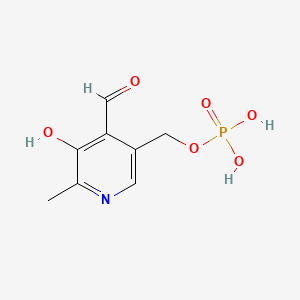
- Formula
- C8H10NO6P
- Weight
- 247.14 Da
- PubChem CID
- 1051
- Exact Mass
- 247.0246 Da
- LogP
- -1.1
- TPSA
- 117 Ų
- H-Bond Donors
- 3
- H-Bond Acceptors
- 7
- Rotatable Bonds
- 4
- Complexity
- 292
Identifiers (SMILES, InChI)
InChI=1S/C8H10NO6P/c1-5-8(11)7(3-10)6(2-9-5)4-15-16(12,13)14/h2-3,11H,4H2,1H3,(H2,12,13,14)
NGVDGCNFYWLIFO-UHFFFAOYSA-NReferences (3)
- [1]Associations of Dietary Intake of Vitamin B6 and Plasma Pyridoxal 5'-Phosphate Level With Depression in US Adults: Findings From NHANES 2005-2010
→ Analysis of NHANES data found significant associations between higher vitamin B6 intake and plasma P5P levels with reduced depression risk in US adults, suggesting an important role in mood regulation.
- [2]Biomedical aspects of pyridoxal 5'-phosphate availability
→ Comprehensive review of P5P's biochemical functions, highlighting its critical role as a cofactor in numerous metabolic pathways and its importance in maintaining cellular health and enzyme function.
- [3]Al-Saad H, et al. Assessing pyridoxine adjuvant therapy effects on blood glucose levels in type 2 diabetes: A randomized clinical trial Journal of Medicine and Life (2023)
→ Vitamin B6 (which is converted to the active coenzyme pyridoxal-5-phosphate) as adjuvant therapy significantly improved fasting glucose and HbA1c in type 2 diabetes; PLP is the bioactive form.
Continue researching Pyridoxal-5-Phosphate
Keep scientific evidence separate from commercial availability. Review how claims are evaluated, explore question-led research paths, or inspect disclosed source records without changing the editorial conclusions on this page.