Ornithine
A non-proteinogenic amino acid that plays a central role in the urea cycle, used supplementally to reduce ammonia-related fatigue, support growth hormone release, and promote liver detoxification.
Evidence-led profile
Research snapshot
- Evidence stage
- Emerging research
- References
- 7 linked sources
- Research coverage
- 1 area
- Editorial review
- Mar 8, 2026
Published by the PepGuide Editorial Team using our research methodology.
Overview
Ornithine (L-ornithine) is a non-proteinogenic amino acid — meaning it is not incorporated into proteins during translation — that serves as a pivotal intermediate in the urea cycle, the metabolic pathway responsible for converting toxic ammonia into urea for renal excretion. Ornithine is generated from arginine by the enzyme arginase and subsequently reacts with carbamoyl phosphate (via ornithine transcarbamylase) to form citrulline, driving the cycle forward. This biochemical centrality underpins ornithine's primary therapeutic applications: ammonia detoxification, exercise fatigue reduction, and hepatoprotection. The compound is most commonly supplemented as L-ornithine hydrochloride or L-ornithine L-aspartate (LOLA), with the latter being an approved pharmaceutical in several countries for hepatic encephalopathy.
The anti-fatigue and ergogenic effects of ornithine supplementation are attributed to accelerated ammonia clearance during prolonged or high-intensity exercise. Ammonia accumulation in muscle and plasma is a recognized contributor to central and peripheral fatigue, and clinical studies have demonstrated that oral ornithine (2–6 g before exercise) significantly reduces post-exercise ammonia levels and subjective fatigue ratings. Additionally, ornithine stimulates growth hormone (GH) secretion, particularly when administered before sleep — an effect that has made it popular in sports nutrition, often in combination with arginine (ornithine alpha-ketoglutarate or OKG formulations). The hepatoprotective properties of L-ornithine L-aspartate are well-characterized, with meta-analyses confirming efficacy in reducing blood ammonia levels and improving mental state in patients with hepatic encephalopathy.
Typical supplemental doses range from 1.5–6 g daily for ergogenic purposes, with 2–3 g before bedtime being a common protocol for GH support. In clinical hepatology, LOLA is dosed at 9–18 g/day orally or 20–40 g/day intravenously. Ornithine synergizes with arginine for nitric oxide production and urea cycle support, with citrulline for sustained ammonia detoxification, and with alpha-ketoglutarate for enhanced TCA cycle anaplerosis. Side effects are uncommon at standard doses but may include gastrointestinal discomfort and diarrhea at higher doses due to osmotic effects. Ornithine is generally well-tolerated and represents a straightforward nutritional intervention for ammonia management and exercise recovery.
Research
Reported Effects
Ammonia Management:: Most effective in conditions with elevated ammonia such as hepatic encephalopathy or prolonged exercise; benefits are context-dependent. Individual Variation:: User responses vary significantly, with some experiencing noticeable fatigue reduction while others report minimal effects. Dosage Sensitivity:: Effectiveness appears dose-dependent, with higher doses (6-12g) showing more consistent results than lower doses. Timing Matters:: Benefits for sleep and recovery may be enhanced when taken before bed or post-exercise, though optimal timing remains unclear
Safety and Limitations
L-Ornithine is generally well-tolerated, but high doses may cause gastrointestinal distress including diarrhea, nausea, and abdominal cramps. It should be used with caution by individuals with kidney disease, as it is metabolized through the urea cycle. It is contraindicated during pregnancy and breastfeeding due to limited safety data.
Common Side Effects
- Gastrointestinal Issues:: Most common side effect includes mild stomach discomfort, nausea, or diarrhea, particularly at higher doses
- Retinal Concerns:: Long-term very high doses (above 600 μmol/l blood concentration) may pose retinal risks, though short-term supplementation is considered safe
- Minimal at Moderate Doses:: Doses up to 12g/day show no significant adverse effects compared to placebo in systematic reviews
- Individual Tolerance:: Some users report no side effects even at higher doses, while others experience digestive upset at lower amounts
Mechanism of Action
Ornithine is a non-proteinogenic amino acid that occupies a central metabolic position at the intersection of nitrogen disposal, amino acid interconversion, and polyamine biosynthesis. In the urea cycle, ornithine accepts a carbamoyl group from carbamoyl phosphate (formed from ammonia and CO2 by carbamoyl phosphate synthetase I) via ornithine transcarbamylase (OTC) to form citrulline. Through subsequent steps involving argininosuccinate synthetase and argininosuccinate lyase, citrulline is converted to arginine, which is then cleaved by arginase to release urea and regenerate ornithine. This cycle is the primary pathway for converting toxic ammonia into excretable urea.
Ornithine also serves as the substrate for ornithine decarboxylase (ODC), the rate-limiting enzyme in polyamine biosynthesis. ODC converts ornithine to putrescine, which is subsequently converted to spermidine and spermine. These polyamines are essential for cell proliferation, DNA stabilization, gene expression regulation, and ion channel modulation. The ODC pathway is tightly regulated and highly active in rapidly dividing cells.
Additionally, ornithine is catabolized by ornithine aminotransferase (OAT) to delta-1-pyrroline-5-carboxylate, which can be further converted to either proline (important for collagen synthesis) or glutamate (feeding into the TCA cycle or glutamine synthesis). Supplemental ornithine promotes growth hormone secretion, likely through modulation of hypothalamic signaling, and accelerates ammonia clearance during exercise and hepatic stress, reducing fatigue.
Research protocol summary
- Typical Dose
- Clinical studies use 2-12 grams per day, with 12,000 mg/day established as the no observed adverse effect level
These values summarize cataloged research protocols. They are not personal dosing instructions or medical guidance.
Molecular Structure
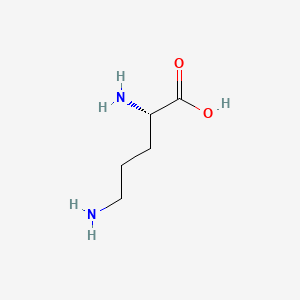
- Formula
- C5H12N2O2
- Weight
- 132.16 Da
- PubChem CID
- 6262
- Exact Mass
- 132.0899 Da
- LogP
- -4.4
- TPSA
- 89.3 Ų
- H-Bond Donors
- 3
- H-Bond Acceptors
- 4
- Rotatable Bonds
- 4
- Complexity
- 95
Identifiers (SMILES, InChI)
InChI=1S/C5H12N2O2/c6-3-1-2-4(7)5(8)9/h4H,1-3,6-7H2,(H,8,9)/t4-/m0/s1
AHLPHDHHMVZTML-BYPYZUCNSA-NReferences (7)
- [2]Safety assessment of L-ornithine oral intake in healthy subjects: a systematic review
→ Systematic review of 22 clinical trials found the no observed adverse effect level to be 12,000 mg/day of L-ornithine hydrochloride, with maximum duration of 156 days. Main adverse events were gastrointestinal disorders, but no significant difference compared to placebo.
- [4]Effects of Composite Supplement Containing Collagen Peptide and Ornithine on Skin Conditions and Plasma IGF-1 Levels
→ Randomized, double-blind, placebo-controlled trial investigating ornithine's effects on skin health and IGF-1 levels, demonstrating potential benefits when combined with collagen peptide.
- [5]Prophylaxis of hepatic encephalopathy: current and future drug targets
→ Review discussing ammonia-lowering agents including ornithine-related therapies for preventing hepatic encephalopathy in cirrhotic patients, highlighting the role of amino acid metabolism in neurological complications.
- [6]Additive Effects of L-Ornithine on Preferences to Basic Taste Solutions in Mice
→ Study found that L-ornithine at low concentrations enhances preferences to sweet, salty, umami, and fat taste solutions in mice, suggesting a role as a 'kokumi' substance that enhances food palatability.
- [7]Supplements with purported effects on muscle mass and strength
→ Comprehensive review of muscle-building supplements found limited but promising evidence for ornithine when paired with arginine in one older study showing improvements in lean mass and power output in weightlifters.
- [3]Retinal risks of high-dose ornithine supplements: a review
→ Review concluded that short-term, low-dose, or transient high-dose ornithine intake is safe for the retina. Blood ornithine levels below 250 μmol/l do not produce retinal alterations, while long-term high concentrations above 600 μmol/l may induce retinal toxicity.
- [1]Ornithine and its role in metabolic diseases: An appraisal
→ Comprehensive review establishing ornithine's role in the urea cycle and its therapeutic potential in conditions characterized by excess ammonia, including hepatic encephalopathy and exercise-induced fatigue. The review highlights ornithine's functions in synthesizing proline, polyamines, and citrulline.
Continue researching Ornithine
Keep scientific evidence separate from commercial availability. Review how claims are evaluated, explore question-led research paths, or inspect disclosed source records without changing the editorial conclusions on this page.