UROLITHIN A
UROLITHIN A research profile covering evidence quality, proposed mechanisms, safety considerations, regulatory status, and linked primary sources.
Evidence-led profile
Research snapshot
- Evidence stage
- Emerging research
- References
- 8 linked sources
- Research coverage
- 1 area
- Editorial review
- Jul 7, 2026
Published by the PepGuide Editorial Team using our research methodology.
Urolithin A is a gut microbiome-derived metabolite produced from ellagitannins and ellagic acid found in pomegranates and walnuts. It stimulates mitophagy (mitochondrial recycling), improving mitochondrial health and function by clearing damaged mitochondria and promoting biogenesis. Only ~30% of people naturally produce urolithin A, making supplementation a reliable alternative.
Mechanism of Action
Mechanism of Action: Urolithin A
Microbiome-Dependent Production
Urolithin A is not found in food directly. It is produced by specific gut bacteria (Gordonibacter urolithinfaciens, Ellagibacter isourolithinifaciens) through metabolism of dietary ellagitannins and ellagic acid found in pomegranates, walnuts, and berries. Approximately 40% of individuals lack the microbial machinery to produce urolithin A endogenously, which has driven development of direct supplementation (Mitopure/Timeline).
Mitophagy Activation
Urolithin A is the first natural compound demonstrated to induce mitophagy across species (C. elegans, mice, humans). The mechanism involves stabilization of PINK1 on depolarized mitochondrial outer membranes, which recruits and activates the E3 ubiquitin ligase Parkin. Parkin ubiquitinates mitochondrial surface proteins (MFN1/2, VDAC1), which are recognized by autophagy receptors (p62, OPTN, NDP52) that bridge damaged mitochondria to autophagosomes.
Mitochondrial Quality Control Cycle
The combination of enhanced mitophagy (clearance) and compensatory biogenesis (renewal) creates a quality control cycle that replaces old, dysfunctional mitochondria with new, efficient ones. This rejuvenation of the mitochondrial network improves oxidative phosphorylation efficiency, reduces reactive oxygen species production, and enhances cellular energy capacity.
Human Clinical Evidence
Phase I/II clinical trials have demonstrated that urolithin A supplementation (500-1000 mg/day) improves mitochondrial biomarkers in skeletal muscle of middle-aged and elderly subjects. Muscle biopsies show upregulation of mitophagy genes, improved mitochondrial respiration, and increased acylcarnitine levels indicating enhanced fatty acid oxidation. Functional outcomes include improved muscle endurance and reduced inflammatory markers.
Senescence and Aging
Urolithin A has been shown to reduce cellular senescence markers (p16, p21, SA-β-gal) and suppress the senescence-associated secretory phenotype (SASP). By clearing dysfunctional mitochondria that drive senescence-associated ROS production, urolithin A addresses a root cause of cellular aging rather than merely managing symptoms.
Muscle Health
Beyond mitochondrial effects, urolithin A preserves muscle mass during aging by reducing atrophy gene expression (atrogin-1, MuRF1) and maintaining satellite cell function. In preclinical models, it improves exercise capacity and prevents age-related muscle decline, positioning it as a promising intervention for sarcopenia.
Research
Reported Effects
Individual Variation:: Effectiveness varies significantly, likely due to differences in gut microbiome composition and natural urolithin A production capacity (~30% naturally produce it). Timeline for Results:: Most users reporting benefits notice effects within 2-4 weeks, with subtle improvements in energy appearing first before more pronounced recovery benefits. Age Dependency:: Studies and user reports suggest stronger benefits in middle-aged and older adults (40+) compared to younger populations. Dose-Response:: Multiple users note that doubling the standard dose (from 500mg to 1000mg) produces more noticeable effects, though at increased cost
- Effectiveness varies significantly, likely due to differences in gut microbiome composition and natural urolithin A production capacity (~30% naturally produce it)
- Most users reporting benefits notice effects within 2-4 weeks, with subtle improvements in energy appearing first before more pronounced recovery benefits
- Studies and user reports suggest stronger benefits in middle-aged and older adults (40+) compared to younger populations
- Multiple users note that doubling the standard dose (from 500mg to 1000mg) produces more noticeable effects, though at increased cost
Safety and Limitations
Safety Profile: Urolithin A
Common Side Effects
- Mild gastrointestinal symptoms: nausea, bloating, and diarrhea
- Headache
- Mild muscle soreness (possibly related to enhanced mitophagy/autophagy)
- Generally very well tolerated in clinical trials at doses up to 1000 mg/day
Serious Adverse Effects
- No serious adverse events reported in published clinical trials (Amazentis Mitopure studies)
- Long-term safety data beyond 4 months is limited
- Theoretical concern: excessive mitophagy could be detrimental in certain metabolic or mitochondrial disease states
- No confirmed organ toxicity at studied doses
Contraindications
- Known hypersensitivity to urolithin A or product excipients
- Pregnancy and lactation (insufficient safety data)
- Active mitochondrial myopathy or mitochondrial disease (effect of enhanced mitophagy unknown)
- Children (no pediatric data)
Drug Interactions
- Immunosuppressants: Autophagy modulation may affect immune function
- Mitochondria-targeted therapies: Overlapping mechanisms; effects unknown
- CYP450 interactions: Not well characterized; preliminary data suggests low interaction potential
- Pomegranate-derived supplements: Urolithin A is a natural gut metabolite of ellagic acid from pomegranate; supplementation bypasses gut conversion, avoiding variable metabolism
Population-Specific Considerations
- Aging population: Primary target demographic; clinical trials show improved mitochondrial function and muscle endurance markers
- Gut microbiome variability: Only ~40% of people naturally produce urolithin A from dietary pomegranate/ellagitannins; direct supplementation bypasses this limitation
- Athletes: Emerging interest for muscle recovery and mitochondrial health
- Novel supplement: Relatively new to market (Mitopure by Amazentis is the primary commercial form); regulatory status as dietary supplement
- GRAS status: Urolithin A has received FDA GRAS designation, supporting general safety at intended use levels
Common Side Effects
- Sleep Issues:: Vivid dreams and occasional insomnia reported, particularly when taken in evening or at higher doses
- Initial Fatigue:: Some users report paradoxical tiredness in first week, possibly due to mitochondrial turnover process
- Digestive Effects:: Minimal GI issues reported, though some note mild stomach discomfort when taken on empty stomach
- Cost Burden:: While not a medical side effect, high cost (~$90-120/month) is consistently cited as the main drawback limiting long-term use
Research protocol summary
- Typical Dose
- 500-1000mg daily is most commonly recommended, with clinical trials using doses in this range
These values summarize cataloged research protocols. They are not personal dosing instructions or medical guidance.
Reconstitution Calculator
Pharmacokinetic Profile
Molecular Structure
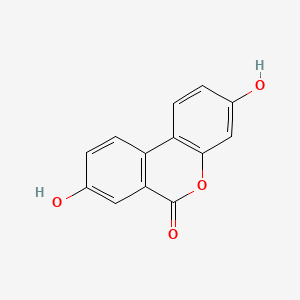
- Formula
- C13H8O4
- Weight
- 228.20 Da
- PubChem CID
- 5488186
- Exact Mass
- 228.0423 Da
- LogP
- 2.3
- TPSA
- 66.8 Ų
- H-Bond Donors
- 2
- H-Bond Acceptors
- 4
- Rotatable Bonds
- 0
- Complexity
- 317
Identifiers (SMILES, InChI)
InChI=1S/C13H8O4/c14-7-1-3-9-10-4-2-8(15)6-12(10)17-13(16)11(9)5-7/h1-6,14-15H
RIUPLDUFZCXCHM-UHFFFAOYSA-NReferences (8)
- [2]Urolithin A improves muscle strength, exercise performance, and biomarkers of mitochondrial health in a randomized trial in middle-aged adults
→ Middle-aged adults supplementing with urolithin A showed improvements in muscle strength, exercise performance, and enhanced mitochondrial function biomarkers compared to placebo.
- [6]Induction of mitochondrial recycling reverts age-associated decline of the hematopoietic and immune systems
→ Urolithin A-induced mitochondrial recycling reversed age-related decline in hematopoietic and immune system function, suggesting anti-aging benefits.
- [3]Assessment of Urolithin A effects on muscle endurance, strength, inflammation, oxidative stress, and protein metabolism in male athletes with resistance training: an 8-week randomized, double-blind, placebo-controlled study
→ In resistance-trained male athletes, 8 weeks of 1g daily urolithin A supplementation improved muscle endurance, reduced inflammation markers, and enhanced protein metabolism status.
- [4]Evaluating the Impact of Urolithin A Supplementation on Running Performance, Recovery, and Mitochondrial Biomarkers in Highly Trained Male Distance Runners
→ This trial in elite male distance runners evaluated urolithin A's effects on running performance, recovery metrics, and mitochondrial health biomarkers during training.
- [5]Urolithin A provides cardioprotection and mitochondrial quality enhancement preclinically and improves human cardiovascular health biomarkers
→ Urolithin A demonstrated cardioprotective effects through mitochondrial quality enhancement in preclinical models and improved cardiovascular health biomarkers in human trials.
- [7]Urolithin A reduces amyloid-beta load and improves cognitive deficits uncorrelated with plaque burden in a mouse model of Alzheimer's disease
→ In Alzheimer's mouse models, urolithin A reduced amyloid-beta plaque burden and improved cognitive deficits including spatial memory and exploratory behavior.
- [8]Urolithin A Exhibits Antidepressant-like Effects by Modulating the AMPK/CREB/BDNF Pathway
→ Urolithin A demonstrated antidepressant-like effects in preclinical models by activating the AMPK/CREB/BDNF pathway, reducing immobility time in behavioral tests.
- [1]Effect of Urolithin A Supplementation on Muscle Endurance and Mitochondrial Health in Older Adults: A Randomized Clinical Trial
→ In older adults (65-90 years), urolithin A supplementation improved muscle endurance and biomarkers of mitochondrial and cellular health in this double-blind, placebo-controlled trial.
Continue researching UROLITHIN A
Keep scientific evidence separate from commercial availability. Review how claims are evaluated, explore question-led research paths, or inspect disclosed source records without changing the editorial conclusions on this page.