Magnesium L-Threonate
Magnesium L-Threonate research profile covering evidence quality, proposed mechanisms, safety considerations, regulatory status, and linked primary sources.
Evidence-led profile
Research snapshot
- Evidence stage
- Emerging research
- References
- 8 linked sources
- Research coverage
- 1 area
- Editorial review
- Mar 8, 2026
Published by the PepGuide Editorial Team using our research methodology.
Overview
Magnesium L-Threonate (MgT), marketed under the brand name Magtein, is a unique magnesium compound developed by researchers at MIT specifically to address the challenge of raising magnesium concentrations in the central nervous system. While most oral magnesium supplements effectively replenish systemic magnesium stores, they have limited ability to increase cerebrospinal fluid magnesium levels due to tight regulation at the blood-brain barrier. L-threonic acid — a metabolite of vitamin C — serves as the chelating agent and appears to facilitate transport of magnesium across the BBB through mechanisms that remain under active investigation.
The foundational research on MgT, published in Neuron (2010) by Bhatt et al., demonstrated that elevating brain magnesium enhanced synaptic density, NMDA receptor signaling, and both short-term and long-term memory in animal models. Subsequent rodent studies showed that MgT could rescue age-related cognitive decline, reduce amyloid-beta plaque deposition in Alzheimer's disease models, and attenuate fear memory in PTSD-like paradigms. A randomized, double-blind, placebo-controlled human trial in older adults with subjective cognitive complaints found that MgT supplementation significantly improved executive function and working memory composite scores. These findings position MgT as a nootropic-grade magnesium form, distinct from Magnesium Glycinate, which is preferred for relaxation and sleep, or Magnesium Taurate, which focuses on cardiovascular health.
The standard dosage of Magnesium L-Threonate provides approximately 144 mg of elemental magnesium per day (typically as 2,000 mg of the compound), which is lower than the elemental magnesium content in many other forms. For this reason, individuals addressing systemic magnesium deficiency may need to combine MgT with another well-absorbed form such as Magnesium Glycinate or Magnesium Orotate. MgT is commonly stacked with other cognitive-support compounds including lion's mane and memantine in neuroplasticity-focused protocols. Side effects are generally mild and may include drowsiness and headache; the compound is well-tolerated in clinical studies.
Mechanism of Action
Magnesium L-threonate (MgT) exerts its effects primarily through its unique ability to cross the blood-brain barrier and elevate brain magnesium concentrations more effectively than other magnesium salts. The L-threonate moiety, a metabolite of vitamin C, acts as a carrier that facilitates magnesium transport across the blood-brain barrier via specific transporter systems. Once in the brain, elevated Mg2+ concentrations enhance synaptic density and neuroplasticity by increasing the expression of NR2B-containing NMDA receptors at hippocampal synapses, which are critical for learning and memory processes.
At the molecular level, increased intracellular magnesium activates downstream signaling cascades including the CREB (cAMP response element-binding protein) pathway and BDNF (brain-derived neurotrophic factor) expression, both essential for long-term potentiation and synaptic strengthening. Magnesium also serves as a physiological voltage-dependent blocker of NMDA receptor channels, preventing excessive calcium influx and excitotoxicity while allowing normal synaptic signaling. This dual action—enhancing beneficial NMDA receptor signaling while blocking pathological overactivation—underlies its neuroprotective properties.
Therapeutically, these mechanisms support cognitive enhancement, particularly in age-related memory decline, and may offer protective effects against neurodegenerative conditions. MgT has demonstrated improvements in short-term and long-term memory, spatial learning, and working memory in preclinical models, with clinical trials showing benefits in cognitive function scores in healthy adults and those with mild cognitive impairment.
Research
Reported Effects
Response Variability:: Effectiveness appears highly individual - works dramatically for some users within days, while others notice minimal to no benefits even after weeks of use. Rapid Onset:: Unlike some supplements requiring weeks to notice effects, many users report noticeable cognitive improvements within 1-7 days of starting. Withdrawal Effects:: Some users report significant cognitive decline when stopping, with brain fog and reduced mental clarity returning within a week, suggesting genuine neurological impact. Comparison to Other Forms:: Users who tried multiple magnesium types often report L-threonate provides unique cognitive benefits not achieved with glycinate, citrate, or oxide forms
- Effectiveness appears highly individual - works dramatically for some users within days, while others notice minimal to no benefits even after weeks of use
- Unlike some supplements requiring weeks to notice effects, many users report noticeable cognitive improvements within 1-7 days of starting
- Some users report significant cognitive decline when stopping, with brain fog and reduced mental clarity returning within a week, suggesting genuine neurological impact
- Users who tried multiple magnesium types often report L-threonate provides unique cognitive benefits not achieved with glycinate, citrate, or oxide forms
Safety and Limitations
Magnesium L-threonate is generally well-tolerated with minimal laxative effects compared to other magnesium forms. Some users may experience anxiety, restlessness, or insomnia, particularly if taken in the evening. Individuals sensitive to glutamatergic effects may have paradoxical reactions, and less common side effects include headaches and digestive issues.
Common Side Effects
- Anxiety Paradox:: Significant minority report increased anxiety, restlessness, or worsening of existing anxiety symptoms, particularly those sensitive to glycine or glutamatergic effects
- Digestive Tolerance:: Generally well-tolerated digestively compared to citrate or oxide forms, with minimal laxative effects reported even at higher doses
- Insomnia Risk:: Some users find it too mentally stimulating if taken in evening, causing difficulty falling asleep or overly active nighttime cognition
- Headaches & Physical Symptoms:: Occasional reports of headaches, dehydration, or neck/back pain, though less common than cognitive side effects
Research protocol summary
- Typical Dose
- Most users take 144-200mg elemental magnesium from L-threonate (typically 2000mg total compound), often split between morning and evening doses
These values summarize cataloged research protocols. They are not personal dosing instructions or medical guidance.
Reconstitution Calculator
Pharmacokinetic Profile
Molecular Structure
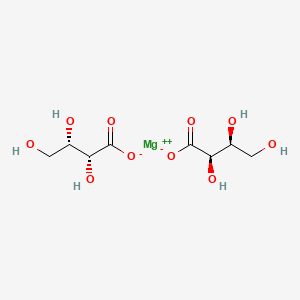
- Formula
- C8H14MgO10
- Weight
- 294.50 Da
- PubChem CID
- 45489777
- Exact Mass
- 294.0437 Da
- TPSA
- 202 Ų
- H-Bond Donors
- 6
- H-Bond Acceptors
- 10
- Rotatable Bonds
- 4
- Complexity
- 95
Identifiers (SMILES, InChI)
InChI=1S/2C4H8O5.Mg/c2*5-1-2(6)3(7)4(8)9;/h2*2-3,5-7H,1H2,(H,8,9);/q;;+2/p-2/t2*2-,3+;/m00./s1
YVJOHOWNFPQSPP-BALCVSAKSA-LReferences (8)
- [6]Elevation of Brain Magnesium Potentiates Neural Stem Cell Proliferation in the Hippocampus of Young and Aged Mice
→ Study found both short- and long-term MgT supplementation increased hippocampal neural stem cell proliferation in young mice and prevented age-associated decline in older mice, suggesting neuroprotective and neurogenic effects.
- [1]A Magtein®, Magnesium L-Threonate, -Based Formula Improves Brain Cognitive Functions in Healthy Chinese Adults
→ Double-blind, placebo-controlled study of 109 adults aged 18-65 found that a magnesium L-threonate-based formulation significantly improved cognitive functions as measured by standardized clinical memory tests commonly used in Chinese hospitals.
- [2]L-Threonic Acid Magnesium Salt Supplementation in ADHD: An Open-Label Pilot Study
→ Open-label pilot study with 15 adults found 47% met response criteria with significant improvements in ADHD symptoms, cognitive flexibility, and IQ performance measures over 12 weeks of supplementation.
- [3]Magnesium-L-threonate alleviate colonic inflammation and memory impairment in chronic-plus-binge alcohol feeding mice
→ Animal study demonstrated that MgT supplementation reduced inflammatory cytokine expression and alleviated memory impairments in alcohol-exposed mice, suggesting protective effects against alcohol-mediated cognitive decline.
- [4]Magnesium supplement enhances spatial-context pattern separation and prevents fear overgeneralization
→ Rat study showed MgT treatment enhanced ability to discriminate between similar contexts and improved pattern separation without enhancing fear memory itself, suggesting cognitive benefits beyond basic memory consolidation.
- [5]Targeting the NMDA receptor subunit NR2B for treating or preventing age-related memory decline
→ Review highlighting that magnesium L-threonate can boost brain NR2B receptor expression, potentially reversing age-related memory deficits through enhanced synaptic plasticity mechanisms.
- [8]Magnesium-L-threonate treats Alzheimer's disease by modulating the microbiota-gut-brain axis
→ Research demonstrated MgT has protective effects on learning and memory in Alzheimer's models, potentially working through modulation of the gut microbiome and gut-brain axis inflammation pathways.
- [7]Magnesium-L-threonate improves sleep quality and daytime functioning in adults with self-reported sleep problems: A randomized controlled trial
→ Randomized controlled trial of 80 adults found 1g/day of MgT for 21 days significantly improved sleep quality metrics and daytime functioning compared to placebo in participants with self-reported sleep problems.
Continue researching Magnesium L-Threonate
Keep scientific evidence separate from commercial availability. Review how claims are evaluated, explore question-led research paths, or inspect disclosed source records without changing the editorial conclusions on this page.