Kaempferol
A naturally occurring flavonol found in many fruits and vegetables with broad anti-inflammatory, antioxidant, anti-cancer, and cardioprotective properties mediated through multiple signaling pathways.
Evidence-led profile
Research snapshot
- Evidence stage
- Emerging research
- References
- 8 linked sources
- Research coverage
- 1 area
- Editorial review
- Mar 8, 2026
Published by the PepGuide Editorial Team using our research methodology.
Overview
Kaempferol (3,4',5,7-tetrahydroxyflavone) is a natural flavonol — a subclass of flavonoids — widely distributed in edible plants including kale, spinach, broccoli, tea, strawberries, grapes, ginkgo biloba, and propolis. It is one of the most common dietary flavonoids, with estimated daily intake ranging from 5–30 mg depending on diet composition. Kaempferol's chemical structure features four hydroxyl groups and a C2-C3 double bond characteristic of flavonols, conferring potent antioxidant activity through hydrogen atom donation, metal chelation, and enzyme modulation. Its bioavailability, while limited by extensive Phase II metabolism (glucuronidation and sulfation), is enhanced by co-administration with piperine or quercetin, which competitively inhibit conjugation enzymes.
The anti-cancer properties of kaempferol have been extensively investigated across dozens of cancer cell lines and preclinical models. It induces apoptosis through both intrinsic (mitochondrial) and extrinsic (death receptor) pathways, arrests cell cycle progression at G2/M phase via CDK1 inhibition, suppresses angiogenesis through VEGF downregulation, and inhibits metastasis by blocking epithelial-mesenchymal transition (EMT) and matrix metalloproteinase (MMP) activity. Kaempferol also sensitizes cancer cells to conventional chemotherapeutic agents and radiation. Epidemiological studies, including large prospective cohorts, have associated higher kaempferol intake with reduced risks of ovarian, pancreatic, lung, and gastric cancers. Its mechanisms overlap with and complement those of related flavonoids quercetin, fisetin, and luteolin.
The cardioprotective and anti-inflammatory effects of kaempferol are mediated through suppression of NF-κB and MAPK signaling cascades, inhibition of COX-2 and iNOS expression, and reduction of pro-inflammatory cytokines. It improves endothelial function by stimulating nitric oxide production via eNOS phosphorylation and protects LDL from oxidation. Kaempferol also exhibits neuroprotective properties, inhibiting monoamine oxidase (MAO) activity, reducing neuroinflammation, and protecting neurons from amyloid-beta and oxidative damage in Alzheimer's disease models. Additionally, it has demonstrated anti-diabetic effects through AMPK activation and GLUT4 translocation enhancement. Typical supplemental doses range from 50–200 mg/day as standardized plant extracts, and it pairs naturally with other polyphenols such as resveratrol and apigenin in comprehensive antioxidant and longevity protocols.
Research
Reported Effects
Aging-Related Processes:: Shows hormetic effects that enhance biological performance, particularly effective for longevity and healthy aging applications. Disease Prevention:: Epidemiological evidence links kaempferol-rich food consumption with reduced risk of cancer, cardiovascular disease, and neurodegenerative disorders. Multi-Target Activity:: Works through multiple mechanisms including antioxidant enzyme preservation, free radical scavenging, and anti-inflammatory pathway modulation. Synergistic Potential:: Demonstrates enhanced effects when combined with other flavonoids like chrysin, suggesting benefit from whole food sources or multi-compound formulations
Safety and Limitations
Safety Profile: Kaempferol
Common Side Effects
- Generally well-tolerated at dietary intake levels (10–50 mg/day from food sources)
- Gastrointestinal discomfort: mild nausea, bloating, or stomach upset at higher supplemental doses
- Headache reported infrequently in supplement users
- Mild dizziness at high oral doses
Serious Adverse Effects
- Cytochrome P450 inhibition: kaempferol inhibits CYP1A2, CYP2C9, and CYP3A4 enzymes, which may lead to elevated plasma levels of co-administered drugs metabolized by these pathways
- Antiplatelet activity: may increase bleeding risk, particularly at high doses or in combination with anticoagulants
- Theoretical concern for estrogenic activity at high concentrations; relevance to estrogen-sensitive cancers is debated but warrants caution
- Rare reports of hepatic enzyme elevation at very high supplemental doses in preclinical models
Contraindications
- Known hypersensitivity to kaempferol or kaempferol-rich botanical extracts
- Active bleeding disorders or upcoming surgery (discontinue 2 weeks prior)
- Hormone-sensitive conditions (breast, ovarian, uterine cancer; endometriosis) — use only under medical supervision due to phytoestrogenic potential
- Severe hepatic impairment (limited safety data)
Drug Interactions
- Anticoagulants/antiplatelets (warfarin, aspirin, clopidogrel): additive bleeding risk via platelet aggregation inhibition
- CYP1A2 substrates (theophylline, clozapine, caffeine): kaempferol may increase serum concentrations
- CYP2C9 substrates (warfarin, phenytoin, losartan): potential for increased drug exposure
- CYP3A4 substrates (statins, cyclosporine, calcium channel blockers): may elevate plasma levels
- Tamoxifen and aromatase inhibitors: theoretical interference with anti-estrogen therapy
- Iron supplements: may affect iron absorption due to chelation properties
Population-Specific Considerations
- Pregnancy/Lactation: insufficient human safety data; dietary amounts likely safe but supplemental doses not recommended
- Children: no established pediatric dosing; avoid concentrated supplements
- Elderly: increased sensitivity to drug interactions due to polypharmacy; start with low doses
- Renal impairment: limited data; use caution with high-dose supplementation
Common Side Effects
- Anxiogenic Effects:: Some users report feeling stressed when taking kaempferol-rich supplements like apigenin, suggesting individual sensitivity variations
- Limited Direct Reports:: Most research focuses on benefits with minimal adverse effects noted in preclinical studies
- Interaction Potential:: As a multi-target compound affecting various cellular pathways, potential for interactions with other supplements and medications exists
- Dose-Dependent Response:: Safety profile appears favorable at dietary levels, though concentrated supplement forms may require careful dosing
Mechanism of Action
Kaempferol is a naturally occurring flavonol that exerts its therapeutic effects through interactions with multiple molecular targets and signaling pathways. As a potent antioxidant, kaempferol directly scavenges reactive oxygen species (ROS) including superoxide anion, hydroxyl radical, and peroxynitrite through electron donation from its hydroxyl groups at positions 3, 5, 7, and 4-prime on the flavone backbone. Beyond direct scavenging, kaempferol activates the Nrf2/ARE (nuclear factor erythroid 2-related factor 2/antioxidant response element) signaling pathway by promoting Keap1 dissociation and Nrf2 nuclear translocation, leading to upregulation of endogenous antioxidant enzymes including superoxide dismutase (SOD), catalase, glutathione peroxidase (GPx), and heme oxygenase-1 (HO-1).
Kaempferol's anti-inflammatory mechanism centers on suppression of the NF-kB signaling cascade. It inhibits IKK-beta kinase activity, preventing IkB-alpha phosphorylation and degradation, thereby blocking NF-kB nuclear translocation and subsequent transcription of pro-inflammatory mediators including COX-2, iNOS, TNF-alpha, IL-1beta, and IL-6. Kaempferol also inhibits the MAPK signaling pathways (ERK, JNK, and p38) upstream of inflammatory gene expression. In the context of cancer, kaempferol modulates multiple proliferative and survival pathways: it inhibits PI3K/Akt/mTOR signaling, suppresses STAT3 phosphorylation and dimerization, induces cell cycle arrest through upregulation of p21 and p27 cyclin-dependent kinase inhibitors, and promotes apoptosis via both intrinsic (mitochondrial cytochrome c release, caspase-9/3 activation) and extrinsic (death receptor-mediated) pathways.
Additionally, kaempferol acts as a selective estrogen receptor modulator (SERM) with weak estrogenic activity, binding to both ER-alpha and ER-beta receptors. It inhibits aromatase (CYP19) activity, potentially reducing estrogen-dependent proliferation. Kaempferol modulates cellular autophagy through AMPK activation and mTOR inhibition, promoting autophagic flux which contributes to both its anti-cancer and neuroprotective effects. In cardiovascular contexts, kaempferol enhances endothelial nitric oxide synthase (eNOS) activity and NO bioavailability while inhibiting NADPH oxidase-mediated vascular oxidative stress. It also inhibits xanthine oxidase and lipoxygenase enzymes, further reducing oxidative and inflammatory burden. These multi-target mechanisms underlie kaempferol's broad therapeutic potential spanning antioxidant, anti-inflammatory, anti-cancer, cardiovascular protective, and neuroprotective activities.
Research protocol summary
- Typical Dose
- Available in standardized Ginkgo extracts, though optimal kaempferol content varies between brands (quality brands vs reputable suppliers discussions)
These values summarize cataloged research protocols. They are not personal dosing instructions or medical guidance.
Molecular Structure
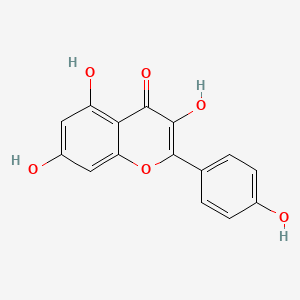
- Formula
- C15H10O6
- Weight
- 286.24 Da
- PubChem CID
- 5280863
- Exact Mass
- 286.0477 Da
- LogP
- 1.9
- TPSA
- 107 Ų
- H-Bond Donors
- 4
- H-Bond Acceptors
- 6
- Rotatable Bonds
- 1
- Complexity
- 451
Identifiers (SMILES, InChI)
InChI=1S/C15H10O6/c16-8-3-1-7(2-4-8)15-14(20)13(19)12-10(18)5-9(17)6-11(12)21-15/h1-6,16-18,20H
IYRMWMYZSQPJKC-UHFFFAOYSA-NReferences (8)
- [4]Kaempferol as a Dietary Anti-Inflammatory Agent: Current Therapeutic Standing
→ Comprehensive review establishing kaempferol as an effective anti-inflammatory agent found in fruits, vegetables, and herbal medicines with high efficacy in both in vivo and in vitro studies.
- [1]Kaempferol, a widely ingested dietary flavonoid and supplement, enhances biological performance via hormesis, especially for ageing-related processes
→ Kaempferol demonstrates hormetic properties that enhance biological performance, particularly for aging-related processes, supporting its use as a dietary supplement for longevity and healthy aging.
- [2]Neurodegenerative Diseases and Flavonoids: Special Reference to Kaempferol
→ Kaempferol shows neuroprotective effects in models of Alzheimer's, Parkinson's, and Huntington's disease by scavenging free radicals, preserving antioxidant enzymes, and crossing the blood-brain barrier for enhanced protection.
- [3]Kaempferol reduces obesity, prevents intestinal inflammation, and modulates gut microbiota in high-fat diet mice
→ In high-fat diet mice, kaempferol reduced obesity, prevented intestinal inflammation, and positively modulated gut microbiota composition, suggesting metabolic health benefits.
- [5]A review on the dietary flavonoid kaempferol
→ Epidemiological studies show consumption of kaempferol-rich foods associates with reduced risk of cancer and cardiovascular disease, with demonstrated antioxidant, anti-inflammatory, antimicrobial, anticancer, cardioprotective, neuroprotective, and antidiabetic activities.
- [6]Kaempferol and Chrysin Synergies to Improve Septic Mice Survival
→ Combination of kaempferol and chrysin showed synergistic effects in improving survival in septic mice by inhibiting proinflammatory mediators including TNF-α, PGE₂, and nitric oxide.
- [7]Chemo-preventive and therapeutic effect of the dietary flavonoid kaempferol: A comprehensive review
→ Comprehensive review of kaempferol's chemo-preventive and therapeutic effects across multiple disease states, highlighting its multi-target potential as a dietary supplement.
- [8]Kaempferol, Myricetin and Fisetin in Prostate and Bladder Cancer: A Systematic Review of the Literature
→ Systematic review examining kaempferol's role in prostate and bladder cancer prevention and treatment, supporting dietary flavonoid intake for cancer risk reduction.
Continue researching Kaempferol
Keep scientific evidence separate from commercial availability. Review how claims are evaluated, explore question-led research paths, or inspect disclosed source records without changing the editorial conclusions on this page.