Modafinil
Modafinil research profile covering evidence quality, proposed mechanisms, safety considerations, regulatory status, and linked primary sources.
Evidence-led profile
Research snapshot
- Evidence stage
- Emerging research
- References
- 15 linked sources
- Research coverage
- 4 areas
- Editorial review
- Jul 7, 2026
Published by the PepGuide Editorial Team using our research methodology.
Overview
Modafinil is a diphenylmethyl sulfinylacetamide compound originally developed by Laboratoire Lafon in France and approved by the FDA in 1998 (marketed as Provigil) for excessive daytime sleepiness associated with narcolepsy, shift work sleep disorder, and obstructive sleep apnea. Unlike traditional psychostimulants such as amphetamines, modafinil promotes wakefulness through a distinct pharmacological profile that does not rely heavily on catecholamine release, resulting in lower abuse potential, less peripheral sympathetic activation, and minimal rebound hypersomnia. Its primary mechanism involves inhibition of the dopamine transporter (DAT), increasing extracellular dopamine concentrations in the prefrontal cortex and nucleus accumbens, though with lower efficacy and different binding kinetics than cocaine or methylphenidate. Additional mechanisms include enhancement of noradrenergic, histaminergic, and orexinergic neurotransmission, and modulation of GABAergic tone.
Modafinil has become one of the most widely used cognitive enhancers globally, with off-label use among students, professionals, and military personnel seeking improved focus, executive function, and sustained attention. Meta-analyses of cognitive studies in healthy, non-sleep-deprived individuals report modest but consistent improvements in attention, executive function, and learning — particularly on complex tasks requiring sustained cognitive effort — with less consistent effects on simple reaction time or working memory. The cognitive benefits appear most pronounced in individuals who are sleep-deprived or have lower baseline cognitive performance. Armodafinil (Nuvigil), the R-enantiomer of modafinil, has a longer half-life and is sometimes preferred for extended wakefulness, though clinical differences between the two are modest.
The standard dose of modafinil is 100–200 mg taken in the morning, with a plasma half-life of 12–15 hours. Side effects are generally mild and include headache, nausea, anxiety, and insomnia (particularly if dosed too late in the day). Rare but serious adverse effects include Stevens-Johnson syndrome and psychiatric symptoms. Modafinil is a mild inducer of CYP3A4, which can reduce the efficacy of hormonal contraceptives and other CYP3A4 substrates. In nootropic stacking contexts, modafinil is often combined with L-theanine to mitigate anxiety, alpha-GPC for cholinergic support, and Magnesium L-Threonate for neuroprotection. It is classified as a Schedule IV controlled substance in the United States due to its mild dopaminergic reinforcing properties, though dependence is rare in clinical practice.
Mechanism of Action
Dopamine Transporter (DAT) Inhibition
The primary pharmacological target of modafinil is the dopamine transporter (DAT). Modafinil binds DAT at a site overlapping but not identical to cocaine's binding site, functioning as an atypical dopamine reuptake inhibitor. DAT knockout mice show no wake-promoting response to modafinil, confirming DAT as the essential molecular target (PMID: 18784649). This increases extracellular dopamine primarily in the prefrontal cortex, nucleus accumbens, and caudate/putamen, enhancing executive function, motivation, and sustained attention.
Noradrenergic Enhancement
Modafinil elevates norepinephrine (NE) concentrations in the prefrontal cortex, dorsal raphe, and locus coeruleus projection areas. This occurs partly through DAT-mediated NE reuptake inhibition (DAT transports NE in cortical regions where NET expression is low) and possibly through direct NET interactions. Alpha-1 adrenergic receptor activation contributes significantly to wakefulness, as alpha-1 antagonists partially attenuate modafinil's arousal effects (PMID: 10379421).
Orexin/Hypocretin Pathway
Modafinil activates orexin-producing neurons in the lateral hypothalamus, increasing c-Fos expression in these cells. Orexin neurons project broadly to wake-promoting centers including the locus coeruleus (NE), dorsal raphe (serotonin), TMN (histamine), and basal forebrain (acetylcholine). This engagement of the orexin system explains modafinil's particular efficacy in narcolepsy, where orexin signaling is deficient, though modafinil retains partial efficacy in orexin-knockout models.
Histaminergic and GABAergic Modulation
Modafinil increases histamine release from the tuberomammillary nucleus, a key arousal center. It also reduces GABA levels in cortical and subcortical regions including the VLPO and median preoptic nucleus (sleep-promoting nuclei), disinhibiting downstream wake-active circuits. The GABA reduction appears secondary to catecholaminergic activation rather than direct GABAergic receptor interaction.
Glutamatergic Effects
Modafinil enhances glutamate release in the hippocampus, thalamus, and cortex, likely secondary to reduced GABAergic inhibition. This glutamatergic enhancement may contribute to cognitive benefits observed in tasks requiring working memory and executive function. The net effect is a shift in the excitatory/inhibitory balance toward arousal without the peripheral sympathetic activation or abuse potential characteristic of amphetamines.
Research
Reported Effects
Highly Effective for Sleep Disorders:: Proven efficacy for narcolepsy and shift work disorder.. Cognitive Enhancement:: Mixed evidence for healthy individuals, but many users report subjective benefits.. Tolerance Development:: Some users report diminished effects over time with daily use.
- Proven efficacy for narcolepsy and shift work disorder.
- Mixed evidence for healthy individuals, but many users report subjective benefits.
- Some users report diminished effects over time with daily use.
Cognitive enhancement
Modafinil has been studied as a cognitive enhancer in healthy, rested, and sleep-deprived adults. Effects are domain-specific and generally modest, most consistently seen in executive function, attention, and working memory. Mechanistically its procognitive effects are linked to prefrontal noradrenaline, dopamine, and glutamatergic modulation.
- Most consistent benefits in attention, executive function and working memory
- Effect sizes are modest and vary by task complexity
- Procognitive action tied to prefrontal catecholamine and glutamate signaling
Wake-promotion and sleep disorders
Modafinil is a non-amphetamine wake-promoting agent with well-established efficacy across the three approved sleep-disorder indications: narcolepsy, shift-work disorder, and residual sleepiness in CPAP-treated obstructive sleep apnea. A 2025/2026 updated meta-analysis reconfirmed improvements in Maintenance of Wakefulness Test and Epworth Sleepiness Scale scores in narcolepsy.
- Improves both objective (MWT/MSLT) and subjective (ESS) sleepiness measures
- 200 mg is effective with a better tolerability profile than 400 mg
- Does not impair nighttime sleep or CPAP adherence in OSA
Mood and cognition in depression
As an adjunct in depression, modafinil augmentation has been associated with greater symptom reduction and improvement of residual fatigue and sleepiness in meta-analyses. A randomized trial in remitted depression showed a single dose improved episodic and working memory, supporting exploration of pro-cognitive uses; 2024-2025 case reports describe benefit in treatment-resistant bipolar depression.
- Adjunctive modafinil linked to greater depressive symptom reduction, evident early
- Improves episodic and working memory in remitted depression
- Main safety signal is increased insomnia risk
Safety and Limitations
Common side effects include headache, anxiety, nervousness, and insomnia. It is contraindicated for individuals with a history of certain heart or cardiovascular conditions. Users should be aware of the potential for serious skin reactions and psychiatric symptoms like anxiety, mania, or hallucinations.
Common Side Effects
- Headache:: Most common side effect, often mitigated by staying well-hydrated.
- Appetite Suppression:: Many users experience reduced hunger.
- Insomnia:: Can occur if taken too late in the day.
- Rare but Serious:: Stevens-Johnson syndrome has been reported in rare cases.
Research protocol summary
- Typical Dose
- 100-200mg once daily, typically in the morning.
These values summarize cataloged research protocols. They are not personal dosing instructions or medical guidance.
Reconstitution Calculator
Pharmacokinetic Profile
Modafinil — Pharmacokinetic Curve
SubcutaneousMolecular Structure
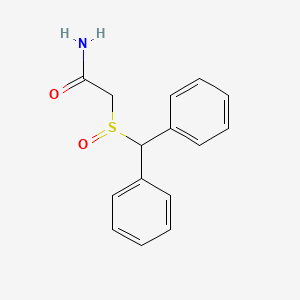
- Formula
- C15H15NO2S
- Weight
- 273.4 Da
- PubChem CID
- 4236
- Exact Mass
- 273.0823 Da
- LogP
- 1.7
- TPSA
- 79.4 Ų
- H-Bond Donors
- 1
- H-Bond Acceptors
- 3
- Rotatable Bonds
- 5
- Complexity
- 302
Identifiers (SMILES, InChI)
InChI=1S/C15H15NO2S/c16-14(17)11-19(18)15(12-7-3-1-4-8-12)13-9-5-2-6-10-13/h1-10,15H,11H2,(H2,16,17)
YFGHCGITMMYXAQ-UHFFFAOYSA-NResearch Indications
Approved Indications
First-line wake-promoting agent for EDS in narcolepsy, supported by pivotal multicenter RCTs.
200 mg before each night shift improves wakefulness and functioning.
Adjunct for residual EDS in patients adherent to CPAP therapy.
Off-label / Investigational Uses
Modest, domain-specific improvements in attention and working memory in healthy and sleep-deprived adults; evidence is mixed.
Augmentation therapy that may reduce residual fatigue, sleepiness and cognitive deficits.
Explored for attention deficits and fatigue in conditions such as MS and cancer.
References (15)
- [2]Caffeine and modafinil modulate the effects of sleep deprivation on thalamic resting-state functional connectivity
→ Both substances affected functional brain connectivity after 36 hours of sleep deprivation, providing insights into neural mechanisms and potential strategies for mitigating cognitive impairment.
- [6]Effects of modafinil on epileptiform activity in absence epilepsy
→ Modafinil significantly reduced both number and duration of epileptic seizures in absence epilepsy models, suggesting potential as a preventive treatment.
- [1]Modafinil Treatment of Cocaine Dependence: A Systematic Review and Meta-Analysis
→ Analysis of 11 trials assessing modafinil's effectiveness for treating cocaine dependency, concluding it is not generally superior to placebo, though US subgroup analysis showed some promise for abstinence.
- [3]Modafinil Therapy and Mental Status Following Aneurysmal Subarachnoid Hemorrhage
→ Modafinil improved alertness and orientation shortly after administration in aSAH patients, suggesting beneficial effects for early mental recovery in acute care settings.
- [4]Effects of modafinil on nocturnal sleep patterns in patients with narcolepsy
→ Modafinil improved daytime sleepiness without significantly worsening nighttime sleep, reducing awakenings in females and increasing sleep onset latency in children/adolescents.
- [5]Chronic administration of caffeine, modafinil, AVL-3288 and CX516 induces time-dependent complex effects on cognition and mood
→ In sleep-deprived mice, caffeine reduced anxiety and enhanced memory over time; AVL-3288 and CX516 improved cognition without depression-like effects, unlike other substances tested.
- [7]Comparison of Solriamfetol and Modafinil on Arousal and Anxiety-Related Behaviors in Narcoleptic Mice
→ Both drugs promoted wakefulness effectively; solriamfetol did so without significant anxiety or locomotor increases, while modafinil induced anxiety-related behaviors.
- [8]Atomoxetine promotes incentive value of modafinil and sensitizes exploratory behavior
→ Combined modafinil and atomoxetine showed noradrenergic system increases addictive potential and exploratory behavior in rats.
- [9]Modafinil exerts anticonvulsive effects against lithium-pilocarpine-induced status epilepticus in rats
→ Modafinil decreased seizure severity and brain inflammation in status epilepticus, potentially through TNF-α and nitric oxide pathway mechanisms.
- [10]Modafinil ameliorates the decline in pronunciation-related working memory caused by sleep deprivation
→ Modafinil significantly improved task accuracy and response times compared to placebo in sleep-deprived men, counteracting cognitive decline from acute sleep deprivation.
- [11]US Modafinil in Narcolepsy Multicenter Study Group Randomized trial of modafinil as a treatment for the excessive daytime somnolence of narcolepsy: US Modafinil in Narcolepsy Multicenter Study Group Neurology (2000)
→ In 271 patients, modafinil 200 and 400 mg significantly improved objective (MSLT/MWT) and subjective (ESS) sleepiness versus placebo over 9 weeks.
- [12]Broughton RJ, Fleming JA, George CF, et al. Randomized, double-blind, placebo-controlled crossover trial of modafinil in the treatment of excessive daytime sleepiness in narcolepsy Neurology (1997)
→ In 75 narcolepsy patients, modafinil 200 and 400 mg increased Maintenance of Wakefulness Test sleep latency by 40% and 54% versus placebo.
- [13]Czeisler CA, Walsh JK, Roth T, et al. Modafinil for excessive sleepiness associated with shift-work sleep disorder New England Journal of Medicine (2005)
→ In 209 patients, 200 mg modafinil before each night shift improved symptoms in 74% vs 36% on placebo over 3 months.
- [14]Hirshkowitz M, Black JE, Wesnes K, et al. Modafinil for treatment of residual excessive sleepiness in nasal continuous positive airway pressure-treated obstructive sleep apnea/hypopnea syndrome Chest (2007)
→ 12-week RCT showed modafinil improved residual sleepiness in CPAP-treated OSA without adversely affecting nighttime sleep or CPAP use.
- [15]Kaser M, Deakin JB, Michael A, et al. Modafinil improves episodic memory and working memory cognition in patients with remitted depression: a double-blind, randomized, placebo-controlled study Biological Psychiatry: Cognitive Neuroscience and Neuroimaging (2017)
→ A single 200 mg dose improved episodic (p=0.01) and working (p=0.04) memory in 60 patients with remitted depression.
Continue researching Modafinil
Keep scientific evidence separate from commercial availability. Review how claims are evaluated, explore question-led research paths, or inspect disclosed source records without changing the editorial conclusions on this page.