Sulbutiamine
Sulbutiamine research profile covering evidence quality, proposed mechanisms, safety considerations, regulatory status, and linked primary sources.
Evidence-led profile
Research snapshot
- Evidence stage
- Emerging research
- References
- 6 linked sources
- Research coverage
- 1 area
- Editorial review
- Mar 8, 2026
Published by the PepGuide Editorial Team using our research methodology.
Overview
Sulbutiamine is a synthetic compound consisting of two modified thiamine (vitamin B1) molecules linked by a disulfide bridge, developed in Japan in the 1960s to address the challenge of thiamine's poor penetration across the blood-brain barrier (BBB). While thiamine is essential for cerebral energy metabolism — serving as the cofactor for pyruvate dehydrogenase, alpha-ketoglutarate dehydrogenase, and transketolase — its charged, hydrophilic structure limits brain uptake through conventional supplementation. Sulbutiamine's lipophilic disulfide structure enables dramatically improved BBB penetration and more efficient elevation of brain thiamine and thiamine triphosphate (ThTP) levels compared to equimolar doses of thiamine, benfotiamine, or other B1 analogs.
In the brain, elevated thiamine and ThTP levels from sulbutiamine supplementation enhance multiple aspects of neuronal function. Sulbutiamine has been shown to upregulate D1 dopamine receptor density in the prefrontal cortex, potentiate glutamatergic and cholinergic transmission, and increase the expression of the vesicular glutamate transporter (VGLUT1) in hippocampal neurons. These effects translate to improved memory formation, enhanced attention, reduced mental fatigue, and mild mood elevation in both animal models and clinical studies. Sulbutiamine is marketed as Arcalion in France and several other countries, where it is prescribed for asthenia (psychogenic fatigue) — a condition characterized by physical and mental exhaustion not attributable to organic disease. Clinical trials have demonstrated reduction in fatigue severity and improvement in subjective well-being in asthenic patients.
Beyond fatigue, sulbutiamine has been investigated for cognitive enhancement in Alzheimer's disease (where cerebral thiamine deficiency is well documented), as an adjunct in early-stage diabetic peripheral neuropathy, and for psychogenic erectile dysfunction — with a small trial showing improved erectile function, possibly through dopaminergic and motivational pathway enhancement. Typical dosing ranges from 400-600 mg/day, usually divided into two doses taken with meals. Unlike thiamine, tolerance to sulbutiamine's stimulating and mood-enhancing effects can develop with chronic daily use, leading many users to cycle it. Sulbutiamine pairs well with CDP-choline or alpha-GPC for cholinergic synergy, and with other nootropics targeting attention and motivation such as phenylpiracetam and noopept.
Mechanism of Action
Sulbutiamine (isobutyrylthiamine disulfide) is a synthetic molecule consisting of two thiamine (vitamin B1) molecules linked by a disulfide bond with isobutyryl ester groups. This lipophilic structure enables sulbutiamine to cross the blood-brain barrier far more efficiently than thiamine itself. Once in the brain, it is metabolized to thiamine and then phosphorylated to thiamine pyrophosphate (TPP), the active coenzyme form. TPP serves as an essential cofactor for pyruvate dehydrogenase, alpha-ketoglutarate dehydrogenase, and transketolase, all critical enzymes in aerobic glucose metabolism and the pentose phosphate pathway.
Beyond its role as a thiamine prodrug, sulbutiamine exerts distinct neuromodulatory effects. It upregulates dopamine D1 receptor density in the prefrontal cortex, likely through a compensatory mechanism in response to transiently reduced dopaminergic transmission. This D1 receptor upregulation is thought to underlie its effects on motivation, attention, and psycho-behavioral inhibition. Sulbutiamine also potentiates cholinergic and glutamatergic neurotransmission in the hippocampus, contributing to memory-enhancing properties observed in animal studies.
Originally developed in Japan to treat asthenia (chronic fatigue), sulbutiamine's mechanism distinctly differs from simple thiamine supplementation. The improved brain bioavailability results in significantly greater elevation of brain TPP compared to equivalent doses of thiamine. Sulbutiamine has also shown effects on the reticular activating system, potentially explaining its anti-fatigue and wakefulness-promoting properties. Unlike many stimulants, it does not appear to produce tolerance or dependence with standard dosing.
Research
Reported Effects
Fast Acting:: Effects often noticed same day.. Tolerance Issues:: Can lose effectiveness with daily use.. Cycling Recommended:: Best used intermittently.
- Effects often noticed same day.
- Can lose effectiveness with daily use.
- Best used intermittently.
Safety and Limitations
Safety Profile: Sulbutiamine
Common Side Effects
- Mild agitation, irritability, and restlessness
- Insomnia, especially with afternoon or evening dosing
- Headache and nausea
- Skin rash or mild allergic reactions
- Tremor at higher doses
- Mood elevation that some users find excessive
Serious Adverse Effects
- Dependence potential: Some evidence of psychological dependence with chronic use; withdrawal symptoms (fatigue, depression, irritability) reported anecdotally
- Bipolar disorder exacerbation: may trigger manic or hypomanic episodes
- Rare hepatotoxicity with prolonged high-dose use
- Rare cases of severe allergic reactions (angioedema)
Contraindications
- Bipolar disorder (risk of mania induction)
- Known hypersensitivity to sulbutiamine or thiamine derivatives
- Active liver disease
- History of substance abuse (potential for psychological dependence)
- Pregnancy and lactation (no safety data)
Drug Interactions
- Stimulants (caffeine, amphetamines, modafinil): Additive CNS stimulation; increased risk of anxiety and insomnia
- Antidepressants (SSRIs, SNRIs): May enhance mood-altering effects; monitor for activation syndrome
- Antipsychotics: May reduce the sedative effects of antipsychotics
- Carbidopa-levodopa: Theoretical interaction via dopaminergic potentiation
Population-Specific Considerations
- Asthenia/chronic fatigue: Primary approved indication in France (Arcalion); typically 400–600 mg/day for 4-week courses
- Cognitive enhancement: Used off-label as a nootropic; crosses blood-brain barrier more efficiently than thiamine
- Cycling recommended: Due to tolerance and dependence concerns, many practitioners recommend intermittent use (e.g., 5 days on, 2 days off)
- Not widely approved: Prescription drug in France; supplement or gray-market product elsewhere
- Thiamine deficiency: Not a substitute for thiamine in clinical deficiency states (e.g., Wernicke-Korsakoff)
Common Side Effects
- Generally Safe:: Few side effects at normal doses.
- Insomnia:: May disrupt sleep if taken late.
- Tolerance:: Effectiveness diminishes with daily use.
- Headaches:: Occasionally reported.
Research protocol summary
- Typical Dose
- 200-600mg daily, often divided.
These values summarize cataloged research protocols. They are not personal dosing instructions or medical guidance.
Reconstitution Calculator
Pharmacokinetic Profile
Molecular Structure
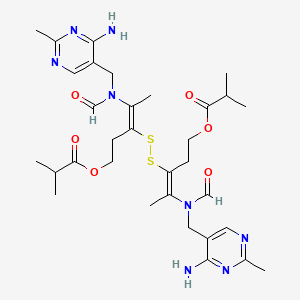
- Formula
- C32H46N8O6S2
- Weight
- 702.9 Da
- PubChem CID
- 3002120
- Exact Mass
- 702.2982 Da
- LogP
- 2.7
- TPSA
- 247 Ų
- H-Bond Donors
- 2
- H-Bond Acceptors
- 14
- Rotatable Bonds
- 19
- Complexity
- 1050
Identifiers (SMILES, InChI)
InChI=1S/C32H46N8O6S2/c1-19(2)31(43)45-11-9-27(21(5)39(17-41)15-25-13-35-23(7)37-29(25)33)47-48-28(10-12-46-32(44)20(3)4)22(6)40(18-42)16-26-14-36-24(8)38-30(26)34/h13-14,17-20H,9-12,15-16H2,1-8H3,(H2,33,35,37)(H2,34,36,38)/b27-21+,28-22+
CKHJPWQVLKHBIH-GPAWKIAZSA-NReferences (6)
- [6]Sulbutiamine shows promising results in reducing fatigue in patients with multiple sclerosis
→ Sulbutiamine significantly reduced fatigue scores in MS patients, particularly those receiving disease-modifying treatments.
- [1]Role of the Synthetic B1 Vitamin Sulbutiamine on Health
→ Reviews sulbutiamine's potential applications including anti-fatigue, nootropic, and antioxidant effects, plus possible roles in treating infections and cancer.
- [2]Adjuvant role of vitamin B analogue (sulbutiamine) with anti-infective treatment in infection-associated asthenia
→ Large study (1772 patients) found sulbutiamine effective in reducing fatigue when used alongside anti-infective treatments.
- [3]Treatment of chronic postinfectious fatigue: randomized double-blind study of two doses of sulbutiamine versus placebo
→ Study on postinfectious fatigue showed temporary improvement in women taking higher doses, though no significant effects observed at conclusion.
- [4]Effects of sulbutiamine (Arcalion 200) on psycho-behavioral inhibition in major depressive episodes
→ Sulbutiamine added to standard treatment helped alleviate psycho-behavioral inhibition in major depressive disorder patients.
- [5]Effects of the association of sulbutiamine with an acetylcholinesterase inhibitor in early stage and moderate Alzheimer's disease
→ In Alzheimer's patients, sulbutiamine combined with acetylcholinesterase inhibitor improved attention and episodic memory.
Continue researching Sulbutiamine
Keep scientific evidence separate from commercial availability. Review how claims are evaluated, explore question-led research paths, or inspect disclosed source records without changing the editorial conclusions on this page.