Daidzein
Daidzein research profile covering evidence quality, proposed mechanisms, safety considerations, regulatory status, and linked primary sources.
Evidence-led profile
Research snapshot
- Evidence stage
- Emerging research
- References
- 9 linked sources
- Research coverage
- 1 area
- Editorial review
- Mar 8, 2026
Published by the PepGuide Editorial Team using our research methodology.
Overview
Daidzein is one of the principal isoflavones found in soybeans and soy-based foods, alongside genistein and glycitein. As a phytoestrogen, daidzein can bind to estrogen receptors (particularly ERβ) and exert weak estrogenic or anti-estrogenic effects depending on the hormonal environment. This selective modulation of estrogen signaling underlies many of its proposed health benefits.
A unique aspect of daidzein metabolism is its conversion by gut bacteria to equol, a metabolite with significantly greater estrogenic potency and antioxidant activity. However, only approximately 30–50% of the population (varying by ethnicity and diet) harbors the intestinal bacteria capable of producing equol, creating a distinction between "equol producers" and "non-producers" that may explain the variable clinical responses to soy isoflavone supplementation. Equol producer status has been associated with greater benefits for menopausal symptom relief and bone mineral density preservation.
Research on daidzein spans cardiovascular health, cancer prevention, and osteoporosis. It has demonstrated the ability to inhibit osteoclast activity while promoting osteoblast differentiation, supporting its role in bone health. Epidemiological data from Asian populations with high soy intake suggest associations with reduced rates of breast and prostate cancer, though the evidence from Western intervention trials remains mixed. Typical supplementation provides 40–80 mg of total isoflavones per day.
Mechanism of Action
Estrogen Receptor Modulation
Daidzein is an isoflavone phytoestrogen found predominantly in soy. It binds selectively to estrogen receptor beta (ERb) with approximately 10-fold higher affinity than ERa, classifying it as a selective estrogen receptor modulator (SERM). At ERb, daidzein acts as a partial agonist, activating transcription of estrogen-responsive elements (ERE) at lower potency than estradiol while competitively antagonizing stronger estrogenic stimulation in tissues with high ERb density (bone, brain, vasculature) (PMID: 9861593).
Equol Metabolism
Daidzein is metabolized by specific intestinal bacteria (e.g., Adlercreutzia equolifaciens, Slackia isoflavoniconvertens) to S-equol, a metabolite with significantly greater ERb affinity and antiandrogenic activity. Only 30-50% of individuals harbor equol-producing microbiota, creating a major source of interindividual variability in daidzein's efficacy. S-equol also binds 5a-dihydrotestosterone (DHT) directly, reducing its androgenic signaling (PMID: 16076989).
Tyrosine Kinase & Cell Cycle Inhibition
Daidzein inhibits protein tyrosine kinases (PTKs), including EGFR and PDGFR, at micromolar concentrations, suppressing Ras/MAPK and PI3K/Akt proliferative signaling. It induces G1 cell cycle arrest via upregulation of p21WAF1 and p27Kip1 cyclin-dependent kinase inhibitors and promotes apoptosis through increased Bax/Bcl-2 ratio and caspase-3 activation (PMID: 18461175).
Bone & Cardiovascular Effects
Through ERb activation in osteoblasts, daidzein upregulates osteocalcin, BMP-2, and alkaline phosphatase expression while suppressing RANKL-mediated osteoclastogenesis. Vasculoprotective effects include endothelial nitric oxide synthase (eNOS) activation, LDL oxidation inhibition, and smooth muscle relaxation.
Research
Reported Effects
PCOS Management:: User reports suggest benefits for polycystic ovarian syndrome when combined with myo-inositol and other supplements, though isolated effects unclear. Dose-Dependent Response:: Research shows biological activity increases with dosage, with studies using 50-500mg showing various metabolic and hormonal effects. Individual Variation:: Effectiveness may depend on gut bacteria ability to convert daidzein to equol, a more bioactive metabolite. Synergistic Effects:: Most positive user experiences involve daidzein as part of comprehensive supplement protocols rather than standalone use
- User reports suggest benefits for polycystic ovarian syndrome when combined with myo-inositol and other supplements, though isolated effects unclear
- Research shows biological activity increases with dosage, with studies using 50-500mg showing various metabolic and hormonal effects
- Effectiveness may depend on gut bacteria ability to convert daidzein to equol, a more bioactive metabolite
- Most positive user experiences involve daidzein as part of comprehensive supplement protocols rather than standalone use
Safety and Limitations
Safety Profile: Daidzein
Common Side Effects
- Gastrointestinal discomfort: bloating, gas, nausea (especially with concentrated supplements)
- Mild headache
- Breast tenderness (related to estrogenic activity)
- Changes in menstrual cycle length or flow in premenopausal women
- Skin flushing
Serious Adverse Effects
- Potential stimulation of estrogen receptor-positive (ER+) breast cancer growth — debated but precautionary avoidance recommended
- Thyroid function interference: daidzein may inhibit thyroid peroxidase, potentially exacerbating hypothyroidism, especially with iodine deficiency
- Endometrial stimulation with prolonged high-dose use (rare)
- May affect fertility at very high doses (animal data suggest disruption of reproductive hormones)
- Equol production (a daidzein metabolite) varies by gut microbiome — effects differ between equol producers and non-producers
Contraindications
- Estrogen receptor-positive breast cancer (current or history)
- Endometriosis or uterine fibroids (estrogen-sensitive conditions)
- Hypothyroidism (especially with concurrent iodine deficiency)
- Pregnancy and breastfeeding at supplemental doses (dietary soy intake generally considered safe)
- Known soy allergy
Drug Interactions
- Tamoxifen and aromatase inhibitors: May interfere with efficacy — avoid concurrent supplemental use
- Thyroid medications (levothyroxine): Daidzein may reduce absorption; separate dosing by 4+ hours
- Warfarin: Soy isoflavones may affect vitamin K metabolism; monitor INR
- CYP interactions: Daidzein inhibits CYP1A2 and CYP2E1 in vitro — potential for interactions with substrates of these enzymes
- Antibiotics: May alter gut flora and equol production, changing daidzein's effective activity
Population-Specific Considerations
- Postmenopausal women: Most studied for bone health and vasomotor symptoms; moderate evidence of benefit
- Men: No feminizing effects at dietary levels; high supplemental doses may affect testosterone:estrogen ratio
- Infants: Soy formula controversy — generally considered safe by major pediatric organizations but avoid unnecessary supplementation
- Asian populations: Higher habitual intake with apparent long-term safety; may reflect adaptation
- Thyroid patients: Monitor thyroid function when starting isoflavone supplementation
Common Side Effects
- Hormonal Concerns:: As a phytoestrogen, potential concerns exist for hormone-sensitive conditions, though research shows complex SERM activity
- Reproductive Effects:: Studies note developmental exposure concerns, though adult supplementation appears well-tolerated in research
- Drug Interactions:: Theoretical interactions with hormone therapies and anticoagulants due to vitamin K content in source materials
- Metabolic Variability:: Individual responses vary based on gut microbiome's ability to produce equol metabolite
Research protocol summary
- Typical Dose
- 50mg daily commonly mentioned in PCOS protocols and research studies on menopausal symptoms
These values summarize cataloged research protocols. They are not personal dosing instructions or medical guidance.
Reconstitution Calculator
Pharmacokinetic Profile
Daidzein — Pharmacokinetic Curve
SubcutaneousMolecular Structure
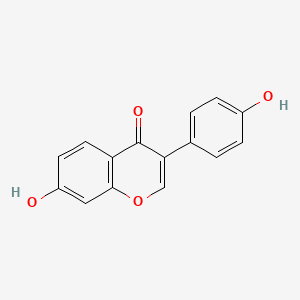
- Formula
- C15H10O4
- Weight
- 254.24 Da
- PubChem CID
- 5281708
- Exact Mass
- 254.0579 Da
- LogP
- 2.5
- TPSA
- 66.8 Ų
- H-Bond Donors
- 2
- H-Bond Acceptors
- 4
- Rotatable Bonds
- 1
- Complexity
- 382
Identifiers (SMILES, InChI)
InChI=1S/C15H10O4/c16-10-3-1-9(2-4-10)13-8-19-14-7-11(17)5-6-12(14)15(13)18/h1-8,16-17H
ZQSIJRDFPHDXIC-UHFFFAOYSA-NReferences (9)
- [7]Daidzein supplementation improved fecundity in sows via modulation of ovarian oxidative stress and inflammation
→ Research showing daidzein supplementation improved reproductive outcomes by reducing ovarian oxidative stress and inflammation, supporting normal ovarian hormone secretion.
- [8]Daidzein ameliorates experimental acute reflux esophagitis in rats via regulation of cytokines
→ Study demonstrating daidzein's protective effects against esophageal reflux through antioxidant activity, reduced lipid peroxidation, and restoration of enzymatic antioxidants in a dose-dependent manner.
- [1]Daidzein from Dietary Supplement to a Drug Candidate: An Evaluation of Potential
→ Comprehensive evaluation showing daidzein's transition from nutraceutical to drug candidate, with documented effects on cardiovascular disease, diabetes, cancer, and neurodegenerative disorders through estrogen receptor modulation and anti-inflammatory pathways.
- [2]Utilization of Isoflavones in Soybeans for Women with Menopausal Syndrome: An Overview
→ Reviews the use of soy isoflavones including daidzein for menopausal symptoms, detailing processing methods, extraction techniques, and biological activity of daidzein and its metabolite S-equol.
- [3]Isoflavone Supplements for Menopausal Women: A Systematic Review
→ Systematic review of 68 studies showing isoflavones including daidzein reduce hot flashes in menopausal women, though effects were small and primarily limited to lumbar vertebrae for bone health.
- [4]Daidzein alleviates ethanol-induced acute gastric injury in rats by targeting ESR1 and activating the PI3K/AKT/CREB signaling pathway
→ Demonstrated that daidzein protects against gastric injury through estrogen receptor-1 targeting and activation of protective cellular signaling pathways, showing therapeutic potential for gastrointestinal disorders.
- [5]Daidzein regulates proinflammatory adipokines thereby improving obesity-related inflammation through PPARγ
→ Study showing daidzein acts as a PPARγ activator, reducing inflammatory adipokines and improving insulin sensitivity in obese mice while preventing fat cell hypertrophy.
- [6]Effects of daidzein on antioxidant capacity in weaned pigs and IPEC-J2 cells
→ 72-day trial demonstrating that dietary daidzein supplementation significantly improved growth performance and antioxidant capacity in pigs through enhanced cellular antioxidant mechanisms.
- [9]Association between daidzein intake and metabolic associated fatty liver disease: A cross-sectional study from NHANES 2017-2018
→ Cross-sectional analysis of 1,476 participants showing relationship between dietary daidzein intake and metabolic fatty liver disease markers, suggesting potential therapeutic applications.
Continue researching Daidzein
Keep scientific evidence separate from commercial availability. Review how claims are evaluated, explore question-led research paths, or inspect disclosed source records without changing the editorial conclusions on this page.