Honokiol
Honokiol research profile covering evidence quality, proposed mechanisms, safety considerations, regulatory status, and linked primary sources.
Evidence-led profile
Research snapshot
- Evidence stage
- Emerging research
- References
- 4 linked sources
- Research coverage
- 1 area
- Editorial review
- Mar 8, 2026
Published by the PepGuide Editorial Team using our research methodology.
Overview
Honokiol is a biphenolic neolignan isolated from the bark, seed cones, and leaves of Magnolia officinalis and Magnolia grandiflora, trees with deep roots in Traditional Chinese and Japanese medicine. Unlike many botanical compounds, honokiol possesses exceptional blood-brain barrier (BBB) permeability due to its small molecular weight (266.3 Da) and high lipophilicity, enabling direct central nervous system activity. It acts as a positive allosteric modulator at GABA-A receptors — binding at the benzodiazepine site to produce anxiolytic and mild sedative effects without the tolerance, dependence, or cognitive impairment associated with classical benzodiazepines.
Beyond its anxiolytic profile, honokiol demonstrates broad-spectrum anti-inflammatory activity through inhibition of NF-κB signaling, suppression of COX-2 and iNOS expression, and reduction of pro-inflammatory cytokines (TNF-α, IL-1β, IL-6). Its antioxidant capacity rivals that of alpha-lipoic-acid, with the ability to scavenge reactive oxygen and nitrogen species and activate the Nrf2/ARE pathway. Preclinical research has shown neuroprotective effects in models of cerebral ischemia, Alzheimer's disease, and excitotoxicity, where honokiol attenuates amyloid-beta aggregation and protects mitochondrial function. These properties position it alongside compounds like huperzine-a and lion-s-mane in cognitive health protocols.
Emerging oncology research has garnered significant attention, with honokiol demonstrating anti-proliferative and pro-apoptotic effects across multiple cancer cell lines including breast, prostate, lung, and glioblastoma. It targets multiple oncogenic pathways — inhibiting STAT3, Akt/mTOR, and EGFR signaling while activating caspase-mediated apoptosis. Honokiol also inhibits angiogenesis and tumor metastasis in preclinical models. Typical supplemental doses range from 200–800 mg/day, often combined with magnolol (its structural isomer found in the same plant) for synergistic effects. Its favorable safety profile and multi-target pharmacology make it one of the most promising botanical compounds under active investigation.
Mechanism of Action
GABA-A Receptor Positive Allosteric Modulation
Honokiol is a biphenyl neolignan isolated from the bark, seed cones, and leaves of Magnolia species. It acts as a positive allosteric modulator of GABA-A receptors, binding to a site distinct from the GABA binding site and the benzodiazepine binding site. Honokiol enhances GABA-mediated chloride ion influx, producing neuronal hyperpolarization and reduced excitability. This mechanism underlies its anxiolytic and sedative effects, which are comparable to benzodiazepines but with reduced dependence liability (PMID: 23644299).
NF-kB Inhibition & Anti-Inflammatory Signaling
Honokiol potently inhibits the NF-kB signaling pathway by preventing phosphorylation and degradation of IkB-alpha, the cytoplasmic inhibitor that sequesters NF-kB. Without IkB-alpha degradation, the p50/p65 NF-kB heterodimer cannot translocate to the nucleus, suppressing transcription of pro-inflammatory genes including TNF-alpha, IL-1beta, IL-6, COX-2, and iNOS. Honokiol also inhibits STAT3 phosphorylation, reducing a parallel inflammatory and pro-survival signaling axis (PMID: 16458296).
Mitochondrial Apoptotic Pathway Activation in Cancer
Honokiol induces apoptosis in cancer cells by activating the intrinsic mitochondrial pathway: it downregulates anti-apoptotic proteins Bcl-2 and Bcl-xL while upregulating pro-apoptotic Bax. This shifts the Bcl-2/Bax ratio, causing mitochondrial outer membrane permeabilization (MOMP), cytochrome c release, and activation of the caspase-9/caspase-3 executioner cascade. Honokiol also inhibits PI3K/Akt/mTOR survival signaling, further sensitizing tumor cells to apoptosis (PMID: 15652431).
Anti-Angiogenic & SIRT3 Activation
Honokiol suppresses tumor angiogenesis by reducing VEGF expression and inhibiting VEGFR2 phosphorylation. It also activates SIRT3 (mitochondrial sirtuin), enhancing mitochondrial antioxidant defenses via SOD2 deacetylation and supporting mitochondrial integrity in cardiomyocytes and neurons, contributing to its broad cytoprotective profile.
Research
Reported Effects
Individual Variability:: Response to honokiol appears highly individual, with some users experiencing strong effects while others report minimal benefits. Dosage Sensitivity:: Effectiveness may be dose-dependent, with higher doses producing more pronounced sedative effects. Comparison to Alternatives:: May be less potent than pharmaceutical anxiolytics but potentially safer with fewer side effects. Research-Practice Gap:: Strong preclinical evidence exists, but limited user reports suggest real-world effectiveness may not match research findings
- Response to honokiol appears highly individual, with some users experiencing strong effects while others report minimal benefits
- Effectiveness may be dose-dependent, with higher doses producing more pronounced sedative effects
- May be less potent than pharmaceutical anxiolytics but potentially safer with fewer side effects
- Strong preclinical evidence exists, but limited user reports suggest real-world effectiveness may not match research findings
Safety and Limitations
Safety Profile: Honokiol
Common Side Effects
- Drowsiness and sedation (honokiol is a GABA receptor modulator with anxiolytic and sedative properties)
- Mild gastrointestinal discomfort (nausea, stomach upset)
- Dizziness and lightheadedness
- Headache
- Dry mouth
- Most human data come from magnolia bark extracts containing honokiol and magnolol together, making isolated honokiol effects difficult to distinguish
Serious Adverse Effects
- Excessive CNS depression: At high doses or combined with other sedatives, honokiol may cause profound sedation, respiratory depression, or impaired consciousness
- Hepatotoxicity: Limited data; isolated case reports of liver enzyme elevations with magnolia bark supplements
- Coagulation effects: Honokiol has demonstrated antiplatelet and antithrombotic activity in preclinical studies; may increase bleeding risk
- Embryotoxicity: Animal studies suggest potential reproductive toxicity at high doses
- Drug interaction-mediated adverse events: CNS depression when combined with benzodiazepines, opioids, or alcohol
Contraindications
- Known hypersensitivity to honokiol, magnolol, or Magnolia officinalis
- Concurrent use of CNS depressants without medical supervision (benzodiazepines, barbiturates, opioids)
- Active bleeding disorders or upcoming surgery (discontinue 2 weeks prior)
- Pregnancy and lactation (embryotoxic potential; insufficient human safety data)
- Severe hepatic impairment
- Operating heavy machinery or driving (due to sedative effects)
Drug Interactions
- Benzodiazepines (diazepam, alprazolam, lorazepam): Additive GABAergic sedation; risk of excessive CNS depression
- Opioids: Enhanced sedation and respiratory depression risk
- Alcohol: Potentiates CNS depressant effects
- Anticoagulants/antiplatelets (warfarin, aspirin, clopidogrel): Honokiol has antiplatelet activity; increased bleeding risk
- Anesthetics: Enhanced sedation; discontinue before surgery
- CYP450 substrates: Honokiol may inhibit CYP1A2, CYP2C8, CYP2C9, and CYP3A4 in vitro; may alter metabolism of substrates of these enzymes
- Antidepressants (SSRIs): Theoretical additive serotonergic or sedative effects
Population-Specific Considerations
- Pregnancy/Lactation: Avoid; animal data suggest embryotoxicity. No human safety data during pregnancy or breastfeeding
- Children: No pediatric safety data; not recommended
- Elderly: Increased sensitivity to sedative effects; higher fall risk; start with very low doses
- Liver disease: Use with caution; limited hepatic safety data
- Surgical patients: Discontinue at least 14 days before elective procedures due to sedative and antiplatelet properties
- Anxiety/insomnia patients: Potentially beneficial but must not replace evidence-based treatments without physician guidance
Common Side Effects
- Sedation:: Primary side effect is excessive drowsiness or sedation, particularly at higher doses
- Tolerance:: Potential for reduced effectiveness with chronic daily use, similar to other GABAergic compounds
- Mild GI Effects:: Some users report digestive discomfort or nausea, particularly on empty stomach
- Drug Interactions:: Potential interactions with other CNS depressants, benzodiazepines, or sedatives due to GABAergic activity
Research protocol summary
- Typical Dose
- Research typically uses 200-1000mg doses, with most studies examining 200-500mg for anxiolytic effects
These values summarize cataloged research protocols. They are not personal dosing instructions or medical guidance.
Reconstitution Calculator
Pharmacokinetic Profile
Molecular Structure
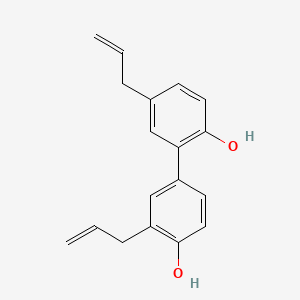
- Formula
- C18H18O2
- Weight
- 266.3 Da
- PubChem CID
- 72303
- Exact Mass
- 266.1307 Da
- LogP
- 5
- TPSA
- 40.5 Ų
- H-Bond Donors
- 2
- H-Bond Acceptors
- 2
- Rotatable Bonds
- 5
- Complexity
- 325
Identifiers (SMILES, InChI)
InChI=1S/C18H18O2/c1-3-5-13-7-9-18(20)16(11-13)14-8-10-17(19)15(12-14)6-4-2/h3-4,7-12,19-20H,1-2,5-6H2
FVYXIJYOAGAUQK-UHFFFAOYSA-NReferences (4)
- [1]Neuro-Modulating Effects of Honokiol: A Review
→ Comprehensive review of honokiol's neuroprotective and neuromodulatory effects, including anxiolytic properties, GABA-A receptor modulation, and potential applications in treating neurological disorders and anxiety.
- [2]Honokiol: A review of its pharmacological potential and therapeutic insights
→ Extensive review of honokiol's pharmacological mechanisms including anti-inflammatory, antioxidant, anxiolytic, and neuroprotective effects across various therapeutic applications.
- [3]Honokiol: A Review of Its Anticancer Potential and Mechanisms
→ Systematic review of honokiol's anticancer properties and molecular mechanisms, demonstrating potential in inducing apoptosis and inhibiting tumor growth across multiple cancer types.
- [4]Neuroprotective effects of honokiol: from chemistry to medicine
→ Review of honokiol's neuroprotective mechanisms including antioxidant activity, anti-inflammatory effects, and therapeutic potential in neurodegenerative diseases and brain injury.
Continue researching Honokiol
Keep scientific evidence separate from commercial availability. Review how claims are evaluated, explore question-led research paths, or inspect disclosed source records without changing the editorial conclusions on this page.