Glutamine
The most abundant free amino acid in the body, critical for immune function, gut health, and muscle recovery during periods of physiological stress.
Evidence-led profile
Research snapshot
- Evidence stage
- Emerging research
- References
- 5 linked sources
- Research coverage
- 1 area
- Editorial review
- Mar 8, 2026
Published by the PepGuide Editorial Team using our research methodology.
Overview
Glutamine is the most abundant free amino acid circulating in the bloodstream and stored in skeletal muscle, accounting for roughly 60% of the total intramuscular amino acid pool. It is classified as conditionally essential because while the body can synthesize it under normal conditions, demand can outstrip production during intense exercise, critical illness, surgery, or other catabolic states. Glutamine plays key roles in nitrogen transport, acid-base balance, immune cell proliferation, and intestinal mucosal integrity.
As a primary fuel source for enterocytes and immune cells, glutamine is critical for maintaining gut barrier function and supporting the proliferative capacity of lymphocytes and macrophages. Supplementation has been studied extensively in clinical settings including post-surgical recovery, burn care, and intensive care units, where glutamine depletion is associated with increased infection rates and impaired healing. In sports nutrition, glutamine supplementation is used to reduce exercise-induced immunosuppression and support muscle recovery, though evidence for direct muscle-building effects is limited compared to leucine or creatine.
Typical supplementation ranges from 5–20 g per day, often divided into multiple doses. Glutamine is commonly available as L-glutamine powder and is frequently included in post-workout formulations alongside BCAAs and glycine. It is generally recognized as safe with minimal side effects at standard doses. Individuals with liver disease or certain metabolic conditions should consult a healthcare provider before supplementing.
Research
Reported Effects
Gastrointestinal Relief:: Highly effective for post-infectious IBS and general gut permeability issues.. Metabolic Stress:: Most effective when the body is under high stress, such as post-surgery or during heavy training.. Performance Gains:: While excellent for recovery, it shows limited direct impact on increasing maximum strength or speed.. Clinical Utility:: Proven effectiveness in accelerating the healing of chronic wounds and burns.
Safety and Limitations
Safety Profile: Glutamine
Common Side Effects
- Generally well-tolerated at standard supplemental doses (5-30 g/day)
- Mild gastrointestinal discomfort (bloating, flatulence, nausea) at higher doses
- Headache and dizziness (uncommon)
- Mild skin rash (rare)
- Changes in bowel habits (constipation or loose stools)
Serious Adverse Effects
- Hepatic encephalopathy risk: In patients with severe liver disease, glutamine can increase ammonia levels, potentially precipitating or worsening hepatic encephalopathy
- Tumor growth concern: Glutamine is a preferred fuel for rapidly dividing cells; theoretical concern about promoting tumor growth in active cancer (debated in literature)
- Mania induction: Case reports of mania in patients with bipolar disorder
- Renal ammonia load: High doses may stress renal function in patients with kidney disease through ammonia metabolism
- Seizure risk: Very rare reports at extremely high doses
Contraindications
- Hepatic encephalopathy or severe liver cirrhosis (risk of ammonia accumulation)
- Reye syndrome
- Known hypersensitivity to glutamine or any formulation component
- Severe renal insufficiency (impaired ammonia clearance)
- Caution in active malignancies (consult oncologist)
Drug Interactions
- Lactulose: Glutamine may counteract lactulose's ammonia-lowering effects in hepatic encephalopathy
- Anticonvulsants: Glutamine may theoretically affect seizure threshold; monitor closely
- Chemotherapy agents: Complex interaction; glutamine may protect mucosa but theoretical concern about tumor fuel supply — oncologist guidance required
- Antibiotics (neomycin): May reduce efficacy of ammonia-lowering antibiotics in hepatic encephalopathy
- Generally minimal drug interactions at standard supplemental doses
Population-Specific Considerations
- Pregnancy/Lactation: Likely safe at dietary levels; supplemental doses lack sufficient safety data — use under medical supervision
- Children: Used in pediatric clinical settings (e.g., sickle cell disease, short bowel syndrome) at adjusted doses under medical supervision
- Elderly: Well-tolerated; may help preserve lean muscle mass and gut integrity
- Cancer patients: Consult oncologist before use; evidence is mixed regarding safety in active malignancy
- ICU/Critical illness: Evidence supports use for gut integrity and immune support, but dosing must be individualized
- Athletes: Commonly used at 5-20 g/day; well-tolerated in healthy populations
Common Side Effects
- Digestive Upset:: Excessive doses can occasionally lead to constipation or mild bloating in sensitive individuals.
- Neurological Sensitivity:: Rare reports of increased anxiety or 'brain fog' in individuals sensitive to glutamate conversion.
- Water Retention:: Some users report a minor increase in intramuscular water retention.
Mechanism of Action
Glutamine is the most abundant free amino acid in the human body and serves as a critical metabolic fuel, particularly for rapidly dividing cells including immune cells, intestinal epithelial cells, and activated lymphocytes. Its primary metabolic pathway, glutaminolysis, involves conversion to glutamate by mitochondrial glutaminase (GLS), followed by conversion to α-ketoglutarate (α-KG) for entry into the TCA cycle (anaplerosis). This provides carbon for ATP production and biosynthetic precursors, while also generating NADPH for reductive biosynthesis and antioxidant defense.
Glutamine activates mTORC1, a master regulator of cell growth and protein synthesis, making it essential for anabolic responses in muscle and immune cells. It serves as a nitrogen donor for de novo nucleotide (purine and pyrimidine) biosynthesis required for DNA and RNA synthesis, and as a precursor for glutathione (GSH), the cell's primary antioxidant molecule. Glutamine uptake is mediated by several amino acid transporters including SLC1A5 (ASCT2), SLC38A1, and SLC38A2, and its metabolite glutamate functions as the brain's primary excitatory neurotransmitter through NMDA, AMPA, and kainate receptors.
In the gut, glutamine is the primary energy source for enterocytes and stimulates the Wnt/β-catenin pathway for intestinal cell proliferation and barrier integrity. In immune cells, glutamine availability is rate-limiting for lymphocyte proliferation and cytokine production. The ERK and JNK kinase pathways can also be activated by glutamine, and glutamine-derived glutamate can activate NF-κB signaling. During critical illness, trauma, or intense exercise, endogenous glutamine production may be insufficient, making it conditionally essential.
Research protocol summary
- Typical Dose
- Common reported dosages for gut health range from 5g to 15g daily, often split into multiple doses.
These values summarize cataloged research protocols. They are not personal dosing instructions or medical guidance.
Molecular Structure
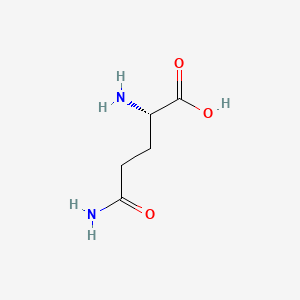
- Formula
- C5H10N2O3
- Weight
- 146.14 Da
- PubChem CID
- 5961
- Exact Mass
- 146.0691 Da
- LogP
- -3.1
- TPSA
- 106 Ų
- H-Bond Donors
- 3
- H-Bond Acceptors
- 4
- Rotatable Bonds
- 4
- Complexity
- 146
Identifiers (SMILES, InChI)
InChI=1S/C5H10N2O3/c6-3(5(9)10)1-2-4(7)8/h3H,1-2,6H2,(H2,7,8)(H,9,10)/t3-/m0/s1
ZDXPYRJPNDTMRX-VKHMYHEASA-NReferences (5)
- [1]Glutamine in Burn Injury
→ Clinical data indicates that glutamine supplementation in burn patients significantly reduces mortality, hospital stay length, and occurrences of gram-negative bacteremia by preserving gut barrier function.
- [2]Glutamine: a potentially useful supplement for athletes
→ This review suggests that exogenous glutamine may help maintain muscle protein mass and support immune function in athletes undergoing heavy exercise training.
- [3]Impact of oral nutritional supplement composition on healing of different chronic wounds: A systematic review
→ The study found that hyperproteic oral formulas containing glutamine and other nutrients can reduce wound area and increase healing rates in patients with pressure injuries and diabetic foot ulcers.
- [4]Randomised placebo-controlled trial of dietary glutamine supplements for postinfectious irritable bowel syndrome
→ Oral glutamine supplementation was shown to safely and effectively reduce symptoms in patients suffering from post-infectious irritable bowel syndrome.
- [5]The effect of glutamine supplementation on athletic performance, body composition, and immune function: A systematic review and a meta-analysis of clinical trials
→ A comprehensive meta-analysis found that glutamine supplementation reduces muscle soreness and improves recovery following intense exercise, though its effect on performance metrics is variable.
Continue researching Glutamine
Keep scientific evidence separate from commercial availability. Review how claims are evaluated, explore question-led research paths, or inspect disclosed source records without changing the editorial conclusions on this page.