Myricetin
Myricetin research profile covering evidence quality, proposed mechanisms, safety considerations, regulatory status, and linked primary sources.
Evidence-led profile
Research snapshot
- Evidence stage
- Emerging research
- References
- 8 linked sources
- Research coverage
- 1 area
- Editorial review
- Mar 8, 2026
Published by the PepGuide Editorial Team using our research methodology.
Overview
Myricetin (3,5,7,3',4',5'-hexahydroxyflavone) is a naturally occurring flavonol belonging to the flavonoid family of polyphenolic compounds. It is found in a wide variety of fruits, vegetables, herbs, and beverages, with particularly high concentrations in bayberries (Myrica rubra, from which it derives its name), grapes, cranberries, blueberries, walnuts, and tea. Structurally, myricetin is distinguished from other common flavonols such as quercetin and kaempferol by an additional hydroxyl group on the B-ring (3',4',5'-trihydroxy pattern), giving it six total hydroxyl groups that contribute to its exceptional radical-scavenging capacity — one of the highest among dietary flavonoids.
The pharmacological activities of myricetin span multiple therapeutic domains. As an antioxidant, it directly scavenges reactive oxygen and nitrogen species, chelates transition metals (Fe2+, Cu2+) that catalyze Fenton reactions, and activates endogenous antioxidant defenses through the Nrf2/ARE pathway. Its anti-inflammatory effects are mediated through inhibition of NF-kB, suppression of COX-2 and iNOS expression, and modulation of MAPK signaling cascades. In metabolic research, myricetin has demonstrated remarkable anti-diabetic potential: it inhibits alpha-glucosidase (reducing postprandial glucose spikes), activates AMPK (enhancing glucose uptake and fatty acid oxidation), improves insulin sensitivity through insulin receptor substrate (IRS) signaling, and protects pancreatic beta cells from glucotoxicity-induced apoptosis. Animal studies have consistently shown reductions in fasting glucose, HbA1c, and insulin resistance with myricetin supplementation.
Neuroprotective research on myricetin has generated particular interest. The compound inhibits the aggregation and fibrillization of both amyloid-beta (Abeta) and tau protein in vitro, with binding affinities that make it one of the most potent natural anti-amyloid flavonoids identified. It crosses the blood-brain barrier, inhibits acetylcholinesterase (enhancing cholinergic transmission), and protects neurons against glutamate excitotoxicity and oxidative stress in cell and animal models of Alzheimer's disease. Anti-cancer research has identified myricetin as an inhibitor of PI3K, Akt, and multiple protein kinases involved in tumor proliferation and survival. Bioavailability of oral myricetin is limited (approximately 10–15%) due to extensive first-pass metabolism and glucuronidation, though this can be improved through co-administration with piperine or phospholipid complexes. Typical supplemental doses range from 100–500 mg daily, and it pairs well with other polyphenols such as resveratrol, quercetin, and fisetin in comprehensive antioxidant and longevity protocols.
Mechanism of Action
Chemical Structure & Antioxidant Capacity
Myricetin (3,5,7,3',4',5'-hexahydroxyflavone) is a flavonol found abundantly in berries, grapes, walnuts, tea, and vegetables. Its six hydroxyl groups — including the 3',4',5'-trihydroxyl (pyrogallol) arrangement on the B-ring — give it one of the highest antioxidant capacities among dietary flavonoids. The catechol/pyrogallol B-ring donates hydrogen atoms to neutralize superoxide (O₂⁻), hydroxyl (OH•), peroxyl (ROO•), and peroxynitrite (ONOO⁻) radicals. The 3-OH and 4-oxo groups chelate Fe²⁺ and Cu²⁺ ions, preventing Fenton reaction-mediated hydroxyl radical generation.
NF-kB & Inflammatory Suppression
Myricetin inhibits NF-kB activation by blocking IKK-mediated IkBα phosphorylation and preventing p65 nuclear translocation. It also suppresses upstream MAPK cascade components — p38, JNK, and ERK1/2 phosphorylation — in LPS-stimulated macrophages and microglial cells. This dual NF-kB/MAPK suppression reduces transcription of COX-2, iNOS, TNF-alpha, IL-1beta, IL-6, and MCP-1, with potency comparable to or exceeding quercetin and kaempferol in cell-based assays (PMID: 19799425).
Nrf2/ARE Pathway Activation
Myricetin activates the Nrf2/Keap1/ARE cytoprotective pathway. It modifies reactive cysteine residues on Keap1, releasing Nrf2 from proteasomal degradation. Nuclear Nrf2 binds antioxidant response elements (ARE), upregulating heme oxygenase-1 (HO-1), NAD(P)H quinone oxidoreductase 1 (NQO1), glutathione S-transferase (GST), and glutamate-cysteine ligase (GCL), enhancing cellular antioxidant and detoxification capacity.
Neuroprotective Effects
In neuronal models, myricetin protects against amyloid-beta-induced toxicity by inhibiting beta-secretase (BACE1) activity and preventing amyloid fibril formation. It reduces tau hyperphosphorylation by inhibiting glycogen synthase kinase 3-beta (GSK-3β) and activating PP2A (protein phosphatase 2A). These combined anti-amyloidogenic and anti-tau effects, along with anti-neuroinflammatory activity in microglia, support neuroprotective applications.
Metabolic & Anticancer Mechanisms
Myricetin activates AMPK in hepatocytes and adipocytes, promoting fatty acid oxidation and glucose uptake while suppressing lipogenesis. In cancer cells, it inhibits the PI3K/Akt/mTOR pathway, induces G2/M cell cycle arrest via CDK1/cyclin B1 inhibition, and promotes apoptosis through mitochondrial membrane depolarization and caspase-3/9 activation.
Research
Reported Effects
Dose-Response Relationship:: Studies show effectiveness at 50-200 mg/kg in animal models with dose-dependent improvements. Multiple Mechanisms:: Works through various pathways including enzyme inhibition, gene expression modulation, and receptor activation. Metabolic Benefits:: Meta-analysis confirms significant effects on glucose and lipid profiles in metabolic disease models. Neuroprotection:: Demonstrated cognitive improvements through neurotrophic factor enhancement and CREB phosphorylation
- Studies show effectiveness at 50-200 mg/kg in animal models with dose-dependent improvements
- Works through various pathways including enzyme inhibition, gene expression modulation, and receptor activation
- Meta-analysis confirms significant effects on glucose and lipid profiles in metabolic disease models
- Demonstrated cognitive improvements through neurotrophic factor enhancement and CREB phosphorylation
Safety and Limitations
Myricetin is generally considered safe with a low risk of side effects, though high doses may cause mild gastrointestinal upset. It may have anti-platelet effects and should be used with caution by individuals on blood-thinning medications. Data on long-term use is limited.
Common Side Effects
- Drug Interactions:: Inhibits CYP2C9, CYP2D6, and P-glycoprotein, potentially affecting metabolism of various medications
- Bioavailability Effects:: May significantly increase bioavailability of co-administered drugs like carvedilol by 52-85%
- Digestive Concerns:: Some users report potential constipation when combined with other supplements in complex regimens
- Safety Profile:: Generally well-tolerated in studies but long-term human safety data limited
Reconstitution Calculator
Pharmacokinetic Profile
Molecular Structure
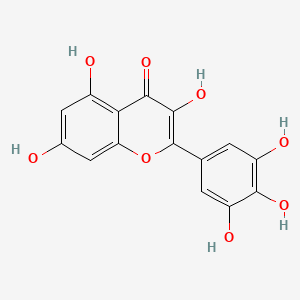
- Formula
- C15H10O8
- Weight
- 318.23 Da
- PubChem CID
- 5281672
- Exact Mass
- 318.0376 Da
- LogP
- 1.2
- TPSA
- 148 Ų
- H-Bond Donors
- 6
- H-Bond Acceptors
- 8
- Rotatable Bonds
- 1
- Complexity
- 506
Identifiers (SMILES, InChI)
InChI=1S/C15H10O8/c16-6-3-7(17)11-10(4-6)23-15(14(22)13(11)21)5-1-8(18)12(20)9(19)2-5/h1-4,16-20,22H
IKMDFBPHZNJCSN-UHFFFAOYSA-NReferences (8)
- [2]Myricetin improves cognitive function in SAMP8 mice and upregulates brain-derived neurotrophic factor and nerve growth factor
→ Daily myricetin intake normalized cognitive dysfunction in aging mouse models by increasing BDNF and NGF levels and enhancing CREB phosphorylation, suggesting neuroprotective benefits.
- [3]Therapeutic potential of multifunctional myricetin for treatment of type 2 diabetes mellitus
→ Review demonstrates myricetin's multiple anti-diabetic mechanisms including inhibiting glucose absorption, enhancing insulin secretion as a possible GLP-1 receptor agonist, and protecting endothelial cells from hyperglycemia-induced oxidative stress.
- [4]Hypoglycemic activity and mechanisms of myricetin
→ Four-week administration of myricetin (50-200 mg/kg) in diabetic rats dose-dependently reduced blood glucose and insulin while protecting pancreatic tissue from apoptosis through regulation of Bax and Bcl-2 genes.
- [5]Unveiling myricetin's pharmacological potency: A comprehensive exploration of the molecular pathways with special focus on PI3K/AKT and Nrf2 signaling
→ Comprehensive review revealed myricetin's therapeutic effects operate through PI3K/AKT and Nrf2 pathways, demonstrating antioxidant, anticancer, anti-inflammatory, antiviral, antidiabetic, and neuroprotective properties.
- [6]Myricetin bioactive effects: moving from preclinical evidence to potential clinical applications
→ Systematic review of preclinical evidence shows myricetin exhibits multiple bioactive effects including anti-inflammatory, antioxidant, anticancer, and metabolic benefits, supporting its potential as a therapeutic supplement.
- [7]Flavonoid Myricetin as Potent Anticancer Agent: A Possibility towards Development of Potential Anticancer Nutraceuticals
→ Review highlights myricetin's anticancer properties through multiple mechanisms, suggesting strong potential for development as an anticancer nutraceutical with applications in preventing and managing various cancer types.
- [8]Myricetin ameliorates the symptoms of collagen-induced arthritis in mice by inhibiting cathepsin K activity
→ Myricetin (25 mg/kg daily) directly inhibited cathepsin K enzyme activity and demonstrated positive effects in reducing arthritic symptoms in mouse models of collagen-induced arthritis.
- [1]Efficacy of Myricetin Supplementation on Glucose and Lipid Metabolism: A Systematic Review and Meta-Analysis of In Vivo Mice Studies
→ Meta-analysis of mouse studies showed myricetin supplementation significantly improved glucose metabolism and lipid profiles in metabolic disease models, demonstrating potential anti-diabetic effects through insulin sensitivity enhancement.
Continue researching Myricetin
Keep scientific evidence separate from commercial availability. Review how claims are evaluated, explore question-led research paths, or inspect disclosed source records without changing the editorial conclusions on this page.