Magnesium Taurate
Magnesium Taurate research profile covering evidence quality, proposed mechanisms, safety considerations, regulatory status, and linked primary sources.
Evidence-led profile
Research snapshot
- Evidence stage
- Emerging research
- References
- 4 linked sources
- Research coverage
- 1 area
- Editorial review
- Mar 8, 2026
Published by the PepGuide Editorial Team using our research methodology.
Overview
Magnesium Taurate is a chelated mineral supplement combining elemental magnesium with taurine, a conditionally essential sulfur-containing amino acid with extensive cardiovascular and neurological activity. The pairing is pharmacologically synergistic: both magnesium and taurine independently contribute to cardiac rhythm stability, blood pressure regulation, and vascular endothelial function, and their combined effects may exceed those of either component alone. Taurine modulates calcium and potassium channels in cardiomyocytes, stabilizing membrane potential and reducing arrhythmia susceptibility, while magnesium acts as a natural calcium channel blocker and cofactor for Na+/K+-ATPase.
Clinical and preclinical research supports the cardiovascular specificity of this formulation. Taurine supplementation has been shown in meta-analyses to reduce systolic blood pressure by approximately 4 mmHg and diastolic pressure by 3 mmHg, effects that complement magnesium's established antihypertensive action. Animal studies using magnesium taurate specifically have demonstrated protection against ischemia-reperfusion injury, reduction in ventricular arrhythmias, and improved endothelial-dependent vasodilation. The taurine component also exhibits antioxidant properties through stabilization of mitochondrial membranes and modulation of the endogenous antioxidant system. This makes Magnesium Taurate the preferred magnesium form for individuals focused primarily on heart health, distinguishing it from Magnesium Glycinate for relaxation and sleep, Magnesium L-Threonate for cognitive support, and Magnesium Orotate for cardiac energy metabolism.
Beyond cardiovascular applications, Magnesium Taurate has garnered interest for neuroprotective effects. Taurine is an inhibitory neuromodulator that activates GABA-A and glycine receptors, and both magnesium and taurine have demonstrated protective effects against excitotoxic neuronal damage in preclinical models. Typical dosing is 1,000–2,000 mg of magnesium taurate daily (providing approximately 80–160 mg elemental magnesium), often taken in divided doses. It is well tolerated and has a mild gastrointestinal profile. In comprehensive cardiovascular protocols, Magnesium Taurate pairs well with CoQ10, omega-3 fatty acids, and menaquinone-7 (vitamin K2-MK7) for synergistic cardioprotective effects.
Mechanism of Action
Magnesium taurate combines the synergistic effects of magnesium and taurine, both of which independently contribute to cardiovascular and neurological health. Magnesium acts as a natural calcium channel antagonist, competing with Ca2+ for binding sites on L-type voltage-gated calcium channels in vascular smooth muscle and cardiomyocytes. This reduces intracellular calcium accumulation, promoting vasodilation, lowering blood pressure, and decreasing vascular resistance. Magnesium also stabilizes cardiac rhythm by modulating the Na+/K+-ATPase and maintaining proper membrane potential in conductive tissue.
Taurine, a sulfur-containing amino acid, exerts complementary cardiovascular protection through multiple mechanisms. It acts as an osmoregulator in cardiomyocytes, maintaining cell volume homeostasis during ischemic stress. Taurine modulates intracellular calcium handling by enhancing sarcoplasmic reticulum Ca2+-ATPase (SERCA) activity, improving calcium sequestration and diastolic relaxation. In the central nervous system, taurine functions as an inhibitory neuromodulator by potentiating GABA-A receptor activity and activating glycine receptors, producing anxiolytic and neuroprotective effects. Taurine also inhibits the renin-angiotensin-aldosterone system (RAAS), reducing angiotensin II-mediated vasoconstriction and sympathetic nervous system overactivation.
The combined formulation provides additive benefits for blood pressure regulation, endothelial function, and antiarrhythmic protection. Both compounds share antioxidant properties—magnesium by preventing mitochondrial calcium overload and taurine by scavenging hypochlorous acid and stabilizing mitochondrial membrane integrity—offering protection against oxidative stress in cardiovascular tissue.
Research
Reported Effects
Sleep Benefits:: Consistently demonstrated improvements in both subjective sleep quality ratings and objective sleep metrics across multiple studies. Cardiovascular Effects:: Strong inverse associations between magnesium/taurine intake and cardiovascular risk factors including blood pressure and cholesterol. Individual Variation:: Effectiveness varies based on baseline magnesium status, with greater benefits seen in those with deficiency or suboptimal levels. Time to Effect:: Benefits typically emerge within 2-3 weeks of consistent supplementation, with continued improvements over longer periods
- Consistently demonstrated improvements in both subjective sleep quality ratings and objective sleep metrics across multiple studies
- Strong inverse associations between magnesium/taurine intake and cardiovascular risk factors including blood pressure and cholesterol
- Effectiveness varies based on baseline magnesium status, with greater benefits seen in those with deficiency or suboptimal levels
- Benefits typically emerge within 2-3 weeks of consistent supplementation, with continued improvements over longer periods
Safety and Limitations
Magnesium taurate is generally well-tolerated, with the primary side effects being digestive issues like diarrhea or cramping at higher doses. People with kidney disease should consult a healthcare provider before use. It may interact with diuretics, heart medicines, and certain antibiotics.
Common Side Effects
- Digestive Effects:: Minimal gastrointestinal side effects compared to other magnesium forms, though some may experience mild stomach upset
- General Tolerability:: Well-tolerated across studies with low dropout rates due to adverse events
- Dosage-Dependent:: Side effects are typically dose-dependent, with higher doses more likely to cause digestive discomfort
- Safety Profile:: Considered safe for most adults when used at recommended doses, with no serious adverse events reported in clinical trials
Research protocol summary
- Typical Dose
- 1-2 grams daily of magnesium taurate, typically split into divided doses
These values summarize cataloged research protocols. They are not personal dosing instructions or medical guidance.
Reconstitution Calculator
Pharmacokinetic Profile
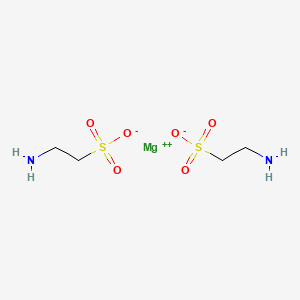
Molecular Structure
- Formula
- C4H12MgN2O6S2
- Weight
- 272.6 Da
- PubChem CID
- 13343447
- Exact Mass
- 271.9987 Da
- TPSA
- 183 Ų
- H-Bond Donors
- 2
- H-Bond Acceptors
- 8
- Rotatable Bonds
- 2
- Complexity
- 107
Identifiers (SMILES, InChI)
InChI=1S/2C2H7NO3S.Mg/c2*3-1-2-7(4,5)6;/h2*1-3H2,(H,4,5,6);/q;;+2/p-2
YZURQOBSFRVSEB-UHFFFAOYSA-LReferences (4)
- [1]The effects of magnesium L-threonate (Magtein®) on cognitive performance and sleep quality in adults: a randomised, double-blind, placebo-controlled trial
→ Magnesium L-threonate supplementation improved overall cognitive performance, working and episodic memory, reduced brain cognitive age by 7.5 years, and showed improvements in sleep-related impairment compared to placebo in adults with dissatisfied sleep.
- [2]Magnesium and taurine, first proven to be preventive for cardiovascular risks
→ Higher urinary taurine and magnesium levels were inversely associated with blood pressure, cholesterol, and obesity risk, with the prevalence of hypertension and hypercholesterolemia being significantly lower in those with highest intake levels.
- [4]Effectiveness of Magnesium Supplementation on Sleep Quality and Mood for Adults with Poor Sleep Quality: A Randomized Double-Blind Placebo-Controlled Crossover Pilot Trial
→ A crossover pilot trial examining 1g/day magnesium supplementation showed improvements in sleep quality measures and mood outcomes in adults with nonclinical insomnia symptoms.
- [3]Magnesium-L-threonate improves sleep quality and daytime functioning in adults with self-reported sleep problems: A randomized controlled trial
→ Three weeks of magnesium L-threonate supplementation improved both subjective and objective sleep scores and daytime functioning in adults with self-reported sleep problems, demonstrating it is safe and well-tolerated.
Continue researching Magnesium Taurate
Keep scientific evidence separate from commercial availability. Review how claims are evaluated, explore question-led research paths, or inspect disclosed source records without changing the editorial conclusions on this page.