Bromantane
Bromantane research profile covering evidence quality, proposed mechanisms, safety considerations, regulatory status, and linked primary sources.
Evidence-led profile
Research snapshot
- Evidence stage
- Emerging research
- References
- 6 linked sources
- Research coverage
- 1 area
- Editorial review
- Mar 8, 2026
Published by the PepGuide Editorial Team using our research methodology.
Overview
Bromantane (chemical name: N-(4-bromophenyl)adamantan-2-amine) was originally developed in Russia during the 1980s as an actoprotector — a class of compounds designed to enhance physical performance under stressful conditions without the side effects associated with conventional stimulants. It was registered in Russia in 1996 under the trade name Ladasten for the treatment of asthenic disorders and neurasthenia.
Unlike classical psychostimulants such as amphetamines, bromantane does not directly activate monoamine receptors or inhibit reuptake transporters. Instead, it upregulates the expression of tyrosine hydroxylase and tryptophan hydroxylase, the rate-limiting enzymes in dopamine and serotonin biosynthesis, respectively. This mechanism of action results in a gradual, sustained enhancement of catecholamine tone rather than an acute surge.
Bromantane gained international attention when several athletes tested positive for the substance at the 1996 Summer Olympics in Atlanta. It was subsequently added to the World Anti-Doping Agency (WADA) prohibited list as a stimulant. Research interest continues in its potential applications for cognitive enhancement, fatigue reduction, and treatment of conditions involving dopaminergic hypofunction.
Mechanism of Action
Dual Dopaminergic-Serotonergic Mechanism
Bromantane (ladasten, adamantylbromphenylamine) is an atypical actoprotector — a pharmacological class of compounds that enhance physical performance without direct psychostimulant or sympathomimetic activity. Bromantane increases dopamine and serotonin synthesis by upregulating the expression of tyrosine hydroxylase (TH) and tryptophan hydroxylase-2 (TPH2), the rate-limiting enzymes in catecholamine and serotonin biosynthesis, respectively. This genomic mechanism distinguishes it from classical stimulants that rely on vesicular release or reuptake inhibition (PMID: 11109511).
Tyrosine Hydroxylase Upregulation
Bromantane activates the CREB (cAMP response element-binding protein) transcription factor pathway in dopaminergic neurons of the ventral tegmental area and substantia nigra. Phosphorylated CREB binds CRE elements in the TH gene promoter, increasing TH mRNA and protein expression. This results in sustained increases in dopamine synthesis capacity in the striatum and prefrontal cortex without the phasic dopamine surges associated with abuse-liable stimulants, explaining its anxiolytic profile alongside psychoactivating effects (PMID: 12493600).
GABA System & Anxiolytic Properties
Bromantane enhances GABAergic neurotransmission by upregulating expression of the GABA-synthesizing enzyme glutamic acid decarboxylase (GAD67) in hippocampal and cortical interneurons. This increases tonic GABAergic inhibition, providing anxiolytic and stress-protective effects without sedation or cognitive impairment. The combination of dopaminergic activation with GABAergic enhancement produces a unique activating-anxiolytic pharmacological profile (PMID: 20150050).
Physical Performance & Thermotolerance
As an actoprotector, bromantane enhances physical work capacity under normal and extreme conditions (heat, hypoxia) by improving mitochondrial efficiency and reducing ammonia accumulation during exercise through enhanced glutamine synthetase activity. It also stabilizes hypothalamic thermoregulatory set-points, improving heat tolerance during prolonged exertion (PMID: 17473721).
Research
Reported Effects
Tolerance-Neutral:: Doesn't seem to cause traditional stimulant tolerance.. Cumulative Benefits:: Dopamine upregulation may persist after cessation.. Consistent Effects:: Most users report reliable, predictable results.
- Doesn't seem to cause traditional stimulant tolerance.
- Dopamine upregulation may persist after cessation.
- Most users report reliable, predictable results.
Safety and Limitations
Common Side Effects
- Mild psychostimulant effects including restlessness, insomnia, and increased anxiety, particularly at higher doses (above 100 mg daily)
- Headache and irritability, most commonly during initial use or dose escalation
- Mild gastrointestinal discomfort including nausea and appetite changes
- Dry mouth and increased thirst reported by some users
- Elevated blood pressure and heart rate, typically transient and dose-dependent
Serious Adverse Effects
- Bromantane was originally developed as a synthetic adaptogen and actoprotector in Russia and has limited Western clinical safety data; long-term safety profiles are not well-characterized
- Banned by the World Anti-Doping Agency (WADA) as a stimulant; the 1996 Olympic disqualification of athletes using bromantane brought attention to its performance-enhancing classification
- Potential for dopaminergic upregulation through enhanced tyrosine hydroxylase expression, which raises theoretical concerns about dopamine dysregulation with chronic use
- Liver enzyme elevations have been reported in some users, though systematic hepatotoxicity studies are limited
- Withdrawal effects including fatigue, low mood, and cognitive sluggishness have been anecdotally reported after prolonged use
Contraindications
- Individuals with anxiety disorders, bipolar disorder, or psychotic conditions should avoid bromantane due to its dopaminergic and mild psychostimulant properties
- Not recommended for individuals with cardiovascular disease, uncontrolled hypertension, or arrhythmias
- Contraindicated in competitive athletes subject to anti-doping regulations
- Individuals with liver disease should avoid use due to limited hepatic safety data
Drug Interactions
- May interact with dopaminergic medications (levodopa, dopamine agonists, MAO inhibitors) by potentiating dopamine activity, increasing risk of agitation, hypertension, or serotonin-like syndrome
- Potential interaction with stimulants (amphetamines, methylphenidate, modafinil) leading to excessive sympathetic activation
- May interact with anxiolytic and sedative medications by partially counteracting their effects
- Theoretical interaction with CYP450 substrates, though specific enzyme inhibition data is sparse
- Concurrent use with antidepressants (SSRIs, SNRIs) warrants caution due to overlapping monoaminergic effects
Special Populations
- Contraindicated during pregnancy and breastfeeding due to complete lack of reproductive safety data
- Not recommended for pediatric or adolescent use
- Limited pharmacokinetic data in elderly populations; use should be approached with extreme caution
Common Side Effects
- Generally Well Tolerated:: Few side effects reported.
- Potential Stimulation:: May cause restlessness in sensitive individuals.
- Limited Research:: Long-term safety data limited in Western literature.
Research protocol summary
- Typical Dose
- 50-100mg daily.
These values summarize cataloged research protocols. They are not personal dosing instructions or medical guidance.
Reconstitution Calculator
Pharmacokinetic Profile
Bromantane — Pharmacokinetic Curve
SubcutaneousMolecular Structure
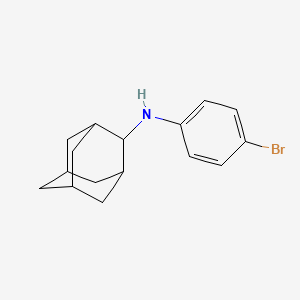
- Formula
- C16H20BrN
- Weight
- 306.24 Da
- PubChem CID
- 4660557
- Exact Mass
- 305.0779 Da
- LogP
- 5
- TPSA
- 12 Ų
- H-Bond Donors
- 1
- H-Bond Acceptors
- 1
- Rotatable Bonds
- 2
- Complexity
- 280
Identifiers (SMILES, InChI)
InChI=1S/C16H20BrN/c17-14-1-3-15(4-2-14)18-16-12-6-10-5-11(8-12)9-13(16)7-10/h1-4,10-13,16,18H,5-9H2
LWJALJDRFBXHKX-UHFFFAOYSA-NReferences (6)
- [1]Effects of bromantane on offspring maturation and development of reflexes
→ Bromantane demonstrates no adverse effects on reproduction and offspring development, with no significant differences in offspring weight gain or nervous system development.
- [5]The neuro- and psychophysiological effects of bromantane
→ Bromantane improves operators' functional state, promoting moderate vigilance and productive action while reducing tremors.
- [6]A quantitative pharmaco-electroencephalographic analysis of the action of bromantane
→ Bromantane demonstrates more marked and prolonged stimulant properties than other adamantane psychostimulants, with a two-phase effect lasting up to 8 hours.
- [3]Analysis of bromantane pharmacological spectrum
→ Bromantane exhibits psychostimulatory and anxiolytic effects, with no effect on BALB/c mice and freezing prevention in C57B1/6 mice.
- [2]Effect of bromantane on the release and metabolism of dopamine in the striatum of freely moving rats
→ Bromantane increases dopamine release in the striatum of rats for 8 hours, slightly decreasing dopamine metabolites.
- [4]The effect of bromantane on the dopamin- and serotoninergic systems of the rat brain
→ Bromantane increases serotonin levels in the brain and affects dopamine levels, suggesting a role for the dopaminergic system in its pharmacological effects.
Continue researching Bromantane
Keep scientific evidence separate from commercial availability. Review how claims are evaluated, explore question-led research paths, or inspect disclosed source records without changing the editorial conclusions on this page.