Menaquinone-7
Menaquinone-7 research profile covering evidence quality, proposed mechanisms, safety considerations, regulatory status, and linked primary sources.
Evidence-led profile
Research snapshot
- Evidence stage
- Emerging research
- References
- 3 linked sources
- Research coverage
- 1 area
- Editorial review
- Mar 8, 2026
Published by the PepGuide Editorial Team using our research methodology.
Overview
Menaquinone-7 (MK-7) is the most widely supplemented and clinically studied form of vitamin K2, a fat-soluble vitamin belonging to the menaquinone family. Produced primarily by bacterial fermentation — with natto (fermented soybeans using Bacillus subtilis var. natto) being the richest dietary source — MK-7 is distinguished from other vitamin K forms by its long isoprenoid side chain, which confers a significantly longer biological half-life (approximately 72 hours) compared to vitamin K1 (phylloquinone, 1–2 hours) or shorter menaquinones like MK-4 (4–6 hours). This extended half-life enables steady-state accumulation with daily dosing and more consistent carboxylation of vitamin K-dependent proteins throughout the body.
The primary therapeutic actions of MK-7 center on its role as an essential cofactor for gamma-glutamyl carboxylase, the enzyme that activates vitamin K-dependent proteins through carboxylation of glutamic acid residues. The two most clinically relevant targets are osteocalcin (bone Gla protein) and matrix Gla protein (MGP). Activated osteocalcin binds calcium within the bone matrix, promoting mineralization and skeletal strength, while activated MGP is the most potent known inhibitor of vascular calcification, preventing calcium deposition in arterial walls. This dual action — directing calcium into bones and away from arteries — has established MK-7 as a cornerstone supplement for both cardiovascular and skeletal health. The landmark 3-year Rotterdam study found that high dietary vitamin K2 intake was associated with a 52% reduction in arterial calcification and a 57% reduction in cardiovascular mortality. The more recent Knapen et al. (2015) RCT demonstrated that MK-7 supplementation (180 mcg/day for 3 years) significantly improved arterial stiffness in healthy postmenopausal women.
MK-7 is typically dosed at 100–200 mcg daily, taken with a fat-containing meal for optimal absorption. It synergizes powerfully with vitamin D3, which upregulates the synthesis of osteocalcin and MGP that MK-7 then activates — making the D3/K2 combination one of the most evidence-based supplement pairings available. MK-7 also complements calcium and Magnesium Glycinate in comprehensive bone health protocols, and pairs with Magnesium Taurate or CoQ10 for cardiovascular support stacks. An important clinical consideration is the interaction with warfarin and other vitamin K antagonist anticoagulants: consistent MK-7 supplementation can counteract anticoagulant effects, so patients on these medications should consult their healthcare provider before supplementation.
Mechanism of Action
Menaquinone-7 (MK-7), a long-chain form of vitamin K2, functions primarily as an essential cofactor for the enzyme gamma-glutamyl carboxylase (GGCX). This enzyme catalyzes the post-translational carboxylation of specific glutamate residues to gamma-carboxyglutamate (Gla) residues in vitamin K-dependent proteins (VKDPs). During this carboxylation reaction, the reduced (hydroquinone) form of MK-7 is oxidized to its epoxide form, which is then recycled back to the active hydroquinone by vitamin K epoxide reductase (VKORC1), forming the vitamin K cycle.
Key VKDPs activated by MK-7 include osteocalcin (bone Gla protein), which regulates calcium deposition in bone matrix and influences glucose metabolism, and matrix Gla protein (MGP), a potent inhibitor of vascular calcification that prevents calcium from depositing in arterial walls. Growth arrest-specific protein 6 (Gas6), another VKDP, mediates cell survival, proliferation, and phagocytosis through TAM receptor signaling. MK-7's long isoprenoid side chain gives it greater lipophilicity and a significantly longer half-life compared to phylloquinone (K1) or shorter menaquinones, resulting in more sustained carboxylase activation.
Beyond its classical cofactor role, MK-7 has been shown to modulate gene expression through activation of the steroid and xenobiotic receptor (SXR/PXR), influencing bone-related genes. It also suppresses NF-kB signaling, reducing inflammatory cytokine production, and may exert antioxidant effects by protecting membrane lipids from peroxidation.
Research
Reported Effects
Evidence-Based Benefits:: Research shows clear improvements in bone density and arterial stiffness in postmenopausal women, though benefits in healthy young adults are less established. Long Half-Life:: MK-7's 3.5-day half-life allows for every-other-day dosing and steady-state levels after approximately 17.5 days of consistent use. Vitamin D Synergy:: Most commonly used alongside vitamin D3 supplementation to optimize calcium metabolism, though the necessity in healthy individuals is debated. Quality Concerns:: Users frequently question whether supplements contain the bioactive all-trans form versus synthetic cis-isomers, with research showing many products contain significant impurities
- Research shows clear improvements in bone density and arterial stiffness in postmenopausal women, though benefits in healthy young adults are less established
- MK-7's 3.5-day half-life allows for every-other-day dosing and steady-state levels after approximately 17.5 days of consistent use
- Most commonly used alongside vitamin D3 supplementation to optimize calcium metabolism, though the necessity in healthy individuals is debated
- Users frequently question whether supplements contain the bioactive all-trans form versus synthetic cis-isomers, with research showing many products contain significant impurities
Safety and Limitations
Vitamin K2 MK-7 is generally well-tolerated but is contraindicated for individuals taking anticoagulant medications like warfarin, as it can significantly reduce their effectiveness and increase the risk of clotting. Side effects are rare but can include minor gastrointestinal upset. People with liver or kidney disease should consult a doctor before using this supplement.
Common Side Effects
- Insomnia:: Multiple users report sleep disturbances and inability to sleep when taking MK-7, particularly at night or with certain formulations
- Dental Pain:: Some users experience tooth sensitivity or pain with specific high-dose or multi-menaquinone formulations
- Individual Variability:: Side effects appear highly individual, with some users tolerating certain brands while experiencing issues with others
- Generally Well-Tolerated:: When side effects occur, they typically resolve within days of discontinuation, and most users report no adverse effects
Research protocol summary
- Typical Dose
- 100-200 mcg daily is the most common supplementation range, with research using 180 mcg showing benefits
These values summarize cataloged research protocols. They are not personal dosing instructions or medical guidance.
Reconstitution Calculator
Pharmacokinetic Profile
Molecular Structure
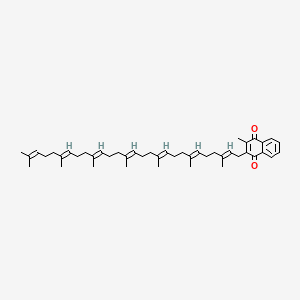
- Formula
- C46H64O2
- Weight
- 649.0 Da
- PubChem CID
- 5287554
- Exact Mass
- 648.4906 Da
- LogP
- 14.5
- TPSA
- 34.1 Ų
- H-Bond Donors
- 0
- H-Bond Acceptors
- 2
- Rotatable Bonds
- 20
- Complexity
- 1310
Identifiers (SMILES, InChI)
InChI=1S/C46H64O2/c1-34(2)18-12-19-35(3)20-13-21-36(4)22-14-23-37(5)24-15-25-38(6)26-16-27-39(7)28-17-29-40(8)32-33-42-41(9)45(47)43-30-10-11-31-44(43)46(42)48/h10-11,18,20,22,24,26,28,30-32H,12-17,19,21,23,25,27,29,33H2,1-9H3/b35-20+,36-22+,37-24+,38-26+,39-28+,40-32+
RAKQPZMEYJZGPI-LJWNYQGCSA-NReferences (3)
- [1]Three-year low-dose menaquinone-7 supplementation helps decrease bone loss in healthy postmenopausal women
→ Low-dose MK-7 supplementation significantly decreased age-related decline in bone mineral density and bone strength in postmenopausal women over three years, suggesting it may help prevent osteoporosis.
- [2]Menaquinone-7 supplementation improves arterial stiffness in healthy postmenopausal women
→ Daily MK-7 supplementation for one year improved arterial stiffness and vascular health parameters in healthy postmenopausal women, demonstrating cardiovascular benefits.
- [3]Low-dose menaquinone-7 supplementation improved extra-hepatic vitamin K status, but had no effect on thrombin generation in healthy subjects
→ MK-7 supplementation dose-dependently improved vitamin K status and carboxylation of extra-hepatic vitamin K-dependent proteins without affecting blood coagulation in healthy individuals.
Continue researching Menaquinone-7
Keep scientific evidence separate from commercial availability. Review how claims are evaluated, explore question-led research paths, or inspect disclosed source records without changing the editorial conclusions on this page.