Pinealon
Pinealon (Ala-Glu-Asp-Gly) is a synthetic tetrapeptide bioregulator derived from the pineal gland that exerts epigenetic regulatory effects on gene expression involved in cognitive aging, neuroprotection, and circadian rhythm control.
Evidence-led profile
Research snapshot
- Evidence stage
- Established research record
- References
- 17 linked sources
- Research coverage
- 5 areas
- Editorial review
- Mar 8, 2026
Published by the PepGuide Editorial Team using our research methodology.
Overview
Pinealon belongs to the Khavinson peptide bioregulator family — short peptides (2–4 amino acids) that act as epigenetic regulators by binding to gene promoter regions and activating transcription of tissue-specific proteins. Unlike longer peptides that act via receptor signaling, Pinealon's primary proposed mechanism is direct chromatin interaction, modulating expression of genes involved in neuroprotection, antioxidant defense, and melatonin synthesis regulation.
It is closely related to Epithalon (Ala-Glu-Asp-Gly is the same sequence as Epithalon's first four residues in some formulations) but is specifically targeted toward pineal and neuronal tissue rather than the thyroid/general aging axis.
Research
Neuroprotection Under Hypoxic Stress
Research using rat cortical neuron cultures demonstrated that Pinealon significantly reduced cell death under hypoxic conditions, outperforming controls. The mechanism involved upregulation of HIF-1α-related survival genes and reduction in caspase-3 activation (apoptosis marker).
Khavinson VKh et al. (2011) — Peptide regulation of gene expression and protein synthesis in brain neurons. Bulletin of Experimental Biology and Medicine
Cognitive Aging & Memory
In aged rat models (22–24 months), Pinealon administration improved spatial memory performance in Morris water maze tests compared to untreated controls. The improvements correlated with increased BDNF expression in the hippocampus and reduced oxidative damage markers (8-OHdG levels).
Tarnovskaya SI et al. (2016) — Mechanism of the biological activity of short peptides: Interaction with specific DNA sites as the basis of gene expression regulation. Cell Biochemistry and Biophysics
Retinal Protection
A notable finding from the Khavinson group: Pinealon demonstrated neuroprotective effects on retinal ganglion cells in models of oxidative stress and age-related degeneration, preserving photoreceptor function. This has generated interest in its application alongside Retinalamin for combined retinal protection.
Khavinson V et al. (2012) — Peptide regulation of aging. SearchGate/Advances in Gerontology
Gene Expression Modulation
Microarray studies in rat brain tissue showed Pinealon modulates expression of over 40 genes involved in neuronal metabolism, stress response, and synaptic plasticity. Key upregulated targets included:
- SIRT1 (sirtuin longevity gene)
- BDNF (neuroplasticity)
- SOD2 (mitochondrial antioxidant)
- BCL2 (anti-apoptotic)
Circadian & Sleep Regulation
Given its pineal gland targeting, research has examined Pinealon's effects on circadian rhythm markers. Animal data suggest it can partially restore age-related decline in melatonin synthesis by upregulating AANAT (arylalkylamine N-acetyltransferase), the rate-limiting enzyme in melatonin production.
Safety and Limitations
Pinealon has been used in Russian clinical gerontology settings for over two decades with a reportedly favorable safety profile. No significant adverse effects have been documented in published literature. As a tetrapeptide, immunogenicity risk is very low. No carcinogenicity, teratogenicity, or organ toxicity data in human trials (only animal safety studies).
Contraindications: None established. Theoretical caution in patients with pineal tumors or significant melatonin-sensitive conditions.
Common Side Effects
- Minimal injection site reactions
- Mild gastrointestinal adjustment
- Occasional headache
- Fatigue
Contraindications
- Pregnancy
- Lactation
Discontinue If
- Severe headaches or mood changes
- Persistent injection site reactions
- Signs of infection at injection site
- Unusual neurological symptoms
- Allergic reactions
Mechanism of Action
Epigenetic / Nuclear Mechanism
Pinealon's principal proposed mechanism distinguishes it from most peptides: rather than binding membrane receptors, it is thought to penetrate the cell nucleus and interact with histone proteins and DNA regulatory regions. This model — developed by Prof. Vladimir Khavinson's group — suggests the peptide acts as a transcription modulator, upregulating expression of genes involved in:
- Antioxidant enzyme production (SOD, catalase, glutathione peroxidase)
- Neurotrophic factor synthesis (BDNF, NGF)
- Melatonin pathway enzymes (AANAT, ASMT)
- Anti-apoptotic signaling (Bcl-2 family)
Pineal Gland Targeting
The peptide shows preferential accumulation in pineal gland tissue and hippocampal neurons in animal studies. This tissue specificity is characteristic of the bioregulator class — short peptides derived from specific glands tend to demonstrate homing to their tissue of origin.
Antioxidant Effects
Multiple in vitro and animal studies report Pinealon reduces reactive oxygen species (ROS) in neuronal cultures, particularly under conditions of hypoxia or oxidative stress induced by hydrogen peroxide or glutamate excitotoxicity.
Research protocol summary
- Typical Dose
- Injectable: 5mg daily or 100-300mcg daily; Oral: 0.2mg twice daily
- Frequency
- Injectable: daily for 20 days; Oral: morning and afternoon on empty stomach
- Route
- Intranasal, sublingual, subcutaneous
- Cycle Length
- 20 days per cycle
- Storage
- Refrigerate at 2-8°C, use within 30 days after reconstitution
These values summarize cataloged research protocols. They are not personal dosing instructions or medical guidance.
Reconstitution Calculator
Pharmacokinetic Profile
- Half-life
- Not established
- Tmax
- Side effects: Minimal injection site reactions
Molecular Structure
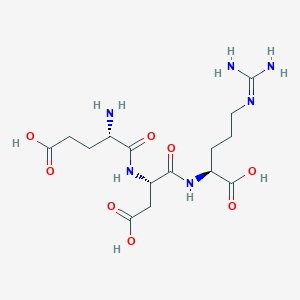
- Formula
- C₁₄H₂₂N₄O₉
- Weight
- 418.4 Da
- Length
- 3 amino acids
- CAS
- Not widely catalogued (research compound)
- PubChem CID
- 10273502
- Exact Mass
- 418.1812 Da
- LogP
- -6.1
- TPSA
- 261 Ų
- H-Bond Donors
- 8
- H-Bond Acceptors
- 10
- Rotatable Bonds
- 14
- Complexity
- 649
Identifiers (SMILES, InChI)
InChI=1S/C15H26N6O8/c16-7(3-4-10(22)23)12(26)21-9(6-11(24)25)13(27)20-8(14(28)29)2-1-5-19-15(17)18/h7-9H,1-6,16H2,(H,20,27)(H,21,26)(H,22,23)(H,24,25)(H,28,29)(H4,17,18,19)/t7-,8-,9-/m0/s1
QPRZKNOOOBWXSU-CIUDSAMLSA-NResearch Indications
Neuroprotection
Clinical protocol of 5mg daily showed significant cognitive improvements in 72-patient study.
Subcutaneous administration allows systemic circulation to brain tissue for neuroprotective effects.
Caspase-3 suppression, ROS reduction, and excitotoxicity protection.
Cognitive
Enhanced neurotransmitter function with 1.9x serotonin increase in cell cultures.
100 ng/kg optimal dose improved spatial learning in hippocampus.
Anti-Aging
Irisin expression increases linked to telomere protection and mitochondrial enhancement.
32-patient study showed significant improvements in aging indicators over 20-30 days.
Research Protocols
oral
Convenient, proven clinical efficacy. Ultra-short peptide structure survives gastric acid.
| Goal | Dose | Frequency | Duration |
|---|---|---|---|
| Cognitive Enhancement | 0.2mg twice daily | Morning and afternoon | —(Route: Empty stomach) |
| Sleep Support | 200mcg | Daily | —(Route: Oral) |
intranasal Injection
Theoretical nose-to-brain delivery, potential rapid CNS access. Limited data available.
subcutaneous Injection
Pineal gland bioregulator. Short intensive cycle, morning/early afternoon.
| Goal | Dose | Frequency | Duration |
|---|---|---|---|
| Phase 1 | 1.0 mg | Once daily | Days 1-5 |
| Phase 2 | 1.5 mg | Once daily | Days 6-14 |
| Phase 3 | 2.0 mg | Once daily | Days 15-20(Cycle 10-20 days, repeat every 2-3 months) |
Reconstitution Guide (20mg vial + 3mL BAC water)
- Wipe vial tops with alcohol swab
- Draw 3.0 mL bacteriostatic water into syringe
- Inject slowly down the inside wall of the peptide vial
- Gently swirl to dissolve — never shake
- Resulting concentration: 6.67 mg/mL
- For 1.0 mg dose: draw 15 units (0.15 mL)
- For 1.5 mg dose: draw 22.5 units (0.225 mL)
- For 2.0 mg dose: draw 30 units (0.30 mL)
- Store reconstituted vial refrigerated at 2-8°C
Interactions
Peptide Interactions
This has generated interest in its application alongside Retinalamin for combined retinal protection.
Reported Research Timeline
Improved mental clarity and focus
Enhanced cognitive processing and memory
Peak neuroprotective and anti-aging benefits
Quality Indicators
What to look for
- White crystalline powder; proper freeze-drying indicated
- Clear reconstituted solution; no particles or cloudiness
- Pharmaceutical packaging with batch numbers from reputable sources
Caution
- Ensure distinction between research (lab only) and pharmaceutical (human use) grade
Red flags
- Discolored powder (yellow or brown) indicates degradation from heat or moisture
- Cloudy solution indicates contamination
Frequently Asked Questions
References (17)
- [8]
- [12]
- [10]
- [1]Human Clinical Trial - Post-Traumatic Cerebrasthenia (2015)
- [11]
- [2]Aging Study - Polymorbidity Patients (2015)
- [5]
- [6]
- [7]
- [16]
- [17]
- [9]
- [3]
- [4]
- [13]Khavinson VKh et al Peptide regulation of gene expression and protein synthesis in brain neurons Bull Exp Biol Med (2011)
- [14]Tarnovskaya SI et al Mechanism of the biological activity of short peptides Cell Biochem Biophys (2016)
- [15]Khavinson V et al Peptide regulation of aging Advances in Gerontology (2012)
Continue researching Pinealon
Keep scientific evidence separate from commercial availability. Review how claims are evaluated, explore question-led research paths, or inspect disclosed source records without changing the editorial conclusions on this page.