L-Carnosine
A naturally occurring dipeptide of beta-alanine and histidine with potent anti-glycation, antioxidant, and neuroprotective properties concentrated in muscle and brain tissue.
Evidence-led profile
Research snapshot
- Evidence stage
- Emerging research
- References
- 8 linked sources
- Research coverage
- 1 area
- Editorial review
- Mar 8, 2026
Published by the PepGuide Editorial Team using our research methodology.
Overview
L-Carnosine (beta-alanyl-L-histidine) is an endogenous dipeptide found in high concentrations in skeletal muscle, cardiac tissue, and the brain, where it serves as a multifunctional protective agent. Its primary mechanisms include potent anti-glycation activity (preventing the formation of advanced glycation end-products, or AGEs, that contribute to aging and diabetic complications), direct antioxidant action through reactive oxygen species scavenging, heavy metal chelation (particularly zinc and copper), and pH buffering in muscle tissue. Carnosine levels decline significantly with age — muscle concentrations drop approximately 63% between ages 10 and 70 — suggesting a role in age-related tissue degeneration. Its precursor beta-alanine is the rate-limiting factor in carnosine synthesis, which is why beta-alanine supplementation also raises muscle carnosine levels.
The anti-glycation properties of L-carnosine are particularly compelling in the context of aging and metabolic disease. AGEs form through non-enzymatic reactions between sugars and proteins, lipids, or nucleic acids, accumulating over a lifetime to cause cross-linking of structural proteins, chronic inflammation via the RAGE receptor, and cellular dysfunction. Carnosine acts as a sacrificial peptide — reacting with reactive aldehydes and carbonyl species before they can damage functional proteins — and has been shown to inhibit AGE formation, protect proteins from carbonyl stress, and reverse early-stage glycation. Clinical studies have demonstrated improvements in glycemic control, HbA1c levels, and oxidative stress markers in diabetic patients supplemented with 1–2 g/day of L-carnosine.
Beyond metabolic applications, L-carnosine shows promise in neuroprotection and cognitive health. It crosses the blood-brain barrier and protects neurons from excitotoxicity, oxidative stress, and beta-amyloid toxicity in preclinical models. Its zinc-chelating properties are relevant to Alzheimer's disease, where zinc-mediated amyloid aggregation plays a pathogenic role. The related compound zinc-carnosine (polaprezinc) is approved in Japan for gastric ulcer treatment, leveraging carnosine's mucosal protective effects. L-carnosine pairs well with other anti-aging compounds such as alpha-lipoic-acid for glycation defense, acetyl-l-carnitine for mitochondrial support, and CoQ10 in comprehensive longevity protocols targeting multiple hallmarks of aging.
Research
Reported Effects
Gut Health Applications:: Zinc-L-carnosine (75mg doses) consistently reported as highly effective for various stomach issues, acid reflux, and leaky gut repair when combined with other gut-healing protocols. Exercise Performance:: Beta-alanine shows reliable benefits for repeated high-intensity efforts and activities relying on anaerobic glycolysis, particularly effective for sports with 40-60 second bursts. Dosage-Dependent Results:: Effects appear more pronounced with consistent supplementation over weeks to months rather than acute dosing. Individual Variation:: Response varies significantly between individuals, with some experiencing dramatic benefits while others notice minimal effects
Safety and Limitations
Safety Profile: L-Carnosine
Common Side Effects
- Generally well-tolerated at typical supplemental doses (500–2000 mg/day)
- Mild gastrointestinal symptoms: nausea, stomach discomfort, and diarrhea, particularly at higher doses
- Transient tingling or paresthesia (rare, typically self-resolving)
- Occasional headache during initial supplementation
- Mild insomnia reported by some users when taken later in the day
Serious Adverse Effects
- Histamine-related reactions: carnosine is structurally related to histidine; individuals with histamine intolerance or mast cell disorders may experience flushing, hives, or exacerbation of symptoms
- Theoretical concern for excitotoxicity at very high doses due to interaction with glutamate receptors (primarily from preclinical studies; clinical relevance uncertain)
- No serious organ toxicity documented in human clinical trials at standard doses
- Rare allergic reactions (urticaria, angioedema) to supplement excipients
Contraindications
- Known hypersensitivity to L-carnosine, beta-alanine, or L-histidine
- Histamine intolerance or systemic mastocytosis (carnosine may be degraded to histidine, increasing histamine production)
- Severe renal impairment (reduced clearance of carnosine and metabolites; limited safety data)
- Epilepsy or seizure disorders (theoretical concern regarding neuroexcitatory potential at high doses)
Drug Interactions
- Antihypertensives (ACE inhibitors): carnosine may have mild blood pressure–lowering effects; additive hypotension possible
- Antidiabetic medications: carnosine may improve insulin sensitivity and glycemic control; monitor for hypoglycemia when combined with insulin or sulfonylureas
- Antihistamines: theoretical pharmacological overlap; carnosine degradation to histidine may partially counteract antihistamine therapy
- Angiotensin-converting enzyme (ACE): carnosine is a substrate for serum carnosinase; drugs affecting this enzyme may alter carnosine levels
- Chelation therapy: carnosine has metal-chelating properties; may interfere with zinc, copper, or iron supplementation
Population-Specific Considerations
- Pregnancy/Lactation: insufficient human safety data; avoid supplemental doses above dietary intake
- Children: limited pediatric studies; generally not recommended as a supplement except under medical supervision
- Elderly: may be particularly beneficial (anti-glycation, neuroprotective properties) but start at lower doses; monitor renal function
- Vegetarians/Vegans: endogenous carnosine levels are lower in non-meat-eaters; supplementation may have more pronounced effects
- Diabetes patients: potentially beneficial for glycemic control but requires monitoring to avoid hypoglycemia with concurrent medications
Common Side Effects
- Paresthesia/Tingling:: Beta-alanine causes characteristic tingling sensation in skin, which can be minimized by dividing doses or using sustained-release formulations
- Copper Depletion:: Long-term zinc-L-carnosine supplementation may cause copper deficiency; users recommend monitoring levels and balancing with copper supplementation
- Taurine Competition:: Some research suggests beta-alanine may deplete taurine levels due to shared transport mechanisms, though clinical significance is debated
- Generally Well-Tolerated:: Most users report minimal side effects with proper dosing, particularly with zinc-carnosine and L-carnosine forms
Mechanism of Action
L-Carnosine (beta-alanyl-L-histidine) is an endogenous dipeptide found in high concentrations in skeletal muscle, cardiac tissue, and the brain. Its mechanism of action encompasses multiple biochemical pathways centered on its unique chemical properties as a dipeptide containing an imidazole ring from its histidine component. L-Carnosine functions as a potent intracellular pH buffer due to the imidazole side chain's pKa of approximately 6.83, which is within the physiological intracellular pH range. During high-intensity exercise or ischemic conditions, carnosine buffers hydrogen ions generated by anaerobic glycolysis and ATP hydrolysis, helping maintain optimal pH for enzymatic function and muscle contractility. This buffering capacity accounts for approximately 40% of the total buffering capacity in type II (fast-twitch) muscle fibers.
L-Carnosine is a potent anti-glycation agent, inhibiting the formation of advanced glycation end-products (AGEs) and advanced lipoxidation end-products (ALEs) through multiple mechanisms. It acts as a sacrificial target for reactive carbonyl species (RCS) including methylglyoxal, glyoxal, and 4-hydroxynonenal (4-HNE), forming carnosine-carbonyl adducts that prevent these reactive species from cross-linking proteins and DNA. This carbonyl-quenching activity protects structural proteins, enzymes, and cellular membranes from glycation-induced damage. Carnosine also chelates transition metal ions (Cu2+, Zn2+, Fe2+, Co2+) through its imidazole nitrogen, amino group, and carboxylate group, forming stable complexes that prevent metal-catalyzed oxidative reactions including Fenton chemistry and copper-mediated LDL oxidation.
As an antioxidant, L-Carnosine directly scavenges reactive oxygen species including superoxide, hydroxyl radical, and singlet oxygen, and inhibits lipid peroxidation chain reactions. It protects against hypochlorite-mediated protein and lipid damage. In neural tissue, carnosine modulates neurotransmission through zinc and copper chelation in the synaptic cleft (where these metals serve as neuromodulators), and may influence glutamatergic signaling. Carnosine has demonstrated protective effects against beta-amyloid aggregation and toxicity by inhibiting amyloid fibril formation and cross-linking. The enzyme carnosinase (CN1 in serum, CN2 intracellularly) rapidly degrades carnosine in circulation, which limits its systemic bioavailability but maintains tight homeostatic control. The combined pH buffering, anti-glycation, metal chelation, antioxidant, and neuroprotective properties make L-Carnosine a multifunctional protective molecule particularly relevant to exercise performance, aging, diabetic complications, and neurodegenerative conditions.
Molecular Structure
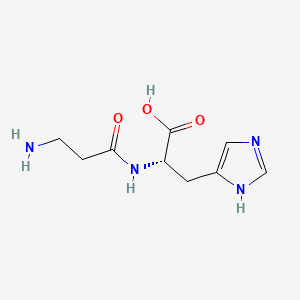
- Formula
- C9H14N4O3
- Weight
- 226.23 Da
- PubChem CID
- 439224
- Exact Mass
- 226.1066 Da
- LogP
- -4
- TPSA
- 121 Ų
- H-Bond Donors
- 4
- H-Bond Acceptors
- 5
- Rotatable Bonds
- 6
- Complexity
- 259
Identifiers (SMILES, InChI)
InChI=1S/C9H14N4O3/c10-2-1-8(14)13-7(9(15)16)3-6-4-11-5-12-6/h4-5,7H,1-3,10H2,(H,11,12)(H,13,14)(H,15,16)/t7-/m0/s1
CQOVPNPJLQNMDC-ZETCQYMHSA-NReferences (8)
- [1]Carnosine and Beta-Alanine Supplementation in Human Medicine: Narrative Review and Critical Assessment
→ Reviews carnosine's wide-ranging effects including anti-inflammatory, antioxidant, antiglycation, and immunomodulatory properties, with applications across multiple areas of human medicine beyond athletic performance.
- [2]β-alanine supplementation to improve exercise capacity and performance: a systematic review and meta-analysis
→ Meta-analysis of 360 participants showed beta-alanine supplementation significantly improved exercise outcomes compared to placebo, with a median effect size of 0.374 versus 0.108 for placebo.
- [3]Role of beta-alanine supplementation on muscle carnosine and exercise performance
→ Beta-alanine supplementation increases muscle carnosine content and total muscle buffer capacity, improving performance during multiple bouts of high-intensity exercise and single bouts lasting more than 60 seconds.
- [4]International society of sports nutrition position stand: Beta-Alanine
→ Official position stand reviewing beta-alanine's mechanism as a substrate for carnosine synthesis, recommending 2-6g daily in divided doses to minimize paresthesia for improving high-intensity exercise performance.
- [5]Effects of β-alanine supplementation on exercise performance: a meta-analysis
→ Preliminary quantitative meta-analysis of 15 studies found beta-alanine improved exercise measures significantly more than placebo, particularly for high-intensity activities relying on anaerobic glycolysis.
- [6]Zinc carnosine: Frontiers advances of supplement for cancer therapy
→ Reviews zinc-L-carnosine's potential therapeutic applications in cancer treatment, noting its unique properties when combined with zinc for gastrointestinal protection and healing.
- [7]Histidine in Health and Disease: Metabolism, Physiological Importance, and Use as a Supplement
→ Comprehensive review of histidine's role in carnosine synthesis and other histidine-containing dipeptides, highlighting the amino acid's importance in proton buffering, antioxidant activity, and various physiological functions.
- [8]Maternal supplementation of L-carnosine improves reflexive motor behaviors in mice offspring
→ Animal study showing prenatal L-carnosine supplementation at various doses improved reflexive motor behaviors in offspring and increased antioxidant markers while reducing oxidative stress.
Continue researching L-Carnosine
Keep scientific evidence separate from commercial availability. Review how claims are evaluated, explore question-led research paths, or inspect disclosed source records without changing the editorial conclusions on this page.