Lysine
An essential amino acid critical for collagen synthesis, antiviral defense against herpes simplex, calcium absorption, and carnitine biosynthesis, with broad applications in immune and structural health.
Evidence-led profile
Research snapshot
- Evidence stage
- Emerging research
- References
- 6 linked sources
- Research coverage
- 1 area
- Editorial review
- Mar 8, 2026
Published by the PepGuide Editorial Team using our research methodology.
Overview
Lysine (L-lysine) is one of the nine essential amino acids that cannot be synthesized by the human body and must be obtained from dietary sources — predominantly animal proteins (meat, dairy, eggs, fish) and legumes. It is the first limiting amino acid in cereal-based diets (wheat, rice, corn), making supplementation particularly relevant for populations dependent on grain-heavy nutrition. Lysine serves as an indispensable building block for connective tissue proteins: it is hydroxylated to hydroxylysine in collagen synthesis (a reaction requiring vitamin-c as a cofactor), providing the cross-linking sites essential for collagen fiber stability in bone, cartilage, tendons, skin, and blood vessels. Lysine is also the obligate precursor (along with methionine) for l-carnitine biosynthesis, the amino acid shuttle required for mitochondrial fatty acid beta-oxidation.
The most widely recognized clinical application of lysine is in the prevention and management of herpes simplex virus (HSV-1 and HSV-2) outbreaks. The lysine-arginine hypothesis proposes that lysine competes with arginine for intestinal absorption and cellular uptake, and since HSV replication is highly dependent on arginine availability (for viral protein synthesis and polyamine production), maintaining a high lysine-to-arginine ratio creates an intracellular environment unfavorable for viral replication. Clinical trials support this approach: a randomized controlled trial found that 1,000 mg of lysine three times daily significantly reduced recurrence frequency and healing time of herpes outbreaks compared to placebo, with the most consistent benefits at doses exceeding 3 g/day. Observational data further support that dietary lysine/arginine ratio correlates with outbreak frequency in susceptible individuals.
Beyond antiviral and structural roles, lysine enhances intestinal calcium absorption and reduces renal calcium excretion, contributing to bone mineral density maintenance — a property synergistic with vitamin-d3 and vitamin-k2 in bone health protocols. It also serves as a substrate for trimethylation (forming trimethyllysine in proteins), connecting it to epigenetic regulation and histone modification. Lysine supplementation has been investigated for anxiety reduction (based on its role as a partial serotonin receptor 4 antagonist and benzodiazepine receptor agonist), with a clinical trial demonstrating reduced cortisol and anxiety in lysine-fortified populations. It pairs naturally with vitamin-c for collagen synthesis support, proline and glycine in comprehensive connective tissue formulas, zinc for immune defense against viral infections, and l-carnitine when supporting fatty acid metabolism. Typical supplemental doses range from 1–3 g/day for maintenance to 3–9 g/day during active HSV management.
Research
Reported Effects
Timing Critical:: Effectiveness is highest when taken consistently at the same time daily (similar to birth control) or immediately at first sign of outbreak symptoms. Brand Matters:: Users emphasize that quality/brand significantly affects results, with quality brands and quality brands frequently mentioned as effective brands. Arginine Balance:: Effectiveness enhanced by avoiding high-arginine foods (peanuts, chocolate, nuts, arugula) which can trigger outbreaks by competing with lysine absorption. Individual Variation:: While most users report excellent results, a small minority note minimal effectiveness, suggesting individual biological variation in response
Safety and Limitations
L-lysine is generally safe but high doses can cause gastrointestinal issues including stomach pain, nausea, and diarrhea. It is not recommended for those with kidney or liver disease, or during pregnancy. Lysine increases calcium absorption, so caution is advised when taking calcium supplements, and it may interact with certain antibiotics.
Common Side Effects
- Gastrointestinal Effects:: Mild stomach discomfort or nausea reported at higher doses (above 3,000mg), typically resolved by taking with food
- Minimal Side Effects:: Vast majority of users report no significant side effects at standard preventive doses (500-1,000mg daily)
- Arginine Depletion:: Very high doses may theoretically reduce arginine levels, though users rarely report this as problematic in practice
- Safe Long-term:: Users report taking lysine daily for years (2-5+ years) without developing tolerance or significant adverse effects
Mechanism of Action
L-Lysine is an essential amino acid that cannot be synthesized endogenously and must be obtained from dietary sources. Its primary metabolic fate involves serving as the obligate precursor for L-carnitine biosynthesis through a multi-step pathway: lysine residues in proteins are first trimethylated by specific methyltransferases using SAM, then released upon protein turnover as trimethyllysine, which is sequentially converted to gamma-butyrobetaine and finally L-carnitine by gamma-butyrobetaine hydroxylase (requiring vitamin C and iron as cofactors). L-carnitine is essential for mitochondrial fatty acid beta-oxidation, transporting long-chain fatty acyl-CoA molecules across the inner mitochondrial membrane via the carnitine shuttle system.
In connective tissue biology, lysine plays a critical structural role in collagen and elastin cross-linking. Lysyl oxidase (LOX), a copper-dependent enzyme, oxidatively deaminates epsilon-amino groups of specific lysine and hydroxylysine residues in collagen fibrils, generating allysine aldehydes that spontaneously undergo aldol condensation and Schiff base formation to create stable covalent cross-links. These cross-links are essential for the tensile strength of tendons, ligaments, bone matrix, and vascular walls. Lysine also contributes to calcium homeostasis by enhancing intestinal calcium absorption and reducing renal calcium excretion, supporting bone mineral density.
The most widely recognized therapeutic application of lysine involves its competitive antagonism with L-arginine. Lysine competes with arginine for absorption via the shared cationic amino acid transporter (CAT-1/SLC7A1) and for cellular uptake. Since herpes simplex virus (HSV) requires arginine for viral polyprotein synthesis and replication, supplemental lysine effectively reduces intracellular arginine availability, suppressing viral replication and recurrence. Additionally, lysine inhibits arginase activity and competes with arginine as a substrate for nitric oxide synthase. In epigenetic regulation, lysine residues on histone tails (particularly H3K4, H3K9, H3K27, and H3K36) are critical sites for methylation and acetylation marks that regulate chromatin structure and gene expression, though free lysine supplementation does not directly modify these marks.
Molecular Structure
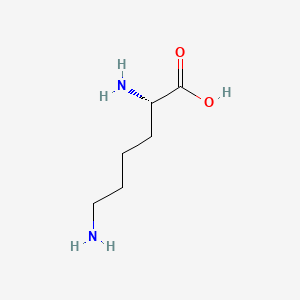
- Formula
- C6H14N2O2
- Weight
- 146.19 Da
- PubChem CID
- 5962
- Exact Mass
- 146.1055 Da
- LogP
- -3
- TPSA
- 89.3 Ų
- H-Bond Donors
- 3
- H-Bond Acceptors
- 4
- Rotatable Bonds
- 5
- Complexity
- 106
Identifiers (SMILES, InChI)
InChI=1S/C6H14N2O2/c7-4-2-1-3-5(8)6(9)10/h5H,1-4,7-8H2,(H,9,10)/t5-/m0/s1
KDXKERNSBIXSRK-YFKPBYRVSA-NReferences (6)
- [5]L-lysine supplementation attenuates experimental autoimmune hepatitis in a chronic murine model
→ Animal study showing lysine supplementation partially reversed liver injury and reduced pro-inflammatory cytokine expression in an autoimmune hepatitis model, suggesting potential protective effects.
- [2]L-lysine dietary supplementation for childhood and adolescent growth: Promises and precautions
→ Review examining lysine supplementation for promoting growth in children, particularly in developing countries with cereal-based diets, while highlighting safety considerations and optimal dosing strategies.
- [1]Lysine: Sources, Metabolism, Physiological Importance, and Use as a Supplement
→ Comprehensive review examining lysine metabolism, post-translational modifications in proteins, and its role in homoarginine and carnitine synthesis, highlighting its importance in epigenetic regulation and nutritional applications.
- [4]Safety assessment of L-lysine oral intake: a systematic review
→ Comprehensive safety evaluation using systematic review methodology to establish safe upper intake limits for lysine supplementation in humans, analyzing adverse events across multiple clinical studies.
- [6]Lysine supplementation is not effective for the prevention or treatment of feline herpesvirus 1 infection in cats: a systematic review
→ Systematic review found no scientific merit for lysine supplementation in preventing or treating feline herpesvirus-1, contradicting its widespread veterinary use despite popularity among practitioners.
- [3]Comprehensive Safety Assessment of l-Lysine Supplementation from Clinical Studies: A Systematic Review
→ Systematic review of 71 studies with 3,357 subjects found lysine doses up to 17.5g/day for up to 1,095 days caused mainly mild gastrointestinal symptoms, establishing a provisional no-observed-adverse-effect level of 6.0g/day.
Continue researching Lysine
Keep scientific evidence separate from commercial availability. Review how claims are evaluated, explore question-led research paths, or inspect disclosed source records without changing the editorial conclusions on this page.