Phenotropil
Phenotropil research profile covering evidence quality, proposed mechanisms, safety considerations, regulatory status, and linked primary sources.
Evidence-led profile
Research snapshot
- Evidence stage
- Emerging research
- References
- 9 linked sources
- Research coverage
- 2 areas
- Editorial review
- Jul 7, 2026
Published by the PepGuide Editorial Team using our research methodology.
Overview
Phenotropil (phenylpiracetam, fonturacetam, Phenylpiracetam, Carphedon) is a synthetic racetam-class compound created by adding a phenyl group to the 4-position of piracetam's pyrrolidone ring. It was developed in the 1980s at the Institute of Biomedical Problems of the Russian Academy of Sciences by Dr. Valentina Ivanovna Akhapkina, originally as part of the Soviet space program to enhance cosmonaut cognitive performance, stress resilience, and cold tolerance during extended space missions. The phenyl group addition dramatically increases lipophilicity and CNS bioavailability compared to piracetam, resulting in approximately 30–60 times greater potency and a pharmacological profile that uniquely combines nootropic, psychostimulant, anxiolytic, and physical performance-enhancing properties. Phenotropil was approved in Russia as a prescription nootropic (marketed as Phenotropil and later Nanotropil) and was subsequently banned by the World Anti-Doping Agency (WADA) after multiple doping violations in Olympic athletes.
The mechanism of action of phenotropil is multifaceted and not fully characterized, reflecting its broad receptor interaction profile. Like other racetams, it positively modulates AMPA-type glutamate receptors, enhancing excitatory neurotransmission and facilitating long-term potentiation — the synaptic basis of learning and memory. However, phenotropil additionally demonstrates significant dopaminergic activity: it increases dopamine receptor density (particularly D1 and D2/D3 subtypes) in the striatum, inhibits dopamine transporter (DAT)-mediated reuptake, and enhances dopaminergic neurotransmission in reward and motor circuits. This dopaminergic component underlies its stimulant properties — increased psychomotor speed, motivation, energy, and wakefulness — that distinguish it from the purely cognitive racetams. Additional mechanisms include GABA-A receptor modulation (contributing anxiolytic effects), nicotinic acetylcholine receptor activation, NMDA receptor modulation, and enhancement of cortical alpha and beta EEG activity. The remarkable cold-tolerance effect, which has been replicated in multiple rodent studies showing extended survival in hypothermic conditions, is thought to involve enhanced mitochondrial function and metabolic thermogenesis.
Phenotropil is typically dosed at 100–300 mg daily, taken in the morning or early afternoon to avoid insomnia. Its stimulant properties are often compared to modafinil, though with a faster onset (30–60 minutes), shorter duration (4–6 hours), and more pronounced eugeroic and motivational effects. Tolerance develops relatively quickly with daily use (typically within 1–2 weeks), necessitating cycling protocols — commonly 2–3 weeks on followed by 1–2 weeks off. Phenotropil stacks well with choline sources like alpha-GPC or CDP-choline for acetylcholine support, with L-theanine to smooth any stimulant edge, and with complementary racetams like oxiracetam or aniracetam for multi-pathway cognitive enhancement. Side effects may include insomnia, irritability, headache (especially without choline supplementation), increased blood pressure, and psychomotor agitation at higher doses. Due to its WADA-banned status, phenotropil is unsuitable for competitive athletes subject to anti-doping testing.
Mechanism of Action
Mechanism of Action
Phenotropil (also known as phenylpiracetam or fonturacetam) is a racetam derivative with a phenyl group added to the 4-position of the piracetam pyrrolidone ring. This structural modification dramatically increases lipophilicity, enhancing blood-brain barrier penetration by approximately 20-fold compared to piracetam, and introduces catecholaminergic activity absent in the parent compound.
Glutamatergic Enhancement
Like other racetams, phenotropil positively modulates AMPA receptors, the primary fast excitatory glutamate receptors. By slowing receptor desensitization kinetics, it prolongs excitatory postsynaptic potentials and facilitates long-term potentiation (LTP) in hippocampal and cortical circuits. This ampakine mechanism underlies the core nootropic effects shared with other racetam family members.
Catecholaminergic Stimulation
The phenyl group addition confers dopamine and norepinephrine reuptake inhibition that is unique among racetams. By blocking DAT and NET, phenotropil increases catecholamine levels in the prefrontal cortex, nucleus accumbens, and striatum. This mechanism produces the psychostimulant properties — enhanced alertness, motivation, physical stamina, and cold tolerance — that led to its ban by WADA as a performance-enhancing substance.
Cholinergic Modulation
Phenotropil enhances nicotinic acetylcholine receptor (nAChR) function, particularly at cortical α4β2 receptors involved in sustained attention and working memory. This cholinergic enhancement synergizes with glutamatergic potentiation to produce broad cognitive improvement.
Neuroprotective Properties
Phenotropil demonstrates anticonvulsant activity, likely through GABA system modulation, and provides neuroprotection against hypoxia, toxins, and ischemic injury. It increases neuronal membrane fluidity, which may improve receptor trafficking and synaptic transmission efficiency. These properties have supported its clinical use in Russia for stroke recovery and traumatic brain injury rehabilitation.
Research
Reported Effects
First-Time Use:: Effects are often noticeable on first use with immediate impact, though some users report sleepiness initially before the body adapts to stimulant properties. Individual Response:: Effectiveness varies significantly between individuals, with some experiencing strong benefits while others report minimal effects or adverse reactions. Tolerance Development:: Users note that effects may diminish after 4-8 weeks of continuous use, with cycling recommended to maintain effectiveness. Comparison to Other Nootropics:: Generally considered more potent than piracetam for acute effects, with users preferring it for one-time or intermittent use rather than daily supplementation
- Effects are often noticeable on first use with immediate impact, though some users report sleepiness initially before the body adapts to stimulant properties
- Effectiveness varies significantly between individuals, with some experiencing strong benefits while others report minimal effects or adverse reactions
- Users note that effects may diminish after 4-8 weeks of continuous use, with cycling recommended to maintain effectiveness
- Generally considered more potent than piracetam for acute effects, with users preferring it for one-time or intermittent use rather than daily supplementation
Phenylated racetam neuromodulation
Phenotropil (phenylpiracetam / fonturacetam) is a phenyl-substituted analogue of piracetam developed in Russia, where it is a prescription drug for asthenia, cerebrovascular disorders, and post-stroke rehabilitation. The phenyl group adds psychostimulant activity and improved blood-brain-barrier penetration. Most efficacy data come from small Russian-language trials that are not indexed in PubMed, so Western-standard controlled evidence is limited.
- Phenyl substitution adds stimulant activity and CNS penetration
- Regional trials report benefit in asthenia and stroke recovery
- Rigorous PubMed-indexed controlled trials are lacking
Safety and Limitations
Safety Profile: Phenotropil
Common Side Effects
- Insomnia and sleep disturbances (most common; dose-dependent; avoid evening dosing)
- Increased blood pressure and mild hypertension
- Psychomotor agitation and restlessness
- Headache
- Mild nausea and gastrointestinal discomfort
- Skin flushing and warmth sensation
- Irritability or emotional lability
Serious Adverse Effects
- Hypertensive crisis in predisposed individuals at high doses
- Severe insomnia with prolonged wakefulness
- Allergic reactions including skin rash and pruritus
- Potential for psychological dependence due to stimulant and mood-elevating effects
- Psychotic symptoms reported rarely at supratherapeutic doses
- Hepatotoxicity with chronic high-dose use (limited data)
Contraindications
- Known hypersensitivity to phenotropil or other racetam compounds
- Uncontrolled hypertension or severe cardiovascular disease
- Severe hepatic impairment
- Severe renal impairment
- Pregnancy and breastfeeding (no safety data)
- Panic disorder or severe anxiety disorders (stimulant effects may exacerbate)
- History of psychosis
- Children under 18 years
Drug Interactions
- Antihypertensives: May counteract blood pressure control; monitor closely
- CNS stimulants (caffeine, amphetamines, modafinil): Additive stimulatory effects; increased risk of hypertension, insomnia, and agitation
- Anticoagulants (warfarin): Some reports of altered coagulation parameters; monitor INR
- Antidepressants (SSRIs): Potential for additive activating effects; monitor for anxiety and agitation
- Other racetams: Additive cognitive effects; dose adjustment may be needed
- Antiepileptics: May alter seizure threshold; use with caution
Population-Specific Considerations
- Cognitive enhancement: Typical doses 100-200 mg once or twice daily; take in the morning or early afternoon to avoid insomnia
- Athletes: Banned by WADA as a stimulant; may cause positive doping test
- Hypertensive patients: Regular blood pressure monitoring essential; may require dose reduction
- Note: Phenotropil (fonturacetam) was developed in Russia and is the same compound as phenylpiracetam. It was originally approved for medical use in Russia but has been discontinued. Not approved by FDA or EMA.
Common Side Effects
- Energy Crash:: Multiple users report significant crashes 5+ hours after dosing, particularly at higher doses (200mg+), with fatigue and mood decline
- Anxiety & Overstimulation:: Some users experience increased anxiety, restlessness, or jitteriness, especially at doses above 100mg without choline supplementation
- Headaches:: Reported by several users, typically preventable or reducible by adding CDP-choline or alpha-GPC to the regimen
- Sleep Disruption:: Can interfere with sleep if taken too late in the day, with users noting the importance of morning administration
Research protocol summary
- Typical Dose
- 100mg is commonly mentioned as a starting dose, with users reporting noticeable effects at this level
These values summarize cataloged research protocols. They are not personal dosing instructions or medical guidance.
Reconstitution Calculator
Pharmacokinetic Profile
Molecular Structure
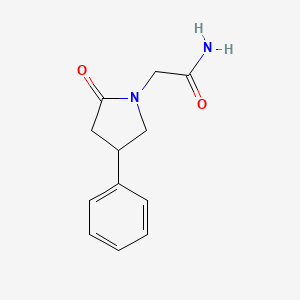
- Formula
- C12H14N2O2
- Weight
- 218.25 Da
- PubChem CID
- 132441
- Exact Mass
- 218.1055 Da
- LogP
- 0.1
- TPSA
- 63.4 Ų
- H-Bond Donors
- 1
- H-Bond Acceptors
- 2
- Rotatable Bonds
- 3
- Complexity
- 285
Identifiers (SMILES, InChI)
InChI=1S/C12H14N2O2/c13-11(15)8-14-7-10(6-12(14)16)9-4-2-1-3-5-9/h1-5,10H,6-8H2,(H2,13,15)
LYONXVJRBWWGQO-UHFFFAOYSA-NResearch Indications
Neuropsychiatric (regional clinical use)
Approved in Russia/CIS for asthenic and chronic fatigue states; reported improvements in energy and mental stamina.
Used adjunctively in rehabilitation after ischemic stroke and cerebrovascular insufficiency in regional trials.
Phenyl-substituted piracetam with stimulant and cognition-modulating properties.
References (9)
- [7]Complex treatment of epilepsy with phenotropil
→ When added to antiepileptic drugs, phenotropil at 100 mg daily for 2 months significantly reduced seizure frequency and improved EEG parameters with reduction in epileptiform changes in epilepsy patients.
- [1]Investigation into stereoselective pharmacological activity of phenotropil
→ Research comparing R- and S-enantiomers found that R-phenotropil showed significant locomotor activity increases at 10-50 mg/kg and antidepressant effects at 50-100 mg/kg, while both enantiomers demonstrated different pharmacological profiles in behavioral tests.
- [2]Effects of nootropic drugs on behavior of BALB/c and C57BL/6 mice in the exploratory cross-maze test
→ Phenotropil improved exploratory behavior in anxious BALB/c mice, reduced anxiety, and increased locomotor activity, demonstrating clear positive modulation of spontaneous orientation in mice with initially low exploratory efficiency.
- [3]Comparative evaluation of the neuroprotective activity of phenotropil and piracetam in laboratory animals with experimental cerebral ischemia
→ Phenotropil demonstrated superior neuroprotective properties compared to piracetam, reducing neurological deficiency, maintaining cognitive functions, increasing survival rates, and promoting restoration of cerebral blood flow in ischemic conditions.
- [4]Effects of nootropic drugs on hippocampal and cortical BDNF levels in mice with different exploratory behavior efficacy
→ Phenotropil increased brain-derived neurotrophic factor (BDNF) levels in the hippocampus of mice with low exploratory efficiency, suggesting its nootropic effects may be mediated through BDNF-dependent neuroplasticity mechanisms.
- [5]Psychoimmunomodulatory effect of phenotropil in animals with immune stress
→ Phenotropil at 25 mg/kg demonstrated psychoimmunomodulatory effects in rats with LPS-induced immune stress, preventing anxiety and fear responses while improving locomotor activity and immunoreactivity.
- [6]Identification and evaluation of the neuroleptic activity of phenotropil
→ Phenotropil showed marked neuroleptic activity in models of both positive and negative psychosis symptoms without sedative effects or adverse reactions typical of traditional antipsychotics, while exhibiting anxiolytic and antidepressant actions.
- [8]Pharmacological effects of fonturacetam (Actitropil) and prospects for its clinical use
→ Comprehensive analysis indicates phenylpiracetam shows promise for cerebral ischemia, neurodegenerative diseases, epilepsy, and mental disorders, with adaptogenic properties and mitochondrial protective effects affecting neurotransmitter systems and metabolism.
- [9]Cohen PA, et al. Unauthorized ingredients in 'nootropic' dietary supplements: A review of the history, pharmacology, and detection Clinical Toxicology / related (2023)
→ Characterizes phenylpiracetam among nootropic ingredients sold in supplements outside approved regulatory pathways in Western markets.
Continue researching Phenotropil
Keep scientific evidence separate from commercial availability. Review how claims are evaluated, explore question-led research paths, or inspect disclosed source records without changing the editorial conclusions on this page.