Rapastinel
Rapastinel research profile covering evidence quality, proposed mechanisms, safety considerations, regulatory status, and linked primary sources.
Evidence-led profile
Research snapshot
- Evidence stage
- Emerging research
- References
- 10 linked sources
- Research coverage
- 1 area
- Editorial review
- Jul 7, 2026
Published by the PepGuide Editorial Team using our research methodology.
Overview
Rapastinel (formerly GLYX-13) is a tetrapeptide (threonine-proline-proline-threonine) derived from a monoclonal antibody that modulates the NMDA receptor by acting as a functional partial agonist at the glycine binding site. Unlike full NMDA antagonists such as ketamine, rapastinel enhances NMDA receptor function at low glutamate concentrations while limiting excessive activation at high concentrations, producing a unique pharmacological profile that supports synaptic plasticity without triggering dissociative, psychotomimetic, or addictive effects. This mechanism positions rapastinel as a potential next-generation antidepressant that captures ketamine's rapid-onset efficacy while avoiding its clinical limitations.
In Phase II clinical trials, a single intravenous dose of rapastinel produced significant antidepressant effects within 24 hours in patients with treatment-resistant depression, with benefits persisting for approximately 7 days. The compound enhanced long-term potentiation (LTP) in hippocampal circuits and increased BDNF (brain-derived neurotrophic factor) expression and downstream signaling through the mTOR and TrkB pathways — mechanisms shared with ketamine and believed to underlie rapid synaptic remodeling. Importantly, rapastinel did not produce the sedation, cognitive impairment, or abuse liability observed with ketamine, and it showed no psychotomimetic effects at therapeutic doses, making it suitable for outpatient administration.
Despite promising Phase II results, rapastinel's Phase III trials (conducted by Allergan) failed to meet primary endpoints for major depressive disorder in 2019, leading to discontinuation of its clinical development program. The failures have been attributed to various factors including dosing regimen challenges, patient selection, and the inherent difficulty of the intravenous route for a maintenance antidepressant. Nevertheless, rapastinel's mechanism of action validated the glycine site of the NMDA receptor as a therapeutic target for depression and influenced the development of oral follow-on compounds. Related glutamatergic antidepressant approaches include ketamine, memantine, and magnesium (which provides physiological NMDA modulation).
Mechanism of Action
Mechanism of Action: Rapastinel
Rapastinel (GLYX-13, Thr-Pro-Pro-Thr) is a synthetic tetrapeptide derived from a monoclonal antibody (B6B21) that modulates NMDA receptor function. It represents a novel mechanism for rapid-acting antidepressant therapy that avoids the psychotomimetic side effects of full NMDA receptor antagonists like ketamine.
NMDA Receptor Pharmacology
Rapastinel acts at the glycine binding site on the GluN1 subunit of NMDA receptors as a functional partial agonist. At synapses with low glycine occupancy, it enhances NMDA receptor-mediated currents; at saturating glycine concentrations, it produces modest inhibition. This bimodal activity creates a self-limiting modulation that enhances physiological NMDA receptor signaling without risking excitotoxicity. It shows selectivity for GluN2B-containing NMDA receptors, which are enriched in cortical and limbic circuits relevant to mood regulation.
Synaptic Plasticity Enhancement
Enhanced NMDA receptor calcium influx in prefrontal pyramidal neurons activates CaMKII, which phosphorylates GluA1 AMPA receptor subunits at Ser831, increasing single-channel conductance. Simultaneously, PKA-mediated GluA1 Ser845 phosphorylation promotes AMPA receptor insertion into the postsynaptic density. This AMPA receptor potentiation is the molecular substrate for long-term potentiation (LTP), which rapastinel enhances both in the hippocampal Schaffer collateral pathway and prefrontal cortex.
BDNF-mTORC1 Signaling Cascade
NMDA receptor activation triggers release of mature BDNF from dendritic stores. BDNF activates TrkB receptors, initiating two parallel cascades: (1) PI3K→Akt→mTORC1 pathway: activates p70S6K and releases 4E-BP1 inhibition of eIF4E, driving rapid translation of dendritic mRNAs encoding synaptic proteins including PSD-95, GluA1, and synapsin I; (2) Ras→MEK→ERK pathway: promotes CREB phosphorylation and transcription of BDNF and other plasticity genes. Together, these produce rapid (within hours) increases in dendritic spine density and synaptic connectivity.
Antidepressant Mechanism
Chronic stress and depression are associated with dendritic atrophy, spine loss, and reduced synaptic connectivity in the medial prefrontal cortex (mPFC). Rapastinel rapidly reverses these deficits by: (1) restoring glutamatergic drive to mPFC pyramidal neurons; (2) increasing BDNF-TrkB signaling in cortical circuits; (3) promoting mTORC1-dependent synaptogenesis; (4) enhancing prefrontal top-down control over amygdala and other limbic structures. Antidepressant-like effects appear within hours and persist for approximately 7 days after a single administration.
Safety Advantages
Unlike ketamine (a channel blocker), rapastinel does not produce dissociative symptoms, psychotomimetic effects, or abuse liability. Unlike full glycine site agonists, it does not cause seizures. The partial agonist mechanism provides a therapeutic window that enhances synaptic plasticity without excitotoxicity, representing a potentially safer approach to NMDA receptor-based antidepressant therapy.
Research
Reported Effects
Clinical Efficacy:: Multiple controlled trials demonstrate rapid and sustained antidepressant effects in treatment-resistant depression comparable to ketamine. Safety Profile:: Shows significantly fewer side effects than ketamine, with no psychotomimetic effects, minimal impact on driving performance, and low abuse potential. Duration of Action:: Single administration produces effects lasting 7+ days in preclinical models and up to several weeks in some clinical observations. Mechanism Validation:: Effects are mediated through well-characterized pathways (ERK/mTOR signaling, BDNF release) supporting synaptic plasticity and neuroplasticity
- Multiple controlled trials demonstrate rapid and sustained antidepressant effects in treatment-resistant depression comparable to ketamine
- Shows significantly fewer side effects than ketamine, with no psychotomimetic effects, minimal impact on driving performance, and low abuse potential
- Single administration produces effects lasting 7+ days in preclinical models and up to several weeks in some clinical observations
- Effects are mediated through well-characterized pathways (ERK/mTOR signaling, BDNF release) supporting synaptic plasticity and neuroplasticity
Safety and Limitations
Safety Profile: Rapastinel (GLYX-13)
Common Side Effects
- Generally well tolerated in clinical trials at doses of 1–10 mg/kg IV
- Mild dissociative symptoms significantly less frequent and less severe than with ketamine
- Transient dizziness and lightheadedness following IV administration
- Mild headache reported in some clinical trial participants
- Transient changes in blood pressure (typically mild elevation) during infusion
Serious Adverse Effects
- Limited long-term safety data as the compound did not complete Phase III development (failed to meet primary endpoints)
- No significant psychotomimetic effects, abuse liability, or cognitive impairment observed in available trial data
- Theoretical concerns about NMDA receptor modulation affecting neuroplasticity with repeated dosing
- No evidence of hepatotoxicity or nephrotoxicity in completed clinical trials
- Cardiac safety profile appeared favorable in Phase II studies (no QT prolongation)
Contraindications
- Known hypersensitivity to rapastinel or any formulation excipients
- Not currently approved for clinical use; available only in research settings
- History of significant adverse reactions to NMDA receptor modulators
- Pregnancy and lactation (no reproductive toxicity data in humans)
- Active substance use disorders (limited data on abuse potential, though preclinical studies suggest low abuse liability)
Drug Interactions
- Other NMDA receptor modulators (ketamine, memantine, dextromethorphan): Potential for additive or unpredictable effects on NMDA receptor function
- CNS depressants (benzodiazepines, opioids, alcohol): May potentiate sedative effects; monitor respiratory and cognitive function
- Antidepressants (SSRIs, SNRIs): Clinical trials included patients on stable antidepressant regimens; no significant interactions observed, but data are limited
- Anticonvulsants: Theoretical interaction given NMDA involvement in seizure physiology; use cautiously
Population-Specific Considerations
- Elderly: Limited data in geriatric populations; start with conservative dosing given age-related changes in NMDA receptor function
- Pediatric: No safety or efficacy data in children or adolescents
- Treatment-resistant depression patients: Primary studied population; appears to have a favorable acute safety profile but long-term data are lacking
- Substance use history: Low abuse potential suggested by preclinical studies, but clinical confirmation is incomplete
- Research use only: Not FDA-approved; any use should be within appropriate research protocols with ethics oversight
Common Side Effects
- Minimal Acute Effects:: Unlike ketamine, rapastinel shows no dissociative effects, psychotomimetic symptoms, or significant cognitive impairment at therapeutic doses
- No Abuse Potential:: Research indicates minimal to no abuse liability, distinguishing it from NMDA antagonists like ketamine
- Sleep Architecture:: Minimal impact on sleep patterns, without the sleep-deprivation-like effects seen with ketamine
- Well-Tolerated:: Clinical trials report comparable safety profiles to placebo with no serious adverse events at studied doses
Reconstitution Calculator
Pharmacokinetic Profile
Molecular Structure
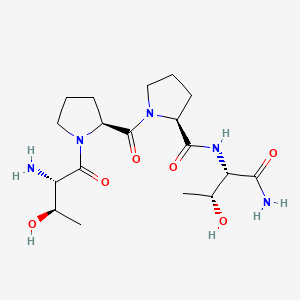
- Formula
- C18H31N5O6
- Weight
- 413.5 Da
- PubChem CID
- 14539800
- Exact Mass
- 413.2274 Da
- LogP
- -2.8
- TPSA
- 179 Ų
- H-Bond Donors
- 5
- H-Bond Acceptors
- 7
- Rotatable Bonds
- 7
- Complexity
- 659
Identifiers (SMILES, InChI)
InChI=1S/C18H31N5O6/c1-9(24)13(19)18(29)23-8-4-6-12(23)17(28)22-7-3-5-11(22)16(27)21-14(10(2)25)15(20)26/h9-14,24-25H,3-8,19H2,1-2H3,(H2,20,26)(H,21,27)/t9-,10-,11+,12+,13+,14+/m1/s1
GIBQQARAXHVEGD-BSOLPCOYSA-NReferences (10)
- [8]Rapastinel (GLYX-13) has therapeutic potential for the treatment of post-traumatic stress disorder
→ Rapastinel showed promise for PTSD treatment by modulating fear memory consolidation through NMDA receptor-mediated metaplasticity in the medial prefrontal cortex.
- [6]Repeated administration of rapastinel produces exceptionally prolonged rescue of memory deficits in phencyclidine-treated mice
→ Multiple doses of rapastinel produced sustained rescue of memory deficits lasting weeks beyond the treatment period in a schizophrenia-like model.
- [2]Comparison of R-ketamine and rapastinel antidepressant effects in the social defeat stress model of depression
→ Both rapastinel and R-ketamine significantly reduced depression-like behaviors in stressed mice, with effects lasting up to 7 days after a single injection.
- [3]The long-lasting antidepressant effects of rapastinel (GLYX-13) are associated with a metaplasticity process in the medial prefrontal cortex and hippocampus
→ Rapastinel's antidepressant effects are linked to enhanced synaptic plasticity and metaplasticity processes in brain regions critical for mood regulation and cognition.
- [4]A randomized, multicenter trial assessing the effects of rapastinel compared to ketamine, alprazolam, and placebo on simulated driving performance
→ Unlike ketamine, rapastinel at doses up to 1800mg showed no significant impairment in driving performance or cognitive function, demonstrating a favorable safety profile.
- [7]ERK/mTOR signaling may underlying the antidepressant actions of rapastinel in mice
→ The antidepressant effects of rapastinel appear to be mediated through ERK and mTOR signaling pathways, which are crucial for synaptic plasticity and neuroplasticity.
- [1]Positive N-Methyl-D-Aspartate Receptor Modulation by Rapastinel Promotes Rapid and Sustained Antidepressant-Like Effects
→ Rapastinel demonstrated rapid and sustained antidepressant effects through NMDA receptor modulation, enhancing synaptic plasticity without producing the dissociative effects seen with ketamine antagonists.
- [5]Rapastinel, an NMDAR positive modulator, produces distinct behavioral, sleep, and EEG profiles compared with ketamine
→ Rapastinel showed minimal effects on locomotor activity, sleep architecture, and gamma oscillations, with no psychotomimetic or dissociative effects unlike ketamine.
- [9]Moskal JR, Burgdorf JS, Stanton PK, et al. The Development of Rapastinel (Formerly GLYX-13); A Rapid Acting and Long Lasting Antidepressant Current Neuropharmacology (2017)
→ Rapastinel is an IV-administered NMDA receptor glycine-site partial agonist; single IV doses of 5 mg/kg and 10 mg/kg produced rapid antidepressant effects in phase 2 MDD trials without ketamine-like dissociative effects.
- [10]Rodriguez CI, Zwerling J, Kalanthroff E, et al. Effect of a Novel NMDA Receptor Modulator, Rapastinel (Formerly GLYX-13), in OCD: Proof of Concept American Journal of Psychiatry (2016)
→ A single IV push of rapastinel 10 mg/kg was administered to OCD patients in a proof-of-concept study.
Continue researching Rapastinel
Keep scientific evidence separate from commercial availability. Review how claims are evaluated, explore question-led research paths, or inspect disclosed source records without changing the editorial conclusions on this page.