Piracetam
The original racetam nootropic and prototype cognitive enhancer, a cyclic derivative of GABA that modulates glutamatergic neurotransmission and membrane fluidity to support memory, learning, and neuroprotection without sedation or stimulation.
Evidence-led profile
Research snapshot
- Evidence stage
- Emerging research
- References
- 16 linked sources
- Research coverage
- 4 areas
- Editorial review
- Jul 7, 2026
Published by the PepGuide Editorial Team using our research methodology.
Overview
Piracetam (2-oxo-1-pyrrolidine acetamide) is the founding member of the racetam class of nootropics, synthesized in 1964 by Romanian chemist Corneliu Giurgea, who also coined the term "nootropic" to describe its unique pharmacological profile — enhancing cognition without the sedation, stimulation, or toxicity associated with psychotropic drugs. Despite being derived from GABA, piracetam does not bind GABA receptors and shows no GABAergic activity. Instead, its primary mechanism involves allosteric modulation of AMPA-type glutamate receptors, enhancing excitatory neurotransmission and facilitating long-term potentiation (LTP), the synaptic process underlying learning and memory formation. Piracetam also modulates NMDA receptors and improves cell membrane fluidity by interacting with phospholipid head groups, which may enhance signal transduction and neurotransmitter receptor function.
Piracetam has been extensively studied in clinical trials spanning several decades. In elderly populations with cognitive decline, meta-analyses have shown statistically significant improvements in memory and global cognitive function compared to placebo. It is approved as a prescription medication in many European and Asian countries for indications including age-related cognitive decline, post-stroke aphasia and recovery, myoclonus (particularly cortical myoclonus, where high-dose piracetam is a recognized treatment), vertigo, dyslexia, and sickle cell disease (where it reduces red blood cell sickling and painful crises by improving membrane deformability). Its safety profile is notably benign — piracetam is water-soluble, shows no significant hepatic metabolism, is renally excreted largely unchanged, and has an extremely high LD50 in animal studies.
Piracetam's relatively modest potency compared to newer racetams has led to the development of numerous derivatives including phenylpiracetam, aniracetam, oxiracetam, pramiracetam, coluracetam, and fasoracetam — each with enhanced potency or distinct receptor selectivity. Typical nootropic dosing ranges from 1,200-4,800 mg/day, often divided into two or three doses. Piracetam is commonly stacked with choline sources such as alpha-GPC or CDP-choline to support acetylcholine synthesis and mitigate occasional headaches attributed to choline depletion. In the United States, piracetam occupies a regulatory gray area — it is not FDA-approved and cannot be marketed as a dietary supplement, yet it is not a controlled substance.
Research
Reported Effects
Cumulative Benefits:: Effects often improve over weeks.. Subtle Action:: Not immediately noticeable like stimulants.. Synergy:: Works well with choline and other racetams.
Myoclonus
Piracetam's best-supported clinical use is as add-on therapy for cortical and action myoclonus. Randomized crossover trials in cortical myoclonus and in progressive myoclonus epilepsy (Unverricht-Lundborg disease) demonstrated dose-dependent reductions in myoclonus severity and functional disability at high oral doses (up to ~24 g/day), with good tolerability.
- 24 g/day significantly improved myoclonus and disability in Unverricht-Lundborg disease
- Benefit follows a linear dose-response relationship
- Generally well tolerated with few, mild, transient adverse effects
Cognition and dementia
As the prototypical racetam nootropic, piracetam has been studied extensively in age-related cognitive impairment. Meta-analyses report improvement on global clinical impression measures, but a Cochrane review concluded the evidence is inadequate to support routine clinical use for dementia, while noting it justifies further research.
- Meta-analysis of 19 RCTs found global clinical improvement in cognitively impaired elderly
- Cochrane review: benefit on global change but not on specific cognitive tests
- Effect on established dementia remains unproven for routine use
Mechanism of action
Piracetam is thought to modulate neuronal and vascular function by enhancing membrane fluidity, improving mitochondrial function, and modulating AMPA/cholinergic neurotransmission and platelet/erythrocyte deformability. These pleiotropic effects are proposed to underlie both its neuroprotective and antimyoclonic actions.
- Restores membrane fluidity and improves cell deformability
- Modulates AMPA-glutamatergic and cholinergic transmission
- Improves microcirculation and mitochondrial efficiency
Safety and Limitations
Common side effects include headaches, insomnia, nervousness, agitation, and gastrointestinal discomfort. It is contraindicated in individuals with severe renal impairment, Huntington's disease, or cerebral hemorrhage. Piracetam may enhance the effects of anticoagulants and thyroid hormones, so medical supervision is advised when used concurrently with these medications.
Common Side Effects
- Headaches:: Common without adequate choline.
- Insomnia:: Possible if taken late in day.
- Brain Fog:: Paradoxically possible at wrong doses.
- Extremely Safe:: Excellent safety record over decades.
Mechanism of Action
Piracetam (2-oxo-1-pyrrolidine acetamide) is the founding compound of the racetam class of nootropics, structurally derived from GABA but lacking direct GABAergic activity. Its mechanism is multifaceted and primarily manifests under conditions of neuronal impairment. At the molecular level, piracetam binds to a unique allosteric site on AMPA-type glutamate receptors, as demonstrated by X-ray crystallography of the GluA2 ligand-binding domain. This positive allosteric modulation enhances glutamatergic excitatory neurotransmission, facilitating long-term potentiation (LTP) and synaptic plasticity, which are fundamental to learning and memory formation.
A central mechanism involves piracetam's interaction with membrane phospholipids. It restores fluidity to aged or damaged neuronal membranes by intercalating with the polar head groups of the phospholipid bilayer. This normalization of membrane dynamics improves the function of membrane-bound proteins including receptors, ion channels, and neurotransmitter transporters. Through this membrane effect, piracetam indirectly enhances cholinergic neurotransmission by increasing muscarinic acetylcholine receptor density and improving acetylcholine turnover in the hippocampus, without directly binding to cholinergic receptors.
Piracetam also exhibits significant neuroprotective and rheological properties. It stabilizes mitochondrial function and enhances cerebral energy metabolism by increasing ATP synthesis and glucose/oxygen utilization under hypoxic conditions. Its rheological effects include reducing blood viscosity, decreasing platelet aggregation, and improving erythrocyte deformability, collectively enhancing cerebral microcirculation. These properties make piracetam particularly effective in age-related cognitive decline, post-stroke recovery, and conditions involving impaired cerebral blood flow.
Research protocol summary
- Typical Dose
- 1.6-4.8g daily, divided into 2-3 doses.
These values summarize cataloged research protocols. They are not personal dosing instructions or medical guidance.
Pharmacokinetic Profile
- Half-life
- 5 h
- Tmax
- 1.25 h
Molecular Structure
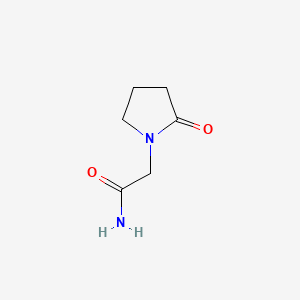
- Formula
- C6H10N2O2
- Weight
- 142.16 Da
- PubChem CID
- 4843
- Exact Mass
- 142.0742 Da
- LogP
- -1.3
- TPSA
- 63.4 Ų
- H-Bond Donors
- 1
- H-Bond Acceptors
- 2
- Rotatable Bonds
- 2
- Complexity
- 167
Identifiers (SMILES, InChI)
InChI=1S/C6H10N2O2/c7-5(9)4-8-3-1-2-6(8)10/h1-4H2,(H2,7,9)
GMZVRMREEHBGGF-UHFFFAOYSA-NResearch Indications
Established / Approved Uses
Add-on therapy for disabling cortical/action myoclonus, including progressive myoclonus epilepsy (Unverricht-Lundborg disease).
Used in several countries for cognitive decline in the elderly; meta-analyses show global improvement though effects on specific tests are modest.
Historically studied as an adjunct to reading instruction in children with dyslexia.
Investigational Uses
Studied for neurological recovery after acute ischemic events with mixed results.
Explored as adjunctive therapy for vertigo of central and peripheral origin.
References (16)
- [8]Efficacy and safety of compound porcine cerebroside and ganglioside injection versus piracetam on cognition
→ Large controlled trial comparing CPCGI injection effectiveness to piracetam for cognitive and functional outcomes in mild to moderate traumatic brain injury.
- [5]Cognitive effects of piracetam in adults with memory impairment: A systematic review and meta-analysis
→ Analysis of multiple clinical trials found no significant difference in memory enhancement between those taking piracetam and the placebo group.
- [6]Physicochemical investigations of nootropic drug piracetam for enhanced solubilization
→ Study demonstrated that mixing surfactants improves drug solubilization, showing that the process is spontaneous and entropically favorable.
- [1]Piracetam for fetal distress in labour
→ One study suggested piracetam might reduce the likelihood of a caesarean section, but there was no significant impact on neonatal health.
- [2]Piracetam for acute ischaemic stroke
→ Research found no significant evidence to support its benefit, with a slight, but not statistically significant, trend towards increased early death.
- [3]Piracetam for reducing the incidence of painful sickle cell disease crises
→ Review of three trials determined evidence was insufficient and of poor quality despite some potential benefits noted in certain trials.
- [4]Piracetam in the treatment of cortical myoclonus
→ Individualized high dosages (7-24g daily) can be very effective with minimal side effects, with improvements observed at up to 45g daily.
- [7]Effect of Piracetam and Iron Treatment on Heart Rate Variability in Patients With Breath-Holding Spell
→ Research observed significant improvements in HRV parameters and a reduction in the number of breath-holding episodes with piracetam treatment.
- [9]Docosahexaenoic Acid Plus Piracetam Versus Piracetam Alone for Treatment of Breath-Holding Spells
→ Adding DHA to piracetam significantly reduced the frequency and severity of breath-holding spells with 16% experiencing spells versus 50% with piracetam alone.
- [10]Piracetam mitigates nephrotoxicity induced by cisplatin via the AMPK-mediated signaling pathways
→ Investigation found piracetam improved kidney function, reduced tissue damage and inflammation against chemotherapy-induced kidney damage.
- [11]Koskiniemi M, Van Vleymen B, Hakamies L, Lamusuo S, Taalas J Piracetam relieves symptoms in progressive myoclonus epilepsy: a multicentre, randomised, double blind, crossover study comparing the efficacy and safety of three dosages of oral piracetam with placebo Journal of Neurology, Neurosurgery, and Psychiatry (1998)
→ Oral piracetam at 9.6, 16.8 and 24 g/day in two divided doses showed a linear dose-response, with 24 g/day producing significant clinical improvement and good tolerability in progressive myoclonus epilepsy.
- [12]Brown P, Steiger MJ, Thompson PD, et al. Effectiveness of piracetam in cortical myoclonus Movement Disorders (1993)
→ Placebo-controlled crossover trial (n=21) showed dose-dependent benefit of piracetam up to 16.8 g/day in disabling cortical myoclonus of varied etiology.
- [13]Flicker L, Grimley Evans G. Piracetam for dementia or cognitive impairment Cochrane Database of Systematic Reviews (2001)
→ Cochrane review found effects on global impression of change but insufficient evidence to support routine clinical use for dementia.
- [14]Waegemans T, Wilsher CR, Danniau A, et al. Clinical efficacy of piracetam in cognitive impairment: a meta-analysis Dementia and Geriatric Cognitive Disorders (2002)
→ Meta-analysis of 19 double-blind placebo-controlled studies found piracetam associated with clinically meaningful global improvement in cognitively impaired elderly.
- [15]Herrschaft H. On the efficacy of piracetam in geriatric patients with acute cerebral ischemia: a clinically controlled double-blind study Archives of Gerontology and Geriatrics (1988)
→ Double-blind controlled study reported neurological improvement with piracetam in geriatric patients following acute cerebral ischemia.
- [16]Herrmann WM, Stephan K. Moving from the question of efficacy to the question of therapeutic relevance: an exploratory reanalysis of a controlled clinical study of 130 inpatients with dementia syndrome taking piracetam International Psychogeriatrics (1992)
→ Reanalysis of a phase III placebo-controlled study (n=130, 4.8 g/day, 3 months) explored clinically relevant response in dementia syndrome.
Continue researching Piracetam
Keep scientific evidence separate from commercial availability. Review how claims are evaluated, explore question-led research paths, or inspect disclosed source records without changing the editorial conclusions on this page.