Galanin
Galanin is a 29-amino acid neuropeptide (30 in most non-human species) that signals through GalR1, GalR2, and GalR3 receptor subtypes to modulate depression, pain, cognition, feeding behavior, and seizure activity. GalR2 agonists are emerging as novel antidepressant candidates, while galanin's role in Alzheimer's disease through regulation of basal forebrain cholinergic neurons makes it a key target in neurodegeneration research.
Evidence-led profile
Research snapshot
- Evidence stage
- Emerging research
- References
- 13 linked sources
- Research coverage
- 7 areas
- Editorial review
- Jul 7, 2026
Published by the PepGuide Editorial Team using our research methodology.
Overview
Galanin is expressed in brain regions of major clinical significance: the locus coeruleus (LC, the principal noradrenergic nucleus), dorsal raphe nucleus (DRN, the principal serotonergic nucleus), basal forebrain cholinergic neurons (including the nucleus basalis of Meynert), hypothalamus, amygdala, hippocampus, and dorsal horn of the spinal cord. In most of these regions, galanin co-localizes with and modulates the release of classical neurotransmitters — it inhibits norepinephrine release in the LC, serotonin release in the DRN, and acetylcholine release in the basal forebrain Hökfelt et al. (2018).
The three galanin receptor subtypes create functional complexity: GalR1 is inhibitory (Gi/o-coupled, hyperpolarizing), GalR2 is predominantly excitatory (Gq/11-coupled, depolarizing, but also couples to Gi/o), and GalR3 is inhibitory (Gi/o-coupled). The net effect of galanin in any given brain region depends on the local expression ratio of these receptor subtypes. This receptor diversity has made galanin pharmacology particularly nuanced — GalR2 agonists are antidepressant and neuroprotective, while GalR1 activation is generally inhibitory and can impair cognition. Understanding subtype-selective pharmacology is central to galanin-based therapeutic development.
Galanin expression is dramatically upregulated following neuronal injury, seizures, and in neurodegenerative disease, suggesting an endogenous neuroprotective role. Galanin is one of the most robustly induced peptides after seizure activity, and galanin knockout mice show increased seizure severity, establishing a clear anticonvulsant function.
Research
Pain Modulation
Galanin plays a complex, dose-dependent role in pain processing at the spinal cord level. Galanin is expressed in small-diameter dorsal root ganglion (DRG) neurons and in spinal cord dorsal horn interneurons, and its expression is dramatically upregulated (10-20 fold) following peripheral nerve injury Liu & Hökfelt (2002). This injury-induced upregulation is among the most robust peptide responses to nerve damage.
At low concentrations, galanin facilitates pain transmission (pronociceptive), primarily through GalR2-mediated excitation of dorsal horn neurons. At higher concentrations, galanin is antinociceptive, primarily through GalR1-mediated inhibition of C-fiber-evoked responses and hyperpolarization of dorsal horn neurons. In neuropathic pain models, intrathecal galanin and GalR1 agonists reduce mechanical allodynia and thermal hyperalgesia. Galanin knockout mice show enhanced pain responses after nerve injury, confirming an endogenous antinociceptive role.
GalR2 agonists have paradoxically shown analgesic effects in certain inflammatory pain models, possibly through enhancement of descending inhibitory pathways or through neurotrophic effects that promote nerve regeneration. The complex, receptor-subtype-dependent and dose-dependent nature of galanin's pain modulation has made developing galanin-based analgesics challenging.
Feeding Behavior and Energy Balance
Galanin is orexigenic — ICV galanin injection stimulates food intake, with preferential stimulation of fat intake. Galanin-expressing neurons in the paraventricular nucleus (PVN) and lateral hypothalamus are activated during fasting and in response to a high-fat diet. The orexigenic effect is primarily mediated by GalR1 in the hypothalamus and is distinct from the NPY/AgRP orexigenic system — galanin stimulates fat preference while NPY stimulates carbohydrate preference. Galanin also modulates alcohol intake; galanin expression in the PVN is upregulated by alcohol consumption, and galanin injection increases voluntary alcohol intake in rodents, suggesting a role in alcohol reward and addiction.
Cognition and Alzheimer's Disease
Galanin profoundly modulates cholinergic function in the basal forebrain, the neuronal population most severely affected in Alzheimer's disease. Galanin fibers hyperinnervate surviving cholinergic neurons in the nucleus basalis of Meynert in Alzheimer's disease, and galanin inhibits acetylcholine release through GalR1-mediated presynaptic inhibition Counts et al. (2009). This galanin hyperinnervation was initially interpreted as contributing to the cholinergic deficit in AD.
However, subsequent research revealed a more nuanced picture: galanin overexpression is neuroprotective for cholinergic neurons, and galanin knockout mice show accelerated cholinergic neurodegeneration in AD models. Counts et al. demonstrated that GalR2 activation promotes cholinergic neuron survival through ERK/Akt signaling, while GalR1 activation inhibits acetylcholine release. Thus, galanin hyperinnervation in AD may represent a compensatory neuroprotective response — preserving cholinergic neurons at the cost of reduced acetylcholine release Counts et al. (2009).
Exogenous galanin impairs performance on hippocampus-dependent memory tasks (Morris water maze, passive avoidance, delayed nonmatching-to-position) when administered ICV, primarily through GalR1-mediated inhibition of hippocampal acetylcholine release and glutamatergic transmission. GalR2 agonists, conversely, enhance cognitive performance in some paradigms.
Depression and Mood Regulation
Galanin is heavily co-expressed with norepinephrine in the locus coeruleus and with serotonin in the dorsal raphe — the two brain regions most implicated in depression pathophysiology. Galanin expression is upregulated in the LC following chronic stress, and galanin overexpression in the LC produces depression-like behavior in animal models Kuteeva et al. (2008). This depression-promoting effect appears mediated by GalR1 and GalR3, which inhibit noradrenergic and serotonergic neuronal firing and neurotransmitter release.
Critically, the galanin receptor subtypes produce opposing effects on mood: GalR1 and GalR3 activation is pro-depressive (inhibiting monoaminergic transmission), while GalR2 activation is antidepressant (enhancing serotonergic transmission and promoting hippocampal neurogenesis). This dichotomy has generated significant interest in GalR2-selective agonists as a novel antidepressant strategy. The GalR2-preferring agonist M1145 produces robust antidepressant-like effects in the forced swim test and chronic mild stress paradigm, effects that are blocked by GalR2 antagonism and absent in GalR2 knockout mice Lu et al. (2007).
Human genetic studies have identified associations between galanin gene (GAL) and galanin receptor gene (GALR1, GALR2) polymorphisms and depression susceptibility, anxiety traits, and antidepressant treatment response, supporting the translational relevance of preclinical findings.
Seizure Modulation
Galanin is a potent endogenous anticonvulsant. Galanin expression increases dramatically (5-10 fold) in hippocampal neurons following seizure activity, and this upregulation serves as an endogenous brake on seizure propagation. Galanin knockout mice show increased seizure severity and status epilepticus-related mortality, while galanin overexpression in hippocampus reduces seizure susceptibility Mazarati et al. (2000).
The anticonvulsant mechanism involves GalR1-mediated inhibition of glutamate release in the hippocampus and GalR1-mediated hyperpolarization of hippocampal neurons through GIRK channel activation. Galanin analogs with improved BBB penetrance and metabolic stability are being developed as potential anticonvulsant therapies, particularly for status epilepticus and treatment-resistant temporal lobe epilepsy.
Galanin receptor pharmacology in epilepsy
Galanin is a 29/30-amino-acid neuropeptide widely expressed in the CNS that signals through three GPCRs (GalR1-3). In the hippocampus it dampens glutamatergic transmission and neuronal excitability. GalR1 knockout mice have spontaneous and more severe seizures, and GalR2 knockdown worsens status epilepticus, establishing galanin as an endogenous anticonvulsant system. Because native galanin does not cross the blood-brain barrier, medicinal chemistry has produced systemically active analogs (NAX 5055, NAX 810-2) with anticonvulsant efficacy.
- GalR1 and GalR2 mediate endogenous seizure suppression in the hippocampus
- CNS-penetrant analogs NAX 5055 and NAX 810-2 are anticonvulsant after systemic dosing
- GalR2 activation also promotes interneuron survival and seizure-induced neurogenesis
Mood, stress, and pain modulation
Galanin is co-stored with classical monoamines in noradrenergic and serotonergic neurons and is released during high-frequency firing and stress. Its receptors differentially regulate mood: GalR1 and GalR3 signaling tends to be pro-depressive/anxiogenic while GalR2 is protective, making subtype-selective ligands attractive antidepressant/anxiolytic leads. GalR2-preferring peptide analogs also produce analgesia across inflammatory and neuropathic pain assays.
- GalR2 agonism / GalR3 antagonism explored for antidepressant and anxiolytic effects
- Galanin engaged by stress and co-released with noradrenaline and serotonin
- GalR2-preferring analogs are analgesic in inflammatory and neuropathic pain models
Safety and Limitations
Galanin is an endogenous neuropeptide with well-characterized central effects:
- Cognitive effects: Exogenous galanin at supraphysiological doses impairs hippocampus-dependent learning and memory through GalR1-mediated inhibition of cholinergic and glutamatergic transmission. This cognitive-impairing potential is a consideration for non-selective galanin agonist therapies
- Feeding stimulation: Central galanin increases food intake and preferentially drives fat consumption. Weight gain is a theoretical concern for chronic galanin agonist therapy
- Sedation: High-dose ICV galanin produces sedation and reduced locomotor activity, likely through GalR1-mediated inhibition of monoaminergic arousal systems
- Cardiovascular: Galanin produces modest hypotension and bradycardia when administered centrally, through inhibition of sympathetic outflow
- Short half-life: Rapid enzymatic degradation (~6-8 minutes) limits duration of adverse effects with native peptide
- Galanin knockout phenotype: GAL-/- mice show increased anxiety, enhanced pain sensitivity, increased seizure susceptibility, but preserved baseline cognition — confirming galanin's endogenous roles in anxiety regulation, pain modulation, and seizure protection
Clinical Research Protocols
- ICV galanin (preclinical only): 0.1-10 nmol ICV injection for behavioral and neurochemical studies. Not administered centrally in humans.
- Intrathecal galanin (preclinical): 0.1-1 nmol intrathecal injection for spinal pain studies. Human intrathecal studies have not been conducted.
- Galanin CSF measurement: CSF galanin measured by RIA; reference range approximately 20-80 pg/mL. Elevated in Alzheimer's disease and following seizures.
- Genetic studies: GAL, GALR1, GALR2, and GALR3 polymorphism analysis for depression, anxiety, and cognitive trait associations.
- GalR2 agonist development: Preclinical candidates include M1145 and analogs; no GalR2-selective agonist has entered clinical trials as of 2025.
Mechanism of Action
Galanin modulates neuronal function through three receptor subtypes with distinct intracellular signaling:
GalR1 (Inhibitory): GalR1 couples to Gi/o proteins, inhibiting adenylyl cyclase, reducing cAMP, and activating G protein-coupled inwardly rectifying potassium (GIRK) channels. GIRK channel activation hyperpolarizes neurons, reducing excitability and neurotransmitter release. GalR1 is highly expressed in the hippocampus (CA1), amygdala, hypothalamus, and spinal cord dorsal horn. In the hippocampus, GalR1 activation inhibits glutamate release and impairs LTP, which may underlie galanin's cognitive-impairing effects at high concentrations.
GalR2 (Excitatory/Trophic): GalR2 primarily couples to Gq/11, activating PLC and generating IP3 and diacylglycerol. IP3-mediated calcium release activates CaMKII, while DAG activates PKC. GalR2 also activates ERK1/2 and Akt survival signaling pathways. Functionally, GalR2 activation is excitatory, neurotrophic, and neuroprotective — promoting neuronal survival, neurite outgrowth, and neurogenesis. GalR2 is expressed in the hippocampal dentate gyrus, amygdala, hypothalamus, and dorsal raphe. GalR2 agonists produce antidepressant-like effects through enhancement of serotonergic and noradrenergic signaling Lu et al. (2007).
GalR3 (Inhibitory): GalR3 couples to Gi/o, inhibiting adenylyl cyclase and activating GIRK channels, similar to GalR1. GalR3 has more restricted expression, with notable presence in the locus coeruleus, raphe nuclei, and hypothalamus. GalR3 antagonists have shown antidepressant-like effects in animal models, suggesting that GalR3 tonically inhibits monoaminergic systems.
Co-transmission Modulation: Galanin is co-stored and co-released with norepinephrine (LC), serotonin (DRN), and acetylcholine (basal forebrain) from the same synaptic vesicles. At low-frequency firing, classical neurotransmitters are preferentially released; at high-frequency firing (as occurs during stress), galanin is co-released and modulates neurotransmitter action through pre- and postsynaptic galanin receptors. This frequency-dependent co-release creates a stress-responsive neuromodulatory system.
Research protocol summary
- Route
- Research: ICV, intrathecal, intranasal
These values summarize cataloged research protocols. They are not personal dosing instructions or medical guidance.
Pharmacokinetic Profile
Galanin — Pharmacokinetic Curve
Research: ICV, intrathecal, intranasalIllustrative model from the listed half-life and time to peak, not measured concentration data.
Ongoing & Future Research
- GalR2-selective agonists for depression: Development of metabolically stable, brain-penetrant GalR2 agonists as a novel antidepressant class targeting a mechanism distinct from monoamine reuptake inhibition.
- GalR1 agonists for epilepsy: Galanin analogs with GalR1 selectivity and improved BBB penetrance for treatment-resistant epilepsy and status epilepticus.
- Galanin in Alzheimer's disease: Investigation of GalR2 agonists to protect cholinergic basal forebrain neurons, potentially slowing progression of cholinergic degeneration.
- GalR3 antagonists for anxiety and addiction: GalR3-selective antagonists for generalized anxiety disorder and alcohol use disorder, building on preclinical evidence of anxiolytic and anti-addiction effects.
- Galanin biomarkers: Development of CSF and plasma galanin as biomarkers for depression treatment response, seizure prediction, and AD staging.
- Galanin in pain medicine: Subtype-selective galanin receptor ligands for neuropathic and inflammatory pain conditions unresponsive to conventional analgesics.
Molecular Structure
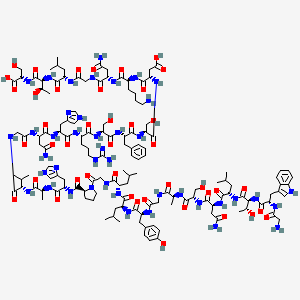
- Formula
- C139H210N42O43
- Weight
- 3157.4 Da
- CAS
- 88813-36-9
- PubChem CID
- 16133823
- Exact Mass
- 3156.5570 Da
- LogP
- -15.9
- TPSA
- 1370 Ų
- H-Bond Donors
- 48
- H-Bond Acceptors
- 48
- Rotatable Bonds
- 100
- Complexity
- 7390
Identifiers (SMILES, InChI)
InChI=1S/C139H210N42O43/c1-65(2)38-84(165-121(206)86(40-67(5)6)166-123(208)88(43-75-31-33-79(188)34-32-75)161-106(193)55-151-114(199)70(11)157-131(216)97(59-182)175-127(212)95(49-104(144)191)170-122(207)87(41-68(7)8)173-136(221)112(72(13)186)180-130(215)90(159-105(192)51-141)44-76-52-150-81-27-19-18-26-80(76)81)116(201)154-58-109(196)181-37-23-30-101(181)134(219)172-91(45-77-53-147-63-155-77)120(205)158-71(12)115(200)178-111(69(9)10)135(220)153-57-108(195)162-94(48-103(143)190)126(211)168-92(46-78-54-148-64-156-78)125(210)164-83(29-22-36-149-139(145)146)119(204)174-98(60-183)132(217)167-89(42-74-24-16-15-17-25-74)124(209)176-99(61-184)133(218)171-96(50-110(197)198)128(213)163-82(28-20-21-35-140)118(203)169-93(47-102(142)189)117(202)152-56-107(194)160-85(39-66(3)4)129(214)179-113(73(14)187)137(222)177-100(62-185)138(223)224/h15-19,24-27,31-34,52-54,63-73,82-101,111-113,150,182-188H,20-23,28-30,35-51,55-62,140-141H2,1-14H3,(H2,142,189)(H2,143,190)(H2,144,191)(H,147,155)(H,148,156)(H,151,199)(H,152,202)(H,153,220)(H,154,201)(H,157,216)(H,158,205)(H,159,192)(H,160,194)(H,161,193)(H,162,195)(H,163,213)(H,164,210)(H,165,206)(H,166,208)(H,167,217)(H,168,211)(H,169,203)(H,170,207)(H,171,218)(H,172,219)(H,173,221)(H,174,204)(H,175,212)(H,176,209)(H,177,222)(H,178,200)(H,179,214)(H,180,215)(H,197,198)(H,223,224)(H4,145,146,149)/t70-,71-,72+,73+,82-,83-,84-,85-,86-,87-,88-,89-,90-,91-,92-,93-,94-,95-,96-,97-,98-,99-,100-,101-,111-,112-,113-/m0/s1
CBSXZYWGVAQSHI-RUKUCZSXSA-NResearch Indications
Primary Research Areas
Endogenous galanin acting at GalR1/GalR2 inhibits hippocampal excitability; CNS-penetrant analogs (NAX 5055, NAX 810-2) show anticonvulsant activity in animal models.
Galanin co-released with noradrenaline/serotonin modulates limbic circuits; GalR1/GalR3 antagonism and GalR2 agonism are studied as antidepressant mechanisms.
GalR2-preferring analogs produce analgesia in inflammatory, neuropathic, and acute pain models.
Other Physiological Roles
Galanin stimulates food intake and modulates insulin and growth hormone secretion.
Promotes survival of hilar interneurons and seizure-induced neurogenesis via GalR2.
Research Protocols
intrathecal Injection
In neuropathic pain models, intrathecal galanin and GalR1 agonists reduce mechanical allodynia and thermal hyperalgesia. - Intrathecal galanin (preclinical): 0.1-1 nmol intrathecal injection for spinal pain studies.
intranasal Injection
Administered via intranasal.
Reported Research Timeline
Rapid onset expected; half-life of ~6-8 minutes (plasma) indicates fast-acting pharmacokinetics
Due to short half-life (~6-8 minutes (plasma)), effects are expected per-dose; consistent daily administration maintains therapeutic levels
Regular administration schedule required; effects are dose-dependent and do not persist between doses
Quality Indicators
What to look for
- Multiple peer-reviewed studies available
Caution
- Short half-life may require frequent dosing
Frequently Asked Questions
References (13)
- [1]Tatemoto, K. et al Galanin — a novel biologically active peptide from porcine intestine FEBS Lett. (1983)
- [6]
- [5]Liu, H. X. & Hökfelt, T The participation of galanin in pain processing at the spinal level Trends Pharmacol. Sci. (2002)
- [2]
- [7]Kuteeva, E. et al Galanin, galanin receptor subtypes and depression-like behavior Cell. Mol. Life Sci. (2008)
- [9]Brunner, S. M. et al — Galanin and galanin receptor expression in neuroblastoma and other pediatric tumors Neuropeptides (2022)
- [10]
- [3]Lu, X. et al A role for galanin in antidepressant actions with a focus on the dorsal raphe nucleus Proc. Natl. Acad. Sci. USA (2007)
- [4]Counts, S. E. et al Galanin in Alzheimer's disease: neuroinhibitory or neuroprotective? Cell. Mol. Life Sci. (2009)
- [11]Webling, K. et al — Galanin receptor ligands: an update on recent patents and therapeutic developments Expert Opin. Ther. Pat. (2023)
- [11]Schauwecker PE, et al. Patterns of seizures, hippocampal injury and neurogenesis in three models of status epilepticus in galanin receptor type 1 (GalR1) knockout mice Neuroscience (2004)
→ GalR1 knockout mice showed more severe seizures and greater hippocampal CA1 injury, establishing that endogenous galanin acting via GalR1/GalR2 restrains seizures and protects neurons.
- [12]Bulaj G, Green BR, Lee HK, et al. Design, synthesis, and characterization of high-affinity, systemically-active galanin analogues with potent anticonvulsant activities Journal of Medicinal Chemistry (2008)
→ Engineered CNS-penetrant galanin analog Gal-B2 (NAX 5055) with high receptor affinity prevented seizures in the 6 Hz mouse model after systemic (IP) dosing, overcoming the native peptide's inability to cross the blood-brain barrier.
- [13]Robertson CR, Scholl EA, Pruess TH, et al. Preclinical evaluation of NAX 810-2, a novel GalR2-preferring analog, for anticonvulsant efficacy and pharmacokinetics Epilepsia (2017)
→ The GalR2-preferring analog NAX 810-2 showed potent anticonvulsant efficacy and improved pharmacokinetics in rodent seizure models, supporting GalR2 as an antiseizure drug target.
Continue researching Galanin
Keep scientific evidence separate from commercial availability. Review how claims are evaluated, explore question-led research paths, or inspect disclosed source records without changing the editorial conclusions on this page.