Armodafinil
Armodafinil research profile covering evidence quality, proposed mechanisms, safety considerations, regulatory status, and linked primary sources.
Evidence-led profile
Research snapshot
- Evidence stage
- Emerging research
- References
- 10 linked sources
- Research coverage
- 4 areas
- Editorial review
- Jul 7, 2026
Published by the PepGuide Editorial Team using our research methodology.
Overview
Armodafinil is the purified (R)-enantiomer of modafinil, belonging to the benzhydryl class of compounds and categorized as a eugeroic — a class of wakefulness-promoting agents pharmacologically distinct from traditional psychostimulants like amphetamines. Marketed under the brand name Nuvigil by Cephalon (now Teva Pharmaceutical), it received FDA approval in 2007 for the treatment of excessive daytime sleepiness associated with narcolepsy, obstructive sleep apnea, and shift work sleep disorder. Compared to racemic modafinil, armodafinil achieves higher plasma concentrations later in the day due to its longer elimination half-life of approximately 15 hours.
The precise mechanism of action remains incompletely understood, but the primary pharmacological target appears to be the dopamine transporter (DAT). Armodafinil acts as a selective, atypical dopamine reuptake inhibitor, increasing extracellular dopamine concentrations particularly in prefrontal cortical regions. This dopaminergic activity triggers downstream effects including activation of wake-promoting orexinergic neurons in the hypothalamus and inhibition of GABAergic transmission in the ventrolateral preoptic nucleus, a key sleep-promoting region. Additional modulation of noradrenergic and histaminergic systems also contributes to its wakefulness-promoting profile.
Armodafinil is also used off-label for attention deficit hyperactivity disorder, chronic fatigue syndrome, major depressive disorder, and as adjunctive therapy in bipolar depression. While it shares the stimulant class with amphetamines from a regulatory standpoint (Schedule IV controlled substance in the United States), it has a substantially lower abuse potential and does not produce the pronounced euphoria associated with classical psychostimulants. Common side effects include headache, nausea, dizziness, and insomnia. It is primarily metabolized via amide hydrolysis and CYP3A4/5-mediated sulfone formation, and may interact with hormonal contraceptives and other CYP3A4 substrates.
Mechanism of Action
Dopamine Transporter Inhibition
Armodafinil is the (R)-enantiomer of modafinil, a eugeroic (wakefulness-promoting) agent. Its primary mechanism involves selective inhibition of the dopamine transporter (DAT), increasing extracellular dopamine concentrations in the nucleus accumbens, prefrontal cortex, and striatum. Armodafinil binds to DAT at an atypical site distinct from classical psychostimulants like amphetamine, producing a slower onset and lower abuse potential (PMID: 19037200).
Orexin/Hypocretin System Activation
Armodafinil activates orexinergic neurons in the lateral hypothalamus, increasing orexin-A and orexin-B signaling through OX1R and OX2R receptors. This stimulates the tuberomammillary nucleus (histaminergic), locus coeruleus (noradrenergic), and dorsal raphe (serotonergic) arousal centers. The orexin-dependent component is critical — armodafinil shows diminished efficacy in orexin-deficient narcolepsy models (PMID: 22050227).
Noradrenergic & Histaminergic Pathways
Downstream of DAT inhibition and orexin activation, armodafinil increases norepinephrine release in the cortex via alpha-1 adrenergic receptor activation and elevates histamine levels in the tuberomammillary nucleus. Both pathways converge on cortical arousal circuits, sustaining wakefulness through enhanced thalamocortical signaling (PMID: 18784649).
GABAergic Suppression
Armodafinil indirectly reduces GABA release in the ventrolateral preoptic area (VLPO), the key sleep-promoting nucleus. By diminishing GABAergic inhibition of wake-active centers, armodafinil shifts the sleep-wake balance toward sustained arousal without the rebound hypersomnia characteristic of amphetamines (PMID: 16076930).
Pharmacokinetic Advantage
The (R)-enantiomer has a longer effective half-life (~15 h vs ~4 h for the S-enantiomer), producing more sustained plasma concentrations and maintaining wakefulness through late afternoon without evening dosing.
Research
Reported Effects
Potent at Lower Doses:: Typically effective at 150mg vs 200mg modafinil.. Genetic Variation:: Effectiveness may vary based on CYP450 enzyme genetics.
- Typically effective at 150mg vs 200mg modafinil.
- Effectiveness may vary based on CYP450 enzyme genetics.
Cognition, mood and fatigue
Beyond wakefulness, armodafinil trials report improvements in attention, memory and fatigue, prompting off-label exploration in depression, bipolar depression, multiple sclerosis and cancer-related fatigue. Effects in these settings and in healthy, rested individuals are more modest and variable, mirroring the modafinil literature.
- Secondary gains in attention, episodic memory and fatigue in sleep-disorder trials
- Studied as adjunct for residual fatigue/sleepiness in mood disorders
- Cognitive-enhancement effects in healthy adults are small and inconsistent
Wake-promotion in sleep disorders
Armodafinil (Nuvigil) is the longer-lasting R-enantiomer of modafinil, approved to treat excessive sleepiness in narcolepsy, residual sleepiness in CPAP-treated obstructive sleep apnea, and shift-work disorder. Randomized trials consistently show improvements in objective wakefulness (MWT) and clinical global impression, with a single morning dose providing higher plasma concentrations late in the day than modafinil.
- Improves objective (MWT) and subjective wakefulness across all three approved indications
- Longer effective half-life than modafinil supports once-daily dosing
- Adjunct only in OSA; does not replace CPAP
Pharmacology and safety
Armodafinil promotes wakefulness through poorly-understood effects on dopamine (dopamine transporter inhibition), and downstream noradrenergic, histaminergic and orexinergic wake systems, without the peripheral sympathomimetic profile of classic stimulants. It is generally well tolerated; the main concerns are headache, insomnia, and rare but serious skin hypersensitivity reactions, plus reduced efficacy of hormonal contraceptives via CYP3A4 induction.
- Wake-promotion linked to dopaminergic and downstream arousal systems
- Common adverse effects: headache, nausea, insomnia
- Rare serious rash (SJS) risk and induction of hormonal contraceptive metabolism
Safety and Limitations
Common Side Effects
- Headache (most common, reported in ~34% of patients per FDA label)
- Nausea and dizziness
- Insomnia and difficulty falling asleep
- Dry mouth
- Anxiety and nervousness
- Diarrhea and upper abdominal pain
- Palpitations
Serious Adverse Reactions (per FDA label)
- Serious skin reactions: Stevens-Johnson syndrome (SJS) and toxic epidermal necrolysis (TEN) reported with modafinil/armodafinil. Discontinue immediately at first sign of rash.
- Multi-organ hypersensitivity (DRESS syndrome): Potentially fatal; presents with fever, rash, lymphadenopathy, and organ involvement
- Angioedema and anaphylaxis: Cases reported post-marketing
- Psychiatric symptoms: Mania, delusions, hallucinations, suicidal ideation; monitor closely in patients with psychiatric history
- Cardiovascular: Not recommended in patients with mitral valve prolapse or left ventricular hypertrophy. Cases of chest pain and palpitations reported.
Contraindications (FDA label - NUVIGIL)
- Known hypersensitivity to armodafinil or modafinil
- History of serious dermatologic reactions to either agent
Drug Interactions
- CYP3A4/5 substrates (cyclosporine, midazolam, triazolam): Armodafinil is a moderate CYP3A4 inducer; may reduce efficacy
- CYP2C19 inhibition: May increase levels of omeprazole, phenytoin, diazepam
- Hormonal contraceptives: Reduced efficacy; alternative or additional contraception recommended during and for one month after discontinuation (FDA label)
- Warfarin: Monitor INR; potential for altered anticoagulant response
- MAOIs: Use with caution
Special Populations
- Pregnancy: FDA former Category C. Insufficient human data; animal studies showed developmental toxicity. A pregnancy registry existed (closed).
- Pediatric: Not approved for pediatric use. Serious skin reactions reported in pediatric patients receiving modafinil.
- Geriatric: Consider lower doses; hepatic clearance may be reduced.
- Hepatic impairment: Reduce dose in severe hepatic impairment (FDA label).
- Schedule IV controlled substance: Risk of abuse and dependence.
Monitoring
- Blood pressure and heart rate at baseline and periodically
- Skin assessments, especially in first weeks of therapy
- Psychiatric symptom monitoring
- Hepatic function in patients with liver disease
- Pregnancy testing in women of childbearing potential
Common Side Effects
- Headaches:: Common, often mitigated with hydration.
- Appetite Suppression:: Significant reduction in hunger.
- Insomnia:: Can disrupt sleep if taken too late.
- Dry Mouth:: Increased thirst common.
Research protocol summary
- Typical Dose
- 150mg once daily in the morning.
These values summarize cataloged research protocols. They are not personal dosing instructions or medical guidance.
Reconstitution Calculator
Pharmacokinetic Profile
Armodafinil — Pharmacokinetic Curve
SubcutaneousMolecular Structure
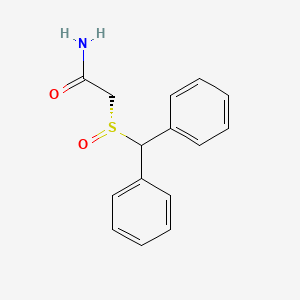
- Formula
- C15H15NO2S
- Weight
- 273.4 Da
- PubChem CID
- 9690109
- Exact Mass
- 273.0823 Da
- LogP
- 1.7
- TPSA
- 79.4 Ų
- H-Bond Donors
- 1
- H-Bond Acceptors
- 3
- Rotatable Bonds
- 5
- Complexity
- 302
Identifiers (SMILES, InChI)
InChI=1S/C15H15NO2S/c16-14(17)11-19(18)15(12-7-3-1-4-8-12)13-9-5-2-6-10-13/h1-10,15H,11H2,(H2,16,17)/t19-/m1/s1
YFGHCGITMMYXAQ-LJQANCHMSA-NResearch Indications
Approved Indications (Nuvigil)
FDA-approved wake-promoting agent for EDS in narcolepsy; the R-enantiomer of modafinil with a longer effective half-life.
Approved adjunct for residual excessive sleepiness despite adequate CPAP therapy; not a substitute for CPAP.
Approved for excessive sleepiness in shift-work disorder; 150 mg taken before the night shift improves wakefulness.
Off-label / Investigational Uses
Explored for fatigue and sleepiness in depression, bipolar depression, multiple sclerosis, and cancer-related fatigue.
Used off-label as a wakefulness/attention enhancer; benefits in rested healthy adults are modest and inconsistent.
References (10)
- [1]Armodafinil as a Potential Pharmacological Treatment for Attention Deficit Hyperactivity Disorder in Adults: A Review
→ Armodafinil demonstrates potential as a treatment for adult ADHD, improving wakefulness, memory, impulse control, and executive functions.
- [2]Adjunctive armodafinil for major depressive episodes associated with bipolar I disorder
→ At 150 mg/day, adjunctive armodafinil improved depressive symptoms in bipolar depression patients, though not all measures showed improvement.
- [3]Adjunct armodafinil improves wakefulness and memory in obstructive sleep apnea/hypopnea syndrome
→ Armodafinil enhanced wakefulness, memory, and reduced fatigue in obstructive sleep apnea patients while maintaining regular nCPAP use.
- [4]Armodafinil as adjunctive therapy in adults with cognitive deficits associated with schizophrenia
→ At 200 mg/day, armodafinil showed no cognitive improvement but appeared to mitigate negative schizophrenia symptoms.
- [5]Armodafinil for treatment of excessive sleepiness associated with shift work disorder
→ Armodafinil significantly improved wakefulness during night shifts and overall clinical condition without affecting daytime sleep.
- [6]Efficacy of Treatment With Armodafinil for Cancer-Related Fatigue in Patients With High-grade Glioma
→ Armodafinil showed no significant reduction in cancer-related fatigue in high-grade glioma patients, but may benefit corticosteroid users.
- [7]A phase 3, double-blind, randomized, placebo-controlled study of armodafinil for excessive sleepiness associated with jet lag disorder
→ At 150 mg/day, armodafinil significantly increased wakefulness and reduced sleep latency following eastward travel across 6 time zones.
- [8]Harsh JR, Hayduk R, Rosenberg R, Wesnes KA, Walsh JK, Arora S, Niebler GE, Roth T The efficacy and safety of armodafinil as treatment for adults with excessive sleepiness associated with narcolepsy Current Medical Research and Opinion (2006)
→ In 196 narcolepsy patients, armodafinil 150 or 250 mg once daily significantly improved Maintenance of Wakefulness Test latency, clinical global impression, memory, attention and fatigue over 12 weeks versus placebo.
- [9]Roth T, White D, Schmidt-Nowara W, Wesnes KA, Niebler G, Arora S, Black J Effects of armodafinil in the treatment of residual excessive sleepiness associated with obstructive sleep apnea/hypopnea syndrome: a 12-week, multicenter, double-blind, randomized, placebo-controlled study in nCPAP-adherent adults Clinical Therapeutics (2006)
→ In CPAP-adherent OSA patients with residual sleepiness, armodafinil increased mean MWT sleep latency (+1.9 vs -1.7 min on placebo) and improved wakefulness and episodic memory over 12 weeks.
- [10]Czeisler CA, Walsh JK, Wesnes KA, Arora S, Roth T Armodafinil for treatment of excessive sleepiness associated with shift work disorder: a randomized controlled study Mayo Clinic Proceedings (2009)
→ In 254 night-shift workers with shift work disorder, armodafinil 150 mg before the shift significantly reduced physiologic sleepiness, improved late-night cognitive performance, and lowered reported errors/near-misses over 12 weeks.
Continue researching Armodafinil
Keep scientific evidence separate from commercial availability. Review how claims are evaluated, explore question-led research paths, or inspect disclosed source records without changing the editorial conclusions on this page.