Phylloquinone
The primary dietary form of vitamin K (vitamin K1) found in green leafy vegetables, essential for blood coagulation and increasingly recognized for its roles in bone mineralization and cardiovascular calcification prevention.
Evidence-led profile
Research snapshot
- Evidence stage
- Emerging research
- References
- 2 linked sources
- Research coverage
- 1 area
- Editorial review
- Mar 8, 2026
Published by the PepGuide Editorial Team using our research methodology.
Overview
Phylloquinone (vitamin K1) is a fat-soluble naphthoquinone that serves as the principal dietary form of vitamin K, distinguished from the menaquinone (vitamin K2) family by its phytyl side chain. It is synthesized by plants as part of the photosynthetic electron transport chain and is most concentrated in dark green leafy vegetables — kale, spinach, broccoli, and collard greens are among the richest sources. Phylloquinone's best-characterized function is as an essential cofactor for gamma-glutamyl carboxylase, the enzyme responsible for post-translational carboxylation of glutamate residues in vitamin K-dependent proteins. This carboxylation activates clotting factors II (prothrombin), VII, IX, and X, as well as anticoagulant proteins C, S, and Z, making adequate vitamin K1 intake critical for hemostatic balance.
Beyond coagulation, phylloquinone participates in bone metabolism through carboxylation of osteocalcin, a protein secreted by osteoblasts that requires vitamin K-dependent activation to bind calcium and integrate into the hydroxyapatite matrix. Undercarboxylated osteocalcin (ucOC) is elevated in vitamin K deficiency and has been associated with reduced bone mineral density and increased fracture risk, particularly in postmenopausal women. Phylloquinone also carboxylates matrix Gla protein (MGP), a potent inhibitor of vascular calcification. Emerging evidence links higher phylloquinone intake with reduced arterial stiffness and coronary artery calcification, complementing the actions of menaquinone-7 (vitamin K2 MK-7), which has a longer half-life and greater extrahepatic tissue distribution.
Phylloquinone absorption is enhanced by dietary fat and is subject to significant interindividual variation. It is transported via chylomicrons and taken up primarily by the liver, where it supports coagulation factor synthesis. Tissue distribution beyond the liver is limited compared to menaquinones, which has fueled debate about whether K1 adequately supports extrahepatic functions like bone and vascular health. Current adequate intake recommendations (90-120 mcg/day for adults) are based primarily on coagulation needs. Phylloquinone works in concert with vitamin D3 and calcium for bone health, and patients on anticoagulant therapy (warfarin) must maintain consistent K1 intake to avoid fluctuations in INR.
Research
Reported Effects
Primary Function:: Highly effective for blood clotting function with well-established physiological role. Cardiovascular Benefits:: Shows promise for reducing atherosclerosis and vascular calcification in research. Brain Health:: Emerging evidence suggests dual benefits for vascular and cerebral health. Synergistic Effects:: Often combined with vitamin D for enhanced bone and cardiovascular benefits
Safety and Limitations
Safety Profile: Phylloquinone
Common Side Effects
- Generally very well-tolerated at dietary and supplemental doses
- Mild gastrointestinal discomfort including nausea and upset stomach
- Injection site reactions with parenteral administration (pain, swelling, erythema)
- Flushing and diaphoresis with intravenous administration
- Altered taste perception (uncommon)
Serious Adverse Effects
- Anaphylactoid reactions: Primarily with intravenous administration; can be severe and life-threatening; includes hypotension, bronchospasm, and cardiac arrest
- Hemolytic anemia, hyperbilirubinemia, and kernicterus in neonates given excessive doses
- Paradoxical worsening of coagulopathy if underlying cause is not vitamin K-related
- Skin reactions including scleroderma-like plaques at injection sites (rare)
- Excessive vitamin K1 intake can render warfarin therapy ineffective, leading to thrombotic events
Contraindications
- Known hypersensitivity to phylloquinone or any formulation components
- Intravenous administration should be reserved for life-threatening situations (anaphylactoid risk)
- Do not use to treat coagulopathy unrelated to vitamin K deficiency
- Caution in severe hepatic disease (may not respond to vitamin K if synthetic function is impaired)
Drug Interactions
- Warfarin and vitamin K antagonists: Direct pharmacological antagonism; even small variations in dietary vitamin K1 can destabilize INR; maintain consistent daily intake
- Broad-spectrum antibiotics: Prolonged use can deplete vitamin K-producing gut bacteria, increasing vitamin K requirements
- Cholestyramine and orlistat: Reduce vitamin K1 absorption (fat-soluble vitamin); separate dosing by several hours
- Mineral oil laxatives: Impair fat-soluble vitamin absorption including vitamin K1
- Anticonvulsants (phenytoin, carbamazepine): May accelerate vitamin K metabolism; increased requirements
- Salicylates (high-dose aspirin): May have additive effects on coagulation
Population-Specific Considerations
- Warfarin patients: Most critical interaction; maintain consistent daily vitamin K1 intake (typically 80-120 mcg/day); sudden changes in green vegetable consumption can destabilize anticoagulation
- Newborns: Routine prophylactic vitamin K1 injection (0.5-1 mg IM) recommended at birth to prevent hemorrhagic disease of the newborn
- Elderly on anticoagulants: Particularly vulnerable to dietary variation effects; education on consistent vitamin K intake essential
- Osteoporosis: Adequate vitamin K1 (along with K2) supports bone health; doses of 200-500 mcg/day studied for bone density
- Fat malabsorption conditions (celiac, Crohn's, short bowel): May require higher doses or parenteral supplementation
Common Side Effects
- Anticoagulant Interactions:: Can interfere with warfarin and similar anticoagulants requiring consistent intake monitoring
- Minimal Toxicity:: Generally well-tolerated with low toxicity risk at recommended doses
- No Common Complaints:: Users rarely report negative effects from vitamin K1 supplementation
- Dosing Concerns:: Some users express hesitation about high-dose formulations in multivitamins
Mechanism of Action
Phylloquinone (vitamin K1) functions as the primary dietary form of vitamin K and acts as a critical cofactor in the vitamin K cycle. Its mechanism centers on serving as a reduced cofactor (vitamin K hydroquinone) for the enzyme gamma-glutamyl carboxylase (GGCX), which catalyzes the post-translational conversion of specific glutamate (Glu) residues to gamma-carboxyglutamate (Gla) residues on vitamin K-dependent proteins. This carboxylation reaction is essential for the calcium-binding capacity of these proteins, enabling their biological activity. The key targets include hepatic coagulation factors (factors II/prothrombin, VII, IX, and X) and anticoagulant proteins C and S.
During the carboxylation reaction, the vitamin K hydroquinone is oxidized to vitamin K 2,3-epoxide. The enzyme vitamin K epoxide reductase (VKOR/VKORC1) then recycles the epoxide back to the quinone form, which is subsequently reduced to the hydroquinone by VKOR or NAD(P)H-dependent quinone reductases, completing the vitamin K cycle. This recycling mechanism is the target of warfarin anticoagulant therapy. Beyond coagulation, phylloquinone-dependent carboxylation of osteocalcin is critical for proper bone mineralization, while carboxylation of matrix Gla protein (MGP) inhibits vascular calcification by preventing calcium deposition in arterial walls.
Phylloquinone also exhibits roles independent of its cofactor function, including potential modulation of inflammatory signaling through suppression of NF-kB activation and regulation of sphingolipid metabolism. These pleiotropic effects contribute to its associations with cardiovascular health and bone integrity beyond the classical coagulation pathway.
Molecular Structure
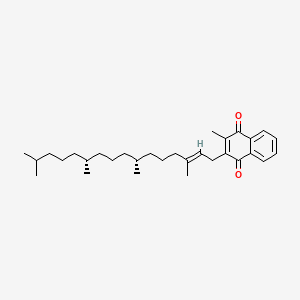
- Formula
- C31H46O2
- Weight
- 450.7 Da
- PubChem CID
- 5284607
- Exact Mass
- 450.3498 Da
- LogP
- 10.9
- TPSA
- 34.1 Ų
- H-Bond Donors
- 0
- H-Bond Acceptors
- 2
- Rotatable Bonds
- 14
- Complexity
- 696
Identifiers (SMILES, InChI)
InChI=1S/C31H46O2/c1-22(2)12-9-13-23(3)14-10-15-24(4)16-11-17-25(5)20-21-27-26(6)30(32)28-18-7-8-19-29(28)31(27)33/h7-8,18-20,22-24H,9-17,21H2,1-6H3/b25-20+/t23-,24-/m1/s1
MBWXNTAXLNYFJB-NKFFZRIASA-NReferences (2)
- [2]Vitamin K - Sources, Physiological Role, Kinetics, Deficiency, Detection, Therapeutic Use, and Toxicity
→ Comprehensive review of vitamin K's role in coagulation, bone metabolism, tissue calcification, and antioxidant activity, with phylloquinone being the main dietary form concentrated in green leafy vegetables.
- [1]Vitamin K Properties in Stroke and Alzheimer's Disease: A Narrative Review
→ Vitamin K deficiency increases risk of hemorrhages, atherosclerosis, and neurodegeneration, while adequate levels may benefit both vascular and cerebral health through sphingolipid biosynthesis and ferroptosis inhibition pathways.
Continue researching Phylloquinone
Keep scientific evidence separate from commercial availability. Review how claims are evaluated, explore question-led research paths, or inspect disclosed source records without changing the editorial conclusions on this page.