Propionyl-L-Carnitine
Propionyl-L-Carnitine research profile covering evidence quality, proposed mechanisms, safety considerations, regulatory status, and linked primary sources.
Evidence-led profile
Research snapshot
- Evidence stage
- Emerging research
- References
- 9 linked sources
- Research coverage
- 1 area
- Editorial review
- Mar 8, 2026
Published by the PepGuide Editorial Team using our research methodology.
Overview
Propionyl-L-carnitine (PLC) is an ester formed by the condensation of L-carnitine with propionic acid (a three-carbon short-chain fatty acid). This structural modification alters its pharmacokinetic and metabolic profile compared to free L-carnitine. The propionyl moiety is metabolized to succinyl-CoA, an anaplerotic substrate that feeds directly into the citric acid cycle, replenishing intermediates and sustaining oxidative energy production — particularly in tissues experiencing metabolic stress or ischemia. This dual-substrate mechanism, combining carnitine's role in mitochondrial fatty acid transport with propionate's anaplerotic contribution, makes PLC especially suited for conditions involving impaired energy metabolism in muscle tissue.
The strongest clinical evidence for PLC is in peripheral arterial disease (PAD), where it has been studied in multiple randomized controlled trials. In patients with intermittent claudication, PLC supplementation (typically 1-3 g/day) has demonstrated significant improvements in maximal walking distance and pain-free walking capacity. The mechanism involves enhanced skeletal muscle oxidative metabolism in ischemic limbs, improved endothelial function through increased nitric oxide production, and antioxidant effects that mitigate ischemia-reperfusion injury. PLC has also shown benefit in heart failure, where it improves cardiac energy metabolism, exercise tolerance, and ejection fraction in some studies. The European Society of Cardiology has acknowledged carnitine derivatives in guidelines for heart failure management.
Beyond cardiovascular applications, PLC has been investigated for male fertility (improving sperm motility and morphology), exercise performance (enhancing lactate threshold and reducing fatigue), and diabetic neuropathy. It is distinguished from other carnitine forms by its preferential uptake in cardiac and skeletal muscle tissue and its unique anaplerotic action. PLC works synergistically with CoQ10 for mitochondrial function, acetyl-L-carnitine for neurological support (ALCAR preferentially targets neural tissue while PLC targets muscle), and alpha-lipoic acid for antioxidant protection. The combination of ALCAR and PLC has been studied as a comprehensive carnitine strategy addressing both neurological and muscular mitochondrial function.
Mechanism of Action
Propionyl-L-carnitine (PLC) is a naturally occurring short-chain ester of L-carnitine that plays a critical role in mitochondrial fatty acid beta-oxidation and cellular energy metabolism. Its primary mechanism involves facilitating the transport of propionyl groups and medium-chain fatty acids across the inner mitochondrial membrane via the carnitine shuttle system, where they enter the citric acid cycle as succinyl-CoA, a key intermediate in the TCA cycle. This preferentially supports energy production in tissues with high metabolic demands, particularly cardiac and skeletal muscle.
PLC exerts significant vascular protective effects through activation of endothelial nitric oxide synthase (eNOS). Research has demonstrated that PLC triggers an AMPK/Src-mediated signaling cascade that activates PI3 kinase and Akt, leading to eNOS phosphorylation at Ser-1177 and increased nitric oxide (NO) production in human aortic endothelial cells (Ning & Zhao, Vascular Pharmacology 2013). This mechanism involves PLC decreasing the intracellular ATP/ADP ratio, activating AMPK, which subsequently stimulates Src kinase as an upstream activator of the PI3K-Akt pathway. PLC also promotes prostaglandin-mediated endothelium-dependent vasodilation, as demonstrated in human subcutaneous arteries (Cipolla et al., Journal of Vascular Surgery 1999). Additionally, PLC reduces oxidative stress by scavenging free radicals and supports mitochondrial membrane integrity, protecting against ischemia-reperfusion injury. These combined metabolic and vascular effects underlie its clinical applications in peripheral arterial disease, heart failure, and exercise intolerance.
Research
Reported Effects
Erectile Dysfunction:: Strong evidence from meta-analyses and clinical trials showing 40-77% response rates when combined with complementary supplements. Peripheral Arterial Disease:: Consistently improves walking distance and claudication symptoms across multiple trials, though effect sizes vary. Exercise Performance:: Mixed results for standalone use; more effective when combined with other carnitine forms or in specific populations. Cardiovascular Health:: Well-established benefits for endothelial function, blood flow, and metabolic markers in both healthy and diseased populations
- Strong evidence from meta-analyses and clinical trials showing 40-77% response rates when combined with complementary supplements
- Consistently improves walking distance and claudication symptoms across multiple trials, though effect sizes vary
- Mixed results for standalone use; more effective when combined with other carnitine forms or in specific populations
- Well-established benefits for endothelial function, blood flow, and metabolic markers in both healthy and diseased populations
Safety and Limitations
Safety Profile: Propionyl-L-Carnitine
Common Side Effects
- Gastrointestinal disturbances: nausea, vomiting, diarrhea, and abdominal cramps
- Fishy body odor (trimethylamine production by gut bacteria)
- Mild headache and dizziness
- Insomnia if taken late in the day
- Increased appetite in some individuals
Serious Adverse Effects
- TMAO elevation: Gut bacterial metabolism of carnitine produces trimethylamine N-oxide, linked to cardiovascular risk in observational studies
- Rare seizure reports in individuals with pre-existing seizure disorders
- Rare allergic reactions (urticaria, angioedema)
- Theoretical risk of increased oxidative stress at very high doses
Contraindications
- Known hypersensitivity to carnitine derivatives
- Severe hepatic impairment (altered carnitine metabolism)
- Active seizure disorders (use only under neurologist guidance)
- Hypothyroidism (carnitine may interfere with thyroid hormone action)
Drug Interactions
- Warfarin and anticoagulants: May potentiate anticoagulant effects; monitor INR
- Thyroid hormones: Carnitine inhibits thyroid hormone entry into cells; may reduce efficacy of levothyroxine
- Acenocoumarol: Case reports of increased anticoagulation
- Valproic acid: May deplete carnitine levels; supplementation may be beneficial
Population-Specific Considerations
- Peripheral artery disease: Best-studied indication; improves walking distance in intermittent claudication
- Heart failure patients: May improve exercise tolerance; use under cardiology supervision
- Pregnancy/lactation: Likely safe at physiological doses but supplemental use lacks data
- Dialysis patients: Carnitine depletion common; supplementation often indicated but requires renal dosing
Common Side Effects
- Gastrointestinal Effects:: Occasional reports of GI upset, though generally well-tolerated compared to other carnitine forms
- Fishy Odor:: Some users report breath, sweat, or urine odor, particularly at higher doses
- TMAO Concerns:: Theoretical concern about carnitine raising TMAO levels, though specific data for PLC is limited
- Individual Tolerance:: Some users report inability to tolerate doses above 500mg, though most studies use 1-3g without significant issues
Research protocol summary
- Typical Dose
- 2g daily of PLC is the most commonly studied dose for erectile dysfunction and cardiovascular benefits
These values summarize cataloged research protocols. They are not personal dosing instructions or medical guidance.
Reconstitution Calculator
Pharmacokinetic Profile
Molecular Structure
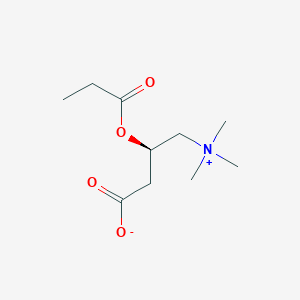
- Formula
- C10H19NO4
- Weight
- 217.26 Da
- PubChem CID
- 188824
- Exact Mass
- 217.1314 Da
- LogP
- 0.9
- TPSA
- 66.4 Ų
- H-Bond Donors
- 0
- H-Bond Acceptors
- 4
- Rotatable Bonds
- 6
- Complexity
- 227
Identifiers (SMILES, InChI)
InChI=1S/C10H19NO4/c1-5-10(14)15-8(6-9(12)13)7-11(2,3)4/h8H,5-7H2,1-4H3/t8-/m1/s1
UFAHZIUFPNSHSL-MRVPVSSYSA-NReferences (9)
- [3]Nutraceutical interventions for erectile dysfunction: a systematic review and network meta-analysis
→ Network meta-analysis found propionyl-L-carnitine combined with L-arginine and niacin showed significant efficacy in improving erectile function in men with ED.
- [4]Propionyl-L-carnitine, L-arginine and niacin in sexual medicine: a nutraceutical approach to erectile dysfunction
→ Single-blind study of 54 men found 3-month supplementation with PLC, L-arginine, and niacin improved erectile function scores, with 40% experiencing improved erections and 77% showing partial response.
- [9]Oral supplementation of propionyl-L-carnitine reduces body weight and hyperinsulinemia in obese Zucker rats
→ 20-week supplementation study found PLC reduced body weight, improved insulin sensitivity, and corrected endothelial dysfunction in genetically obese rats.
- [5]Propionyl-L-carnitine corrects metabolic and cardiovascular alterations in diet-induced obese mice
→ Animal study demonstrated PLC supplementation completely prevented weight gain in high-fat diet mice while improving glucose tolerance, lipid profiles, and cardiovascular function.
- [6]Glycine propionyl-L-carnitine modulates lipid peroxidation and nitric oxide in human subjects
→ Eight-week study found GPLC decreased lipid peroxidation and increased nitric oxide levels in human subjects, with 3g daily showing significant effects on both markers.
- [7]Glycine propionyl-L-carnitine increases plasma nitrate/nitrite in resistance trained men
→ Double-blind crossover study showed 4 weeks of GPLC supplementation significantly increased plasma nitric oxide markers in resistance-trained men compared to placebo.
- [8]L-carnitine and propionyl-L-carnitine improve endothelial dysfunction in spontaneously hypertensive rats
→ Animal research found both L-carnitine and PLC improved endothelial function in hypertensive rats through different mechanisms involving nitric oxide and COX products.
- [1]A systematic review and meta-analysis of propionyl-L-carnitine for intermittent claudication
→ Meta-analysis found PLC improved maximum walking distance and claudication onset time in patients with peripheral artery disease, though results were inconsistent across trials.
- [2]Propionyl-L-carnitine improves exercise performance and functional status in patients with claudication
→ Randomized controlled trial of 155 patients showed PLC significantly improved peak walking time and claudication onset time compared to placebo in patients with disabling claudication.
Continue researching Propionyl-L-Carnitine
Keep scientific evidence separate from commercial availability. Review how claims are evaluated, explore question-led research paths, or inspect disclosed source records without changing the editorial conclusions on this page.