Hyperforin
Hyperforin research profile covering evidence quality, proposed mechanisms, safety considerations, regulatory status, and linked primary sources.
Evidence-led profile
Research snapshot
- Evidence stage
- Emerging research
- References
- 2 linked sources
- Research coverage
- 1 area
- Editorial review
- Mar 8, 2026
Published by the PepGuide Editorial Team using our research methodology.
Overview
Hyperforin is an acylphloroglucinol compound and the principal pharmacologically active constituent of Hypericum perforatum (St. John's Wort), accounting for much of the plant's well-documented antidepressant efficacy. Unlike selective serotonin reuptake inhibitors (SSRIs) that target a single neurotransmitter system, hyperforin exhibits a unique broad-spectrum mechanism: it inhibits the reuptake of serotonin, norepinephrine, dopamine, GABA, and glutamate by activating TRPC6 (transient receptor potential canonical 6) ion channels. This activation increases intracellular sodium concentration, which dissipates the sodium gradient required for neurotransmitter transporter function, effectively reducing reuptake across multiple systems simultaneously.
Clinical evidence supporting hyperforin's antidepressant activity is substantial. Meta-analyses of randomized controlled trials demonstrate that standardized St. John's Wort extracts (containing 3–5% hyperforin) are significantly more effective than placebo and comparable to SSRIs for mild-to-moderate depression, with fewer side effects and lower discontinuation rates. The Cochrane Collaboration review encompassing over 5,000 patients confirmed these findings. Hyperforin also demonstrates anti-inflammatory properties through inhibition of COX-1, 5-LOX, and NF-κB pathways, antibacterial activity against Gram-positive organisms including MRSA, and wound-healing promotion — properties that complement those of its co-occurring compound hypericin.
A significant clinical consideration with hyperforin is its potent induction of cytochrome P450 enzymes (particularly CYP3A4) and P-glycoprotein via activation of the pregnane X receptor (PXR). This makes hyperforin-containing supplements capable of reducing the efficacy of numerous medications including oral contraceptives, warfarin, cyclosporine, HIV protease inhibitors, and many others. Low-hyperforin or hyperforin-free St. John's Wort extracts have been developed to minimize drug interactions while retaining some antidepressant activity through other constituents. For mood support with fewer interaction concerns, users may consider combining such extracts with SAMe or 5-htp, though these combinations also require careful clinical oversight due to serotonergic accumulation risk.
Mechanism of Action
Hyperforin is a prenylated phloroglucinol derivative and one of the principal bioactive constituents of St. John's wort (Hypericum perforatum), primarily responsible for the plant's antidepressant properties. Unlike conventional antidepressants that target specific monoamine transporters, hyperforin achieves broad-spectrum neurotransmitter reuptake inhibition through a unique mechanism involving ion channel modulation.
Hyperforin is a potent agonist of transient receptor potential canonical 6 (TRPC6) channels. Activation of these non-selective cation channels increases intracellular sodium and calcium concentrations, which disrupts the ion gradients that drive neurotransmitter reuptake transporters. This results in simultaneous inhibition of serotonin, norepinephrine, dopamine, GABA, and glutamate reuptake—a breadth of action unmatched by most synthetic antidepressants. The TRPC6-dependent mechanism has been confirmed by studies showing that the antidepressant effects of hyperforin are abolished in TRPC6 knockout models.
Beyond its neuropsychiatric effects, hyperforin demonstrates anti-inflammatory activity by inhibiting pro-inflammatory mediator production and 5-lipoxygenase, an enzyme involved in leukotriene synthesis. It also possesses anti-angiogenic properties, inhibiting new blood vessel formation, which has generated interest in its potential application in oncology. These diverse pharmacological actions make hyperforin one of the most pharmacologically interesting natural products.
Research
Reported Effects
Standardization Critical:: Clinical efficacy is directly linked to hyperforin content in a dose-dependent manner; products standardized for hypericin alone may not provide comparable benefits. Long-term Success:: Multiple users report taking hyperforin-standardized St. John's Wort for 20+ years with sustained benefits and no tolerance development. Individual Variation:: While many users experience dramatic benefits, effectiveness varies and proper product selection (hyperforin-standardized vs hypericin-standardized) is crucial. Comparison to SSRIs:: Users often describe it as a natural alternative to conventional antidepressants, though it works through a unique multi-target mechanism rather than selective serotonin reuptake inhibition
- Clinical efficacy is directly linked to hyperforin content in a dose-dependent manner; products standardized for hypericin alone may not provide comparable benefits
- Multiple users report taking hyperforin-standardized St. John's Wort for 20+ years with sustained benefits and no tolerance development
- While many users experience dramatic benefits, effectiveness varies and proper product selection (hyperforin-standardized vs hypericin-standardized) is crucial
- Users often describe it as a natural alternative to conventional antidepressants, though it works through a unique multi-target mechanism rather than selective serotonin reuptake inhibition
Safety and Limitations
Safety Profile: Hyperforin
Common Side Effects
- Photosensitivity: increased susceptibility to sunburn, especially at doses >1800 mg/day of St. John's wort extract (standardized to hyperforin)
- Gastrointestinal symptoms: nausea, abdominal pain, diarrhea, constipation, and dry mouth
- Dizziness, headache, and restlessness
- Fatigue or sedation (paradoxical in some users)
- Vivid dreams or insomnia
Serious Adverse Effects
- Serotonin syndrome: potentially life-threatening when combined with serotonergic drugs (SSRIs, SNRIs, triptans, MAOIs); symptoms include agitation, hyperthermia, clonus, and altered mental status
- Severe phototoxicity: blistering or second-degree burns with intense UV exposure at high doses
- Manic episodes: may trigger mania or hypomania in individuals with bipolar disorder
- Hepatotoxicity: rare case reports of elevated liver enzymes
- Suicidal ideation: as with any antidepressant-like compound, risk in early treatment, especially in adolescents
Contraindications
- Concurrent use of SSRIs, SNRIs, MAOIs, or other serotonergic agents
- Bipolar disorder (risk of manic switching)
- Concurrent use of immunosuppressants (cyclosporine, tacrolimus) — hyperforin is a potent CYP3A4 and P-glycoprotein inducer
- Planned organ transplant recipients
- Known hypersensitivity to Hypericum perforatum
Drug Interactions
- CYP3A4 induction (CRITICAL): hyperforin is one of the most potent known CYP3A4 inducers, reducing plasma levels of oral contraceptives, cyclosporine, tacrolimus, warfarin, HIV protease inhibitors, statins, and many other drugs by 50–70%
- CYP2C9, CYP2C19, CYP1A2 induction: broader enzyme induction affects benzodiazepines, phenytoin, and proton pump inhibitors
- P-glycoprotein induction: reduces absorption and increases clearance of digoxin, dabigatran, and other P-gp substrates
- Serotonergic drugs: risk of serotonin syndrome with SSRIs, triptans, tramadol, dextromethorphan
- Oral contraceptives: breakthrough bleeding and contraceptive failure documented
Population-Specific Considerations
- Pregnancy / lactation: AVOID — may reduce efficacy of prenatal medications; limited safety data; hyperforin detected in breast milk
- Children / adolescents: use only under specialist supervision; increased risk of behavioral activation
- Elderly: heightened drug interaction risk due to polypharmacy; requires medication review before initiation
- Pre-surgical patients: discontinue at least 5 days before anesthesia (enzyme induction effects persist)
- Organ transplant patients: absolutely contraindicated due to profound reduction in immunosuppressant levels
Common Side Effects
- Drug Interactions:: Major concern - St. John's Wort strongly induces cytochrome P450 enzymes, significantly reducing effectiveness of birth control, antidepressants, and many other medications
- Photosensitivity:: Increases skin sensitivity to sunlight, requiring sun protection measures during use
- Mania Risk:: Contraindicated in bipolar disorder as it can trigger manic episodes; not suitable as first-line treatment without proper medical evaluation
- Serotonin Concerns:: Potential for serotonergic interactions when combined with other mood-affecting supplements or medications
Research protocol summary
- Typical Dose
- Typical doses contain 300mg St. John's Wort extract standardized to hyperforin content, taken 2-3 times daily
These values summarize cataloged research protocols. They are not personal dosing instructions or medical guidance.
Reconstitution Calculator
Pharmacokinetic Profile
Molecular Structure
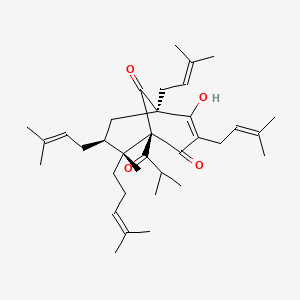
- Formula
- C35H52O4
- Weight
- 536.8 Da
- PubChem CID
- 441298
- Exact Mass
- 536.3866 Da
- LogP
- 9.6
- TPSA
- 71.4 Ų
- H-Bond Donors
- 1
- H-Bond Acceptors
- 4
- Rotatable Bonds
- 11
- Complexity
- 1140
Identifiers (SMILES, InChI)
InChI=1S/C35H52O4/c1-22(2)13-12-19-33(11)27(16-14-23(3)4)21-34(20-18-25(7)8)30(37)28(17-15-24(5)6)31(38)35(33,32(34)39)29(36)26(9)10/h13-15,18,26-27,37H,12,16-17,19-21H2,1-11H3/t27-,33+,34+,35-/m0/s1
KGSZHKRKHXOAMG-HQKKAZOISA-NReferences (2)
- [2]Hyperforin: A natural lead compound with multiple pharmacological activities
→ Systematic review identifying hyperforin as a lead compound with diverse pharmacological activities including anti-depression, anti-tumor, anti-dementia, and anti-diabetes properties, emphasizing its potential for innovative drug development.
- [1]Role of Hyperforin in the Pharmacological Activities of St. John's Wort
→ Comprehensive review demonstrating hyperforin's antidepressant activity through inhibition of multiple neurotransmitter uptake systems and its efficacy in behavioral models of depression, with clinical studies linking therapeutic efficacy to hyperforin content in a dose-dependent manner.
Continue researching Hyperforin
Keep scientific evidence separate from commercial availability. Review how claims are evaluated, explore question-led research paths, or inspect disclosed source records without changing the editorial conclusions on this page.