Creatine Monohydrate
Creatine Monohydrate research profile covering evidence quality, proposed mechanisms, safety considerations, regulatory status, and linked primary sources.
Evidence-led profile
Research snapshot
- Evidence stage
- Emerging research
- References
- 8 linked sources
- Research coverage
- 1 area
- Editorial review
- Mar 8, 2026
Published by the PepGuide Editorial Team using our research methodology.
Overview
Creatine monohydrate is a naturally occurring compound synthesized from the amino acids glycine, arginine, and methionine. It is stored primarily in skeletal muscle as phosphocreatine, where it serves as a rapid reserve for regenerating adenosine triphosphate (ATP) during high-intensity, short-duration activities. Creatine monohydrate is the most studied and cost-effective form of creatine supplementation.
Supplementation with creatine monohydrate has been consistently shown to increase intramuscular phosphocreatine stores by 20–40%, leading to measurable improvements in strength, power, and high-intensity exercise capacity. The International Society of Sports Nutrition considers it the most effective ergogenic nutritional supplement available for increasing lean body mass and anaerobic performance. A typical protocol involves a loading phase of 20 g/day for 5–7 days followed by a maintenance dose of 3–5 g/day.
Beyond athletic performance, emerging research highlights creatine's neuroprotective potential. The brain is a significant consumer of ATP, and creatine supplementation has been investigated for benefits in traumatic brain injury, depression, and age-related cognitive decline. Its safety profile is well-established, with decades of research supporting its use in healthy populations without significant adverse effects on kidney or liver function.
Mechanism of Action
Phosphocreatine Energy Buffer — Creatine Kinase System
Creatine monohydrate provides creatine (N-[aminoiminomethyl]-N-methyl glycine), a naturally occurring guanidino compound synthesized endogenously from arginine, glycine, and methionine in the liver and kidneys (~1 g/day) and obtained from dietary meat (~1 g/day from a mixed diet). Following oral absorption, creatine is taken up by skeletal muscle (which stores 95% of total body creatine) via the sodium-dependent creatine transporter SLC6A8 (CrT). Intracellular creatine is phosphorylated by mitochondrial creatine kinase (mt-CK) to phosphocreatine (PCr), which serves as a spatial and temporal energy buffer — rapidly regenerating ATP from ADP during high-intensity muscular contraction via the cytosolic creatine kinase (CK-MM) reaction: PCr + ADP + H+ → Cr + ATP (PMID: 12701816).
ATP Resynthesis & High-Intensity Performance
The phosphocreatine system provides the fastest rate of ATP resynthesis (~9 mmol ATP/kg dry muscle/second), exceeding glycolysis (~5 mmol/s) and oxidative phosphorylation (~2.5 mmol/s). Creatine supplementation (loading: 20 g/day × 5 days; maintenance: 3-5 g/day) increases intramuscular total creatine by 20-40% and PCr by 10-20%, extending the duration of maximal-intensity effort from ~10 seconds to ~15 seconds and improving repeated-sprint recovery. Meta-analyses demonstrate 5-15% improvements in maximal strength and 1-5% improvements in lean body mass (PMID: 14636102).
Osmotic Cell Volumization & Anabolic Signaling
Creatine uptake via SLC6A8 is sodium-coupled, drawing water into the myocyte and producing cell volumization (cellular swelling). This hydration-mediated increase in cell volume activates mechanosensitive signaling cascades including mTORC1/p70S6K and inhibits protein degradation through suppression of myostatin and ubiquitin-proteasome pathway activity. Cell swelling also stabilizes protein structure and reduces leucine oxidation (PMID: 15870625).
Neuroprotective & Cognitive Effects
Brain creatine kinase isoforms (CK-BB) maintain neuronal ATP homeostasis. Creatine supplementation (5-20 g/day) improves cognitive performance under metabolic stress (sleep deprivation, hypoxia) and shows neuroprotective effects in models of traumatic brain injury and neurodegenerative disease through enhanced mitochondrial energy buffering (PMID: 29704637).
Research
Reported Effects
High Efficacy for Most:: Majority of users report noticeable benefits within 2-4 weeks, with creatine considered one of the most effective and reliable supplements available. Individual Response Variation:: Approximately 20-30% of users report minimal effects or are non-responders, while others (especially vegetarians with low baseline stores) see dramatic improvements. Cognitive Benefits Emerging:: Newer research supports mental performance benefits, with many users confirming improvements in focus and cognitive endurance previously unknown to them. Baseline Dependent:: Users with already high dietary creatine intake (meat eaters) may see less dramatic effects compared to vegetarians or those with lower baseline stores
- Majority of users report noticeable benefits within 2-4 weeks, with creatine considered one of the most effective and reliable supplements available
- Approximately 20-30% of users report minimal effects or are non-responders, while others (especially vegetarians with low baseline stores) see dramatic improvements
- Newer research supports mental performance benefits, with many users confirming improvements in focus and cognitive endurance previously unknown to them
- Users with already high dietary creatine intake (meat eaters) may see less dramatic effects compared to vegetarians or those with lower baseline stores
Safety and Limitations
Safety Profile: Creatine Monohydrate
Overview Creatine monohydrate is one of the most extensively studied and safest dietary supplements available. It is naturally produced in the body and found in red meat and fish. Hundreds of clinical trials spanning over three decades support its safety at recommended doses. The International Society of Sports Nutrition considers it safe for both short- and long-term use.
Common Side Effects
- Water retention and associated weight gain (1-3 kg), especially during loading phases
- Mild gastrointestinal discomfort: bloating, cramping, and nausea, typically during loading doses
- Muscle cramping (reported anecdotally but not supported by controlled trials)
- Mild diarrhea when taken in large single doses
- Transient increase in serum creatinine levels (a metabolic byproduct, not indicative of kidney damage)
Serious Adverse Effects
- No serious adverse effects have been documented in healthy individuals at recommended doses in controlled clinical trials
- Long-term studies (up to 5 years) show no adverse effects on kidney function, liver function, or lipid profiles in healthy individuals
- Elevated serum creatinine is expected and does not reflect renal damage — clinicians should be aware this may confound kidney function tests
- No credible evidence linking creatine to rhabdomyolysis, dehydration, or heat illness in properly hydrated individuals
Contraindications
- Pre-existing severe renal disease (CKD stages 4-5) — caution warranted due to limited safety data, not proven harm
- Known hypersensitivity to creatine monohydrate
- Rare genetic creatine metabolism disorders (creatine transporter deficiency, GAMT deficiency)
Drug Interactions
- Nephrotoxic medications (NSAIDs, aminoglycosides, cyclosporine): theoretical concern for additive renal stress, though not demonstrated clinically with creatine
- Caffeine: some evidence suggests caffeine may partially blunt creatine's ergogenic benefits, though combined use is not unsafe
- Diuretics: may affect creatine's water retention effects
- No significant cytochrome P450 interactions documented
- Does not interfere with most standard blood tests except creatinine-based eGFR calculations
Special Populations
- Adolescents (>12 years): limited but reassuring safety data; conservative dosing recommended
- Elderly: well-tolerated and may counteract age-related muscle loss (sarcopenia)
- Pregnancy and breastfeeding: insufficient data to recommend; not contraindicated based on mechanism
- Vegetarians/vegans: may benefit more from supplementation due to lower baseline creatine stores
Dosage Considerations
- Loading phase (optional): 20 g/day divided into 4 doses for 5-7 days
- Maintenance: 3-5 g/day indefinitely
- Cycling is not necessary based on current evidence
Common Side Effects
- Sleep Disturbances:: Commonly reported insomnia, reduced deep sleep, early waking, and restlessness in approximately 15-20% of users, often resolved by timing or dose adjustment
- Digestive Issues:: Bloating, gas, stomach cramping, and occasional diarrhea reported, particularly at higher doses or when taken on empty stomach
- Water Retention & Bloating:: Expected muscle water retention is desired, but some experience uncomfortable facial or general bloating and increased sweating
- Muscle Cramps:: Some users report increased muscle cramping, particularly charley horses, which may be mitigated with increased electrolyte intake and proper hydration
Research protocol summary
- Typical Dose
- 5g daily is the most commonly recommended and used dose, with no loading phase necessary for most users
These values summarize cataloged research protocols. They are not personal dosing instructions or medical guidance.
Reconstitution Calculator
Pharmacokinetic Profile
Creatine Monohydrate — Pharmacokinetic Curve
SubcutaneousMolecular Structure
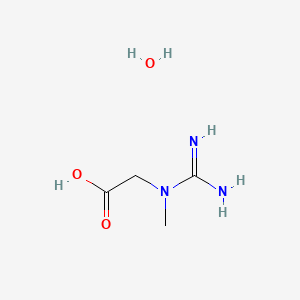
- Formula
- C4H11N3O3
- Weight
- 149.15 Da
- PubChem CID
- 80116
- Exact Mass
- 149.0800 Da
- TPSA
- 91.4 Ų
- H-Bond Donors
- 4
- H-Bond Acceptors
- 4
- Rotatable Bonds
- 3
- Complexity
- 134
Identifiers (SMILES, InChI)
InChI=1S/C4H9N3O2.H2O/c1-7(4(5)6)2-3(8)9;/h2H2,1H3,(H3,5,6)(H,8,9);1H2
MEJYXFHCRXAUIL-UHFFFAOYSA-NReferences (8)
- [1]Common questions and misconceptions about creatine supplementation: what does the scientific evidence really show?
→ Comprehensive review addressing safety and efficacy of creatine, confirming it as one of the most well-studied supplements with established benefits for muscle performance and minimal adverse effects when used appropriately.
- [4]Effects of creatine supplementation on memory in healthy individuals: a systematic review and meta-analysis of randomized controlled trials
→ Meta-analysis of randomized controlled trials demonstrates that creatine supplementation has positive effects on memory performance in healthy individuals.
- [2]Effects of Creatine Supplementation on Brain Function and Health
→ Evidence shows creatine supplementation increases brain creatine stores and may improve cognitive function and memory, particularly in aging adults and during metabolic stress like sleep deprivation.
- [5]Creatine for Exercise and Sports Performance, with Recovery Considerations for Healthy Populations
→ Extensive review confirms creatine supplementation consistently improves performance in short-duration, high-intensity exercise and enhances training adaptations with minimal side effects.
- [6]Heads Up for Creatine Supplementation and its Potential Applications for Brain Health and Function
→ Review highlights emerging evidence for creatine's neuroprotective effects and potential benefits for cognitive function, mood, and brain health beyond athletic performance.
- [7]Adverse effects of creatine supplementation: fact or fiction?
→ Comprehensive safety review found creatine supplementation is generally well-tolerated with few adverse effects, contradicting media reports of health risks while noting occasional gastrointestinal issues.
- [3]Oral creatine monohydrate supplementation improves brain performance: a double-blind, placebo-controlled, cross-over trial
→ Study found that 5g daily creatine supplementation for six weeks significantly improved working memory and intelligence test scores in young adults, demonstrating measurable cognitive benefits.
- [8]Creatine supplementation improves performance, but is it safe? Double-blind placebo-controlled study
→ Study evaluated 41 biochemical parameters and renal function markers, finding creatine supplementation caused no adverse events while improving performance and body weight in resistance training practitioners.
Continue researching Creatine Monohydrate
Keep scientific evidence separate from commercial availability. Review how claims are evaluated, explore question-led research paths, or inspect disclosed source records without changing the editorial conclusions on this page.