GHRP-2
GHRP-2 (pralmorelin) is a synthetic growth hormone secretagogue that binds the ghrelin receptor, with research applications in muscle preservation, appetite regulation, immune function, sleep quality, and pain modulation.
Evidence-led profile
Research snapshot
- Evidence stage
- Established research record
- References
- 16 linked sources
- Research coverage
- 8 areas
- Editorial review
- Mar 8, 2026
Published by the PepGuide Editorial Team using our research methodology.
Overview
GHRP-2 has been investigated in stage II clinical trials for assessment of short stature and is under active research for its effects on appetite, muscle growth, the immune system, and sleep cycles. By activating the ghrelin receptor, GHRP-2 stimulates natural growth hormone release from the anterior pituitary, leading to downstream increases in insulin-like growth factor-1 (IGF-1) and broad anabolic effects.
Research
Appetite Stimulation
GHRP-2 has been shown to significantly boost food intake in healthy adult men, mimicking the orexigenic effects of ghrelin (Laferrere et al., 2005). This effect extends to obese subjects, who also respond to the appetite-stimulating properties of GHRP-2 (Laferrere et al., 2006). Reliable appetite stimulation in the setting of chronic disease, cachexia, and post-surgical recovery could significantly improve long-term patient outcomes.
Cardioprotection
Research in fetal heart cell cultures shows that GHRP-2 and its analogues (GHRP-1, GHRP-6) protect heart cells by reducing apoptosis (Muccioli et al., 2000). This is particularly relevant following myocardial infarction, when cardiomyocytes are prone to programmed cell death due to ischemia. Studies with the related peptide hexarelin have identified specific cardiac receptors for growth hormone secretagogues, opening pathways for novel cardiovascular drug development (Bodart et al., 1999).
Immune System Enhancement
GHRP-2 stimulates the thymus, promoting T cell maturation and increasing both the number and diversity of T cells produced. Since thymic function declines with age, contributing to inadequate tissue repair, lost immunity, and increased susceptibility to infections and cancer, GHRP-2's ability to rejuvenate the thymus represents a significant potential application in aging-related immune decline (Taub et al., 2010).
Sleep Quality
GHRP-2 increases the duration of stage 3 and stage 4 sleep by approximately 50% each, increases REM sleep by roughly 20%, and reduces deviation from normal sleep patterns by up to one-third. These improvements translate to better cognitive function, blood pressure regulation, healing, and energy levels (Copinschi et al., 1997).
Pain Perception
GHRP-2 has demonstrated direct effects on pain perception through selective opioid receptor agonism. The peptide binds primarily to opioid receptors responsible for pain relief and sedation, raising the possibility of developing selective opioid agonists that could mitigate respiratory depression and addiction risks associated with traditional opioids (Zeng et al., 2014).
Muscle Preservation and Growth
Research in yaks demonstrates that GHRP-2 can overcome natural growth plateaus caused by food deprivation, disease, and adverse conditions by boosting muscle growth through increased protein deposition and decreased protein degradation (Hu et al., 2016). The most significant finding is that GHRP-2 reduces muscle atrophy by inactivating atrogin-1 and MuRF1, key regulators of the muscle degradation pathway (Yamamoto et al., 2008). By activating growth hormone and IGF-1, GHRP-2 encourages lean body mass development even in adverse conditions (Phung et al., 2000).
Ongoing & Future Research
Active and recent clinical investigations involving GHRP-2 and closely related ghrelin receptor agonists include:
- NCT00091585: Study of ghrelin and growth hormone secretagogues in GH-deficient subjects, examining diagnostic utility of the GHRP-2 stimulation test
- NCT00512356: Evaluation of ghrelin and GHRP-2 effects on appetite, food intake, and energy expenditure in healthy volunteers and obese subjects
- NCT01444703: Investigation of growth hormone secretagogue receptor agonists in cancer-related cachexia and appetite stimulation
- NCT00093613: Assessment of ghrelin and ghrelin mimetics on body composition and metabolic parameters in HIV-associated wasting
Broader ghrelin receptor agonist research continues in cachexia (cancer and COPD), sarcopenia of aging, wound healing acceleration, and functional GH deficiency diagnostics. The pralmorelin provocation test continues to gain adoption as a front-line diagnostic for GH deficiency in endocrinology practice.
Comparison to Related Compounds
| Feature | GHRP-2 | GHRP-6 | Hexarelin | Ipamorelin | MK-677 |
|---|---|---|---|---|---|
| Selectivity | High | Moderate | Moderate | Highest | Moderate |
| Appetite stimulation | Mild-moderate | Strong | Minimal | Minimal | Moderate |
| Cortisol elevation | Dose-dependent, mild | Moderate | Moderate | Negligible | Minimal |
| Prolactin elevation | Dose-dependent, mild | Moderate | Moderate | Negligible | Minimal |
| CD36 binding | No | Yes | Yes | No | No |
| Half-life | ~25-30 min | ~15-30 min | ~60 min | ~2 hours | ~4-6 hours (oral) |
| Route | SC, oral, sublingual | SC, oral, sublingual | SC | SC | Oral |
| Cardioprotection | Indirect (via GH/IGF-1) | Yes (CD36-mediated) | Strong (CD36-mediated) | Indirect | Indirect |
GHRP-2 occupies a middle ground among growth hormone secretagogues. Compared to GHRP-6, it is more selective for GH release with less appetite stimulation and reduced cortisol/prolactin elevation at equivalent doses (Bowers et al., 1991). Unlike hexarelin, GHRP-2 does not bind the CD36 scavenger receptor, meaning it lacks the direct cardioprotective signaling that hexarelin provides. Ipamorelin is the most selective GHRP, producing virtually no cortisol or prolactin changes, but GHRP-2 produces a larger GH pulse magnitude. MK-677 (ibutamoren) is the only oral non-peptide ghrelin mimetic, offering convenience but with a much longer half-life that produces sustained rather than pulsatile GH elevation (Moulin et al., 2007).
Safety and Limitations
GHRP-2 has been evaluated in stage II clinical trials and is marketed as a diagnostic agent for growth hormone deficiency. Common effects associated with growth hormone secretagogues include transient increases in cortisol and prolactin at higher doses, mild water retention, and increased appetite. GHRP-2 may transiently elevate blood glucose levels. As a ghrelin receptor agonist, it can increase gastric motility and hunger. No serious adverse effects have been reported at standard research doses, though long-term safety data from large-scale human trials remain limited. Potential interactions with the hypothalamic-pituitary axis warrant careful monitoring in clinical applications.
Common Side Effects
- Increased appetite (less than GHRP-6)
- Mild water retention
- Tingling or numbness in extremities
- Tiredness or lethargy after injection
- Mild headache
Contraindications
- Active cancer or history of cancer
- Pregnancy or breastfeeding
- Pituitary disorders
- Diabetic retinopathy
- WADA prohibited for competitive athletes
Discontinue If
- Severe or persistent headaches
- Unusual swelling in hands or feet
- Signs of carpal tunnel syndrome
- Allergic reactions
Mechanism of Action
GHRP-2 acts as an agonist at the growth hormone secretagogue receptor (GHS-R1a), the same receptor targeted by endogenous ghrelin. Binding stimulates growth hormone release from somatotroph cells of the anterior pituitary in a pulsatile fashion. GHRP-2 also reduces expression of muscle-specific ubiquitin ligases (atrogin-1 and MuRF1) that control muscle degradation pathways, providing dual anabolic effects through both increased protein deposition and decreased protein degradation. Additionally, GHRP-2 has demonstrated activity at opioid receptors, particularly those involved in pain modulation.
Research protocol summary
- Typical Dose
- 100-300 mcg
- Frequency
- 2-3x daily
- Route
- Subcutaneous injection, Oral, Sublingual
- Cycle Length
- 8-12 weeks
- Storage
- 2-8°C refrigerated
These values summarize cataloged research protocols. They are not personal dosing instructions or medical guidance.
Reconstitution Calculator
Pharmacokinetic Profile
GHRP-2 — Pharmacokinetic Curve
Subcutaneous injection, Oral, SublingualIllustrative model from the listed half-life and time to peak, not measured concentration data.
Molecular Structure
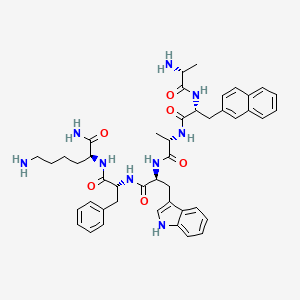
- Formula
- C45H55N9O6
- Weight
- 817.9 Da
- Length
- 6 amino acids
- CAS
- 158861-67-7
- PubChem CID
- 6918245
- Exact Mass
- 817.4275 Da
- LogP
- 2.5
- TPSA
- 256 Ų
- H-Bond Donors
- 9
- H-Bond Acceptors
- 8
- Rotatable Bonds
- 21
- Complexity
- 1440
Identifiers (SMILES, InChI)
InChI=1S/C45H55N9O6/c1-27(47)41(56)52-38(24-30-19-20-31-14-6-7-15-32(31)22-30)43(58)50-28(2)42(57)53-39(25-33-26-49-35-17-9-8-16-34(33)35)45(60)54-37(23-29-12-4-3-5-13-29)44(59)51-36(40(48)55)18-10-11-21-46/h3-9,12-17,19-20,22,26-28,36-39,49H,10-11,18,21,23-25,46-47H2,1-2H3,(H2,48,55)(H,50,58)(H,51,59)(H,52,56)(H,53,57)(H,54,60)/t27-,28+,36+,37-,38-,39+/m1/s1
HRNLPPBUBKMZMT-RDRUQFPZSA-NResearch Indications
Growth Hormone Enhancement
Used as a diagnostic agent in Japan for assessing growth hormone deficiency in clinical settings.
Stimulates endogenous growth hormone release through ghrelin receptor activation.
Indirectly increases IGF-1 levels through enhanced GH secretion.
Body Composition
Enhanced muscle protein synthesis through elevated growth hormone and IGF-1 levels.
Improved lipolysis and body composition through GH-mediated fat oxidation.
Faster recovery from exercise and improved sleep quality.
Protective Effects
Myoprotective effects in muscle atrophy models through GHS-R1a stimulation.
Cytoprotective effects observed in cardiac tissue research.
Research Protocols
subcutaneous Injection
Growth hormone releasing peptide administered subcutaneously. Evening timing aligns with natural GH rhythms.
| Goal | Dose | Frequency | Duration |
|---|---|---|---|
| Loading phase | 100 mcg | Once daily | Weeks 1-2 |
| Escalation | 150 mcg | Once daily | Weeks 3-4 |
| Standard dose | 200 mcg | Once daily | Weeks 5-12+(Advanced: 250-300 mcg/day. Cycle: 8-16 weeks.) |
Reconstitution Guide (5mg vial + 3mL BAC water)
- Wipe vial tops with alcohol swab
- Draw 3.0 mL bacteriostatic water into syringe
- Inject slowly down the inside wall of the peptide vial
- Gently swirl to dissolve — never shake
- Resulting concentration: 1.67 mg/mL
- For 100 mcg dose: draw 6 units (0.06 mL)
- For 200 mcg dose: draw 12 units (0.12 mL)
- Store reconstituted vial refrigerated at 2-8°C
Interactions
Peptide Interactions
Powerful synergy; GHRH + GHRP combination amplifies GH release significantly.
Similar mechanism to Mod GRF 1-29 combination; sermorelin is a truncated GHRH(1-29) analog. Pre-made blends are commercially available for research
No known negative interactions; different mechanisms.
Both are GHRPs; can be alternated but typically not stacked together.
Similar mechanism; GHRP-2 is more potent with less appetite stimulation.
Reported Research Timeline
GH spike within 15-30 minutes of injection
Improved sleep quality and recovery
Noticeable improvements in energy and well-being
Visible changes in body composition and muscle fullness
Full benefits realized with consistent use
Quality Indicators
What to look for
- White to off-white lyophilized powder
- Clear solution after reconstitution
- Intact vacuum seal on vial
Caution
- Slight clumping that dissolves easily
Red flags
- Discolored or yellow powder
- Cloudy solution after reconstitution
- Particles or precipitates in solution
Frequently Asked Questions
References (16)
- [4]
- [14]
- [1]
- [2]
- [3]
- [15]
- [16]
- [5]Yamamoto et al *Life Sci.* (https://pubmed.ncbi.nlm.nih.gov/18295293/) Life Sci. (2008)
- [6]Phung et al *Domest Domest. Anim. Endocrinol. (2000)
- [7]Laferrere et al *J J. Clin. Endocrinol. Metab. (2005)
- [8]
- [9]Muccioli et al *Ann Ann. Endocrinol. (2000)
- [10]
- [11]Taub et al *Curr Curr. Opin. Pharmacol. (2010)
- [12]
- [13]Zeng et al *Peptides* Peptides (2014)
Continue researching GHRP-2
Keep scientific evidence separate from commercial availability. Review how claims are evaluated, explore question-led research paths, or inspect disclosed source records without changing the editorial conclusions on this page.