Neuropeptide Y (NPY)
Neuropeptide Y (NPY) is a 36-amino acid peptide and the most abundant neuropeptide in the mammalian brain, playing critical roles in appetite regulation, anxiety modulation, stress resilience, cardiovascular control, and bone metabolism through Y1–Y5 receptor subtypes.
Evidence-led profile
Research snapshot
- Evidence stage
- Emerging research
- References
- 14 linked sources
- Research coverage
- 5 areas
- Editorial review
- Mar 8, 2026
Published by the PepGuide Editorial Team using our research methodology.
Overview
NPY is one of the most evolutionarily conserved peptides known, with the human sequence differing from rat NPY by only a single amino acid. This remarkable conservation underscores its fundamental biological importance. NPY exerts its diverse effects through a family of five G-protein-coupled receptors (Y1, Y2, Y4, Y5, and y6), each with distinct tissue distribution and functional roles. The Y1 and Y5 receptors mediate appetite stimulation in the hypothalamus, while Y2 receptors serve as presynaptic autoreceptors regulating NPY release. NPY signaling is implicated in conditions ranging from obesity and anxiety disorders to cardiovascular disease and bone loss.
In the peripheral nervous system, NPY is co-released with norepinephrine from sympathetic nerve terminals, where it potentiates vasoconstriction and modulates sympathetic tone. This dual central-peripheral distribution makes NPY a key integrator of autonomic, neuroendocrine, and metabolic function.
Research
Appetite and Energy Homeostasis
NPY is the most potent orexigenic peptide known. Central administration of NPY into the paraventricular nucleus (PVN) or arcuate nucleus of the hypothalamus produces robust food intake in satiated animals. NPY-expressing neurons in the arcuate nucleus (AgRP/NPY neurons) are activated by fasting and leptin deficiency, and their firing drives feeding behavior through Y1 and Y5 receptor activation Clark et al. (1984). Chronic central NPY infusion produces hyperphagia, obesity, insulin resistance, and decreased thermogenesis, mirroring features of the metabolic syndrome. Y1 and Y5 receptor antagonists have been extensively explored as anti-obesity therapeutics, though clinical translation has been limited by CNS penetration and specificity challenges.
Anxiety and Stress Resilience
NPY is one of the brain's primary anxiolytic mediators. Central NPY administration reduces anxiety-like behavior in the elevated plus maze, conflict tests, and fear-potentiated startle paradigms, primarily through Y1 receptors in the amygdala Heilig et al. (1993). Critically, NPY levels are elevated in stress-resilient individuals — studies in military special forces personnel showed that soldiers who maintained higher NPY levels during extreme stress training exhibited superior performance and faster recovery Morgan et al. (2000). NPY polymorphisms (particularly Leu7Pro) have been associated with anxiety traits and alcohol dependence, and intranasal NPY administration has shown anxiolytic effects in preclinical models of PTSD.
Cardiovascular Regulation
NPY is a potent vasoconstrictor when co-released with norepinephrine from sympathetic nerves. It acts via Y1 receptors on vascular smooth muscle to produce long-lasting vasoconstriction and potentiates the contractile effects of norepinephrine Zukowska-Grojec et al. (1993). Elevated plasma NPY levels are found in hypertension, heart failure, and acute myocardial infarction. Beyond vasoconstriction, NPY promotes angiogenesis through Y2 receptors, stimulating endothelial cell proliferation and migration — a property relevant to ischemic tissue revascularization and tumor vascularization.
Bone Metabolism
NPY signaling through Y2 receptors in the hypothalamus regulates bone formation. Y2 receptor knockout mice exhibit dramatically increased bone mass, revealing that central Y2 signaling normally inhibits osteoblast activity Baldock et al. (2002). This hypothalamic-bone axis operates through sympathetic nervous system signaling and offers potential therapeutic targets for osteoporosis. Peripheral NPY also directly affects bone cells, with Y1 receptors on osteoblasts mediating local effects on bone remodeling.
NPY Receptor Subtypes as Drug Targets
The NPY receptor family represents multiple drug targets for distinct indications:
- Y1 antagonists: Anti-anxiety and anti-obesity potential. Compounds like BIBO3304 show anxiolytic-like effects in animal models.
- Y2 agonists/antagonists: Y2 agonists (e.g., PYY₃₋₃₆) for appetite suppression; Y2 antagonists for bone anabolism.
- Y5 antagonists: Multiple pharmaceutical programs targeted Y5 for obesity (velneperit, MK-0557), though clinical results have been disappointing.
- Intranasal NPY: Being explored for PTSD and acute stress disorders, leveraging NPY's anxiolytic properties with nose-to-brain delivery Sayed et al. (2018).
Safety and Limitations
NPY is an endogenous neuropeptide with well-characterized physiology. Safety considerations in research contexts include:
- Appetite stimulation: Central NPY administration produces robust hyperphagia. Chronic exposure in animal models induces obesity, insulin resistance, and hyperlipidemia.
- Cardiovascular effects: Peripheral NPY can cause vasoconstriction, potentially elevating blood pressure. Caution in hypertensive models.
- Pro-angiogenic: NPY promotes angiogenesis via Y2 receptors. Theoretical concern in contexts of active malignancy or pathological neovascularization.
- Seizure modulation: NPY is generally anticonvulsant (via Y2 receptors), but Y1 receptor activation may have pro-convulsant effects in some circuits.
- No human therapeutic trials: NPY-based therapeutics remain largely preclinical. Intranasal NPY for PTSD has entered early clinical investigation with a favorable tolerability profile.
- Endogenous safety: As the most abundant brain neuropeptide, NPY operates within established physiological systems with well-characterized feedback mechanisms.
Mechanism of Action
NPY signals through five receptor subtypes, all coupled to Gi/Go proteins:
- Y1 receptor: Postsynaptic receptor widely expressed in brain (cortex, hippocampus, hypothalamus) and vasculature. Mediates anxiolytic effects, appetite stimulation, and vasoconstriction. Couples to Gi → inhibition of adenylate cyclase → decreased cAMP. Also activates MAPK and PI3K pathways Wahlestedt et al. (1993).
- Y2 receptor: Primarily presynaptic autoreceptor regulating NPY and neurotransmitter release. Abundant in hippocampus, hypothalamus, and vagal afferents. Mediates satiety when activated peripherally (PYY₃₋₃₆ acts here). Also implicated in seizure suppression and bone metabolism Naveilhan et al. (1999).
- Y4 receptor: Preferentially binds pancreatic polypeptide (PP) over NPY. Expressed in gut, brainstem, and hypothalamus. Modulates gastrointestinal motility and satiety.
- Y5 receptor: Co-mediates appetite stimulation with Y1 in the hypothalamus. Expressed in hypothalamic feeding centers and limbic structures. Y5 antagonists have been explored as anti-obesity agents Marsh et al. (1998).
- Sympathetic co-transmission: NPY is co-stored and co-released with norepinephrine from sympathetic nerve terminals. It potentiates norepinephrine-mediated vasoconstriction via Y1 receptors on vascular smooth muscle and inhibits further norepinephrine release via presynaptic Y2 receptors.
Research protocol summary
- Route
- Intracerebroventricular, Intravenous (research)
These values summarize cataloged research protocols. They are not personal dosing instructions or medical guidance.
Reconstitution Calculator
Pharmacokinetic Profile
Neuropeptide Y (NPY) — Pharmacokinetic Curve
Intracerebroventricular, Intravenous (research)Illustrative model from the listed half-life and time to peak, not measured concentration data.
Molecular Structure
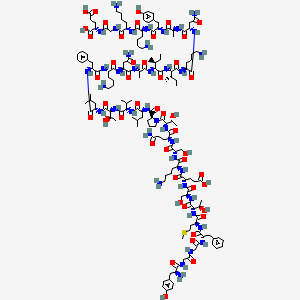
- Formula
- C₁₉₀H₂₈₇N₅₅O₅₇S
- Weight
- 4253.7 Da
- CAS
- 82785-45-3
- PubChem CID
- 16132316
- Exact Mass
- 3463.8255 Da
- LogP
- -13.9
- TPSA
- 1430 Ų
- H-Bond Donors
- 48
- H-Bond Acceptors
- 53
- Rotatable Bonds
- 118
- Complexity
- 7850
Identifiers (SMILES, InChI)
InChI=1S/C158H251N39O46S/c1-17-84(9)126(153(237)182-102(44-29-34-65-163)137(221)186-112(74-118(166)206)142(226)171-86(11)131(215)183-110(73-94-48-52-96(204)53-49-94)146(230)177-99(41-26-31-62-160)135(219)175-98(40-25-30-61-159)134(218)170-78-122(210)173-106(158(242)243)56-59-124(213)214)193-154(238)127(85(10)18-2)192-132(216)87(12)172-143(227)113(75-119(167)207)185-136(220)100(42-27-32-63-161)178-147(231)111(72-92-38-23-20-24-39-92)184-144(228)107(68-81(3)4)188-155(239)129(89(14)201)195-152(236)125(83(7)8)191-148(232)108(69-82(5)6)187-151(235)116-45-35-66-197(116)157(241)130(90(15)202)196-140(224)103(54-57-117(165)205)179-149(233)114(79-198)189-138(222)101(43-28-33-64-162)176-139(223)104(55-58-123(211)212)180-150(234)115(80-199)190-156(240)128(88(13)200)194-141(225)105(60-67-244-16)181-145(229)109(71-91-36-21-19-22-37-91)174-121(209)77-168-120(208)76-169-133(217)97(164)70-93-46-50-95(203)51-47-93/h19-24,36-39,46-53,81-90,97-116,125-130,198-204H,17-18,25-35,40-45,54-80,159-164H2,1-16H3,(H2,165,205)(H2,166,206)(H2,167,207)(H,168,208)(H,169,217)(H,170,218)(H,171,226)(H,172,227)(H,173,210)(H,174,209)(H,175,219)(H,176,223)(H,177,230)(H,178,231)(H,179,233)(H,180,234)(H,181,229)(H,182,237)(H,183,215)(H,184,228)(H,185,220)(H,186,221)(H,187,235)(H,188,239)(H,189,222)(H,190,240)(H,191,232)(H,192,216)(H,193,238)(H,194,225)(H,195,236)(H,196,224)(H,211,212)(H,213,214)(H,242,243)/t84-,85-,86-,87-,88+,89+,90+,97-,98-,99-,100-,101-,102-,103-,104-,105-,106-,107-,108-,109-,110-,111-,112-,113-,114-,115-,116-,125-,126-,127-,128-,129-,130-/m0/s1
JMHFFDIMOUKDCZ-NTXHZHDSSA-NResearch Indications
Neuropsychiatric
NPY is an endogenous anxiolytic peptide. Higher NPY levels correlate with resilience against PTSD and stress recovery. Y1 and Y5 receptor activation in the amygdala reduces anxiety in preclinical models.
NPY exhibits analgesic properties through Y1 receptor modulation in the CNS. Exerts pain-reducing effects in preclinical models, though no approved NPY-based analgesics exist.
NPY plays a role in controlling epileptic seizures through central nervous system mechanisms. Preclinical evidence supports anticonvulsant potential, but clinical translation remains in early stages.
Metabolic Regulation
NPY is a potent orexigenic peptide mediating appetite through hypothalamic signaling. Y2R/Y4R agonists (obinepitide) and Y5R antagonists (velneperit, MK-0557) have entered clinical trials for obesity management.
NPY modulates energy expenditure, lipid metabolism, and adipogenesis. Peripheral Y receptor modulation may ameliorate metabolic conditions, but clinical development of NPY receptor ligands has been slow.
Tissue Repair
NPY promotes angiogenesis through Y2 receptor signaling. Y2 receptor knockout mice show blocked NPY-induced angiogenesis and delayed wound healing, confirming NPY role in tissue repair.
Research Protocols
intranasal Injection
NPY polymorphisms (particularly Leu7Pro) have been associated with anxiety traits and alcohol dependence, and intranasal NPY administration has shown anxiolytic effects in preclinical models of PTSD. - Intranasal NPY: Being explored for PTSD and acute stress disorders, leveraging NPY's anxiolytic pr
intravenous Injection
Administered via intravenous injection.
intracerebroventricular Injection
Administered via intracerebroventricular.
Interactions
Peptide Interactions
NPY is co-released with norepinephrine from sympathetic nerve terminals and potentiates alpha-adrenergic vasoconstriction. Clonidine reduces central sympathetic outflow but combined peripheral effects with exogenous NPY could produce unpredictable blood pressure changes. Hemodynamic monitoring is recommended (Zukowska-Grojec, 1995).
Reported Research Timeline
Rapid onset expected; half-life of ~20–30 minutes (plasma) indicates fast-acting pharmacokinetics
Due to short half-life (~20–30 minutes (plasma)), effects are expected per-dose; consistent daily administration maintains therapeutic levels
Regular administration schedule required; effects are dose-dependent and do not persist between doses
Quality Indicators
What to look for
- Multiple peer-reviewed studies available
Frequently Asked Questions
References (14)
- [13]Zhang L et al — Neuropeptide Y in metabolic syndrome: integrating central and peripheral mechanisms Trends Endocrinol Metab (2023)
- [14]
- [1]Tatemoto K, Carlquist M, Mutt V Neuropeptide Y — a novel brain peptide with structural similarities to peptide YY and pancreatic polypeptide Nature (1982)
- [2]Clark JT, Kalra PS, Crowley WR, Kalra SP Neuropeptide Y and human pancreatic polypeptide stimulate feeding behavior in rats Endocrinology (1984)
- [3]Heilig M, Koob GF, Ekman R, Britton KT Corticotropin-releasing factor and neuropeptide Y: role in emotional integration Trends Neurosci (1993)
- [4]
- [5]Marsh DJ, Hollopeter G, Kafer KE, Palmiter RD Role of the Y5 neuropeptide Y receptor in feeding and obesity Nat Med (1998)
- [6]Morgan CA, Wang S, Southwick SM, et al Plasma neuropeptide-Y concentrations in humans exposed to military survival training Biol Psychiatry (2000)
- [7]Baldock PA, Sainsbury A, Couzens M, et al Hypothalamic Y2 receptors regulate bone formation J Clin Invest (2002)
- [8]Naveilhan P, Hassani H, Canals JM, et al Normal feeding behavior, body weight and leptin response require the neuropeptide Y Y2 receptor Nat Med (1999)
- [9]Zukowska-Grojec Z, Wahlestedt C Origin and actions of neuropeptide Y in the cardiovascular system (1993)
- [12]Tasan RO et al — NPY and its receptors in epilepsy: therapeutic potential and challenges Br J Pharmacol (2023)
- [11]Sah R et al — Neuropeptide Y and PTSD: from bench to bedside Biol Psychiatry (2022)
- [10]Sayed S, Van Dam NT, Horn SR, et al A randomized dose-ranging study of neuropeptide Y in patients with posttraumatic stress disorder Int J Neuropsychopharmacol (2018)
Continue researching Neuropeptide Y (NPY)
Keep scientific evidence separate from commercial availability. Review how claims are evaluated, explore question-led research paths, or inspect disclosed source records without changing the editorial conclusions on this page.